
Transformed synechococcus elongatus having capability of producing acetone from carbon dioxide
- Summary
- Abstract
- Description
- Claims
- Application Information
AI Technical Summary
Benefits of technology
Problems solved by technology
Method used
Image

Examples
example 1
Establishment of Strategy for Producing Acetone
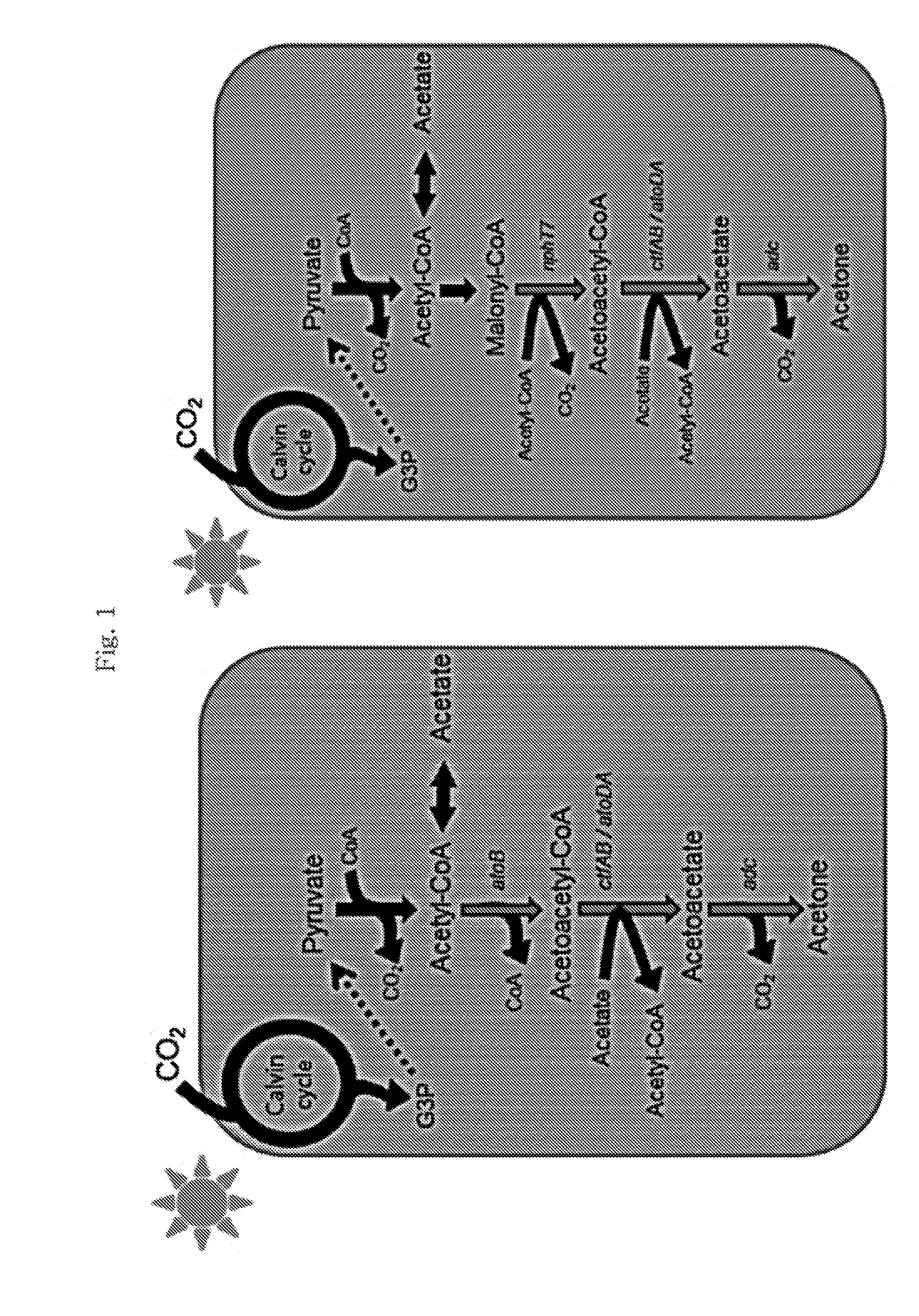
[0055]A metabolic pathway as shown in FIG. 1 was designed to prepare a Synechococcus elongatus strain having excellent capability of producing acetone.
example 2
Preparation of Vector
[0056]At first, pBbE1c-RFP (Lee T S, Krupa R A, Zhang F, Hajimorad M, Holtz W J, Prasad N, Lee S K, Keasling J D (2011 b) BglBrick vectors and datasheets: a synthetic biology platform for gene expression. J Biol Eng 5:12) and Invitrogen's pSyn_1 were used. Specifically, the lacI, ptrc and RFP portions of pBbE1c-RFP were subjected to PCR and the spectinomycin resistance gene, NSIa, NS1b and pUC replication origin of pSyn_1 were subjected to PCR. Then, a new vector was completed by joining the two PCR products through the OPEC cloning method (Quan J, Tian J (2009) Circular Polymerase Extension Cloning of Complex Gene Libraries and Pathways. PLoS ONE 4 (7): e6441. doi:10.1371 / journal.pone.0006441) (CPEC Ref. http: / / j5.jbei.org / j5manual / pages / 22.html). In order to replace the RFP portion of the vector with GFP, RFP was removed using EcoRI / XhoI restriction enzymes and the GFP portion of another BglBrick vector pBbB5k-GFP (Lee T S, Krupa R A, Zhang F, Hajimorad M, Hol...
example 3
Preparation of Transformed Synechococcus elongatus Strain
[0058]The vectors of SEQ ID NOS 6-9 prepared in Example 2 were inserted into the neutral site I of a wild-type Synechococcus elongatus (S. elongatus) PCC7942 strain (PCC7942 (ATCC® 33912™)) by natural transformation (Golden et al. 1987, Grigorieva and Shestakov 1982). The transformation was confirmed by PCR (5′->3′ primer sequence: forward (SEQ ID NO 10): CTGATTGTTCTAGGCGCTG / reverse (SEQ ID NO 11): TTTGGCAATCTGAAGACCCG).
PUM
| Property | Measurement | Unit |
|---|---|---|
| Temperature | aaaaa | aaaaa |
| Fraction | aaaaa | aaaaa |
| Selectivity | aaaaa | aaaaa |
Abstract
Description
Claims
Application Information
 Login to View More