Unlock instant, AI-driven research and patent intelligence for your innovation.

Mixed material, method for producing same, and organic element using same

a technology of mixed materials and organic elements, applied in the direction of electrically-conductive paints, sustainable manufacturing/processing, final product manufacturing, etc., can solve the problem of inability to easily handle lithium metals, and achieve the effect of convenient production and low cos

Active Publication Date: 2017-03-02
SHARP KK
View PDF6 Cites 2 Cited by
  • Summary
  • Abstract
  • Description
  • Claims
  • Application Information

AI Technical Summary

Benefits of technology

The patent text describes how an invention allows for the creation of a high-quality organic element using a cheap and readily available mixed material. This method can be used to produce vapor deposition of lithium, which is important for several applications in electronics and optics. Overall, the patent aims to provide a cost-effective solution for creating great organic elements.

Problems solved by technology

This makes it impossible to easily handle lithium metals.

Method used

the structure of the environmentally friendly knitted fabric provided by the present invention; figure 2 Flow chart of the yarn wrapping machine for environmentally friendly knitted fabrics and storage devices; image 3 Is the parameter map of the yarn covering machine
View more

Image

Smart Image Click on the blue labels to locate them in the text.
Viewing Examples
Smart Image
  • Mixed material, method for producing same, and organic element using same
  • Mixed material, method for producing same, and organic element using same
  • Mixed material, method for producing same, and organic element using same

Examples

Experimental program
Comparison scheme
Effect test

first embodiment

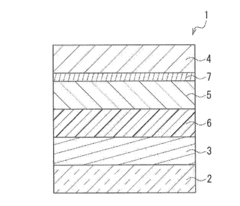
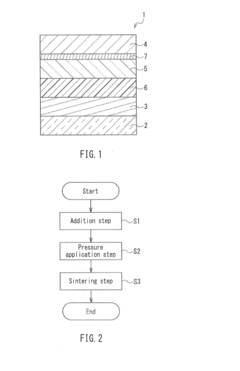
[0041]FIG. 1 is a cross-sectional view showing the configuration of an organic EL element using a mixed material according to a first embodiment of the present invention. In FIG. 1, an organic EL element 1 of the present embodiment includes a substrate 2, a first electrode 3 provided on the substrate 2 and serving as a positive electrode, and a second electrode 4 provided above the first electrode 3 and serving as a negative electrode. Moreover, in the organic EL element 1, a light emitting layer 5, a hole transport layer 6, and an electron injection layer (carrier generation layer) 7 are provided between the first electrode 3 and the second electrode 4.

[0042]A material such as, for example, glass is used for the substrate 2. A transparent electrode material such as, for example, ITO is used for the first electrode 3. The first electrode 3 has a thickness of 100 nm, for example.

[0043]For the second electrode 4, for example, silver, a transparent electrode material such as ITO or IZO...

second embodiment

[0080]FIG. 6 is a cross-sectional view showing the configuration of an organic EL element using a mixed material according to a second embodiment of the present invention.

[0081]In FIG. 6, the present embodiment differs from the first embodiment mainly in that a plurality of sets of the light emitting layer (active layer) and the electron injection layer are provided between the first electrode (positive electrode) and the second electrode (negative electrode). It should be noted that the same elements as those of the first embodiment are denoted by the same reference numerals, and their redundant description is omitted.

[0082]That is to say, as shown in FIG. 6, in the organic EL element 1 of the present embodiment, a first hole injection layer 6a1 and a first hole transport layer 6b1 are sequentially formed on the first electrode 3 provided on the substrate 2. Also, a first light emitting layer 5a, a first electron transport layer 8a, and a first electron injection layer 7a are seque...

third embodiment

[0088]FIG. 7 is a cross-sectional view showing the configuration of an organic thin-film solar cell using a mixed material according to a third embodiment of the present invention.

[0089]In FIG. 7, the present embodiment differs from the first embodiment mainly in that the mixed material of the present invention is used for an electron injection layer of the organic thin-film solar cell having a power generation layer as an active layer. It should be noted that the same elements as those of the first embodiment are denoted by the same reference numerals, and their redundant description is omitted.

[0090]That is to say, in FIG. 7, an organic thin-film solar cell 11 of the present embodiment includes, between the first electrode 3 and the second electrode 4, a power generation layer 15, which serves as the active layer, and the electron injection layer 7 provided on the second electrode 4 side of the power generation layer 15.

[0091]The power generation layer 15 has a p-type organic semi...

the structure of the environmentally friendly knitted fabric provided by the present invention; figure 2 Flow chart of the yarn wrapping machine for environmentally friendly knitted fabrics and storage devices; image 3 Is the parameter map of the yarn covering machine
Login to View More

PUM

PropertyMeasurementUnit
thicknessaaaaaaaaaa
thicknessaaaaaaaaaa
thicknessaaaaaaaaaa
Login to View More

Abstract

A mixed material for vapor deposition of lithium contains lithium oxide M1 in an amount of 90% or more, sodium chloride (at least one material selected from oxides, sulfides, chlorides, and fluorides of alkali metals) M2 having a melting point lower than the melting point of lithium oxide M1, and magnesium oxide (at least one material selected from oxides and sulfides of alkaline-earth metals) M3 having a melting point higher than the melting point of lithium oxide M1.

Description

TECHNICAL FIELD[0001]The present invention relates to a mixed material for vapor deposition of lithium, a method for producing the mixed material, and an organic element using the mixed material.BACKGROUND ART[0002]In recent years, organic elements exemplified by OLEDs (organic EL displays) use lithium as an electron injection material. That is to say, such organic elements include a positive electrode, a negative electrode, and an active layer (recombination portion) which is provided between the positive electrode and the negative electrode and in which electrons and holes (positive holes) can recombine. Moreover, in such organic elements, in order to, for example, improve the efficiency of injection of charges (electrons) into the active layer, an electron injection layer (carrier generation layer) is provided on the negative electrode side of the active layer.[0003]Lithium is preferably used for the above-described electron injection layer. However, as is well known, lithium met...

Claims

the structure of the environmentally friendly knitted fabric provided by the present invention; figure 2 Flow chart of the yarn wrapping machine for environmentally friendly knitted fabrics and storage devices; image 3 Is the parameter map of the yarn covering machine
Login to View More

Application Information

Patent Timeline
no application Login to View More
Patent Type & Authority Applications(United States)
IPC IPC(8): C09D5/24H01L51/52C09D1/00H01L51/44H01L51/05H01L51/10H01L51/50H01L51/42
CPCC09D5/24H01L51/5012H01L51/5206H01L51/5221H01L51/5092H01L2251/301H01L51/4253H01L51/441H01L51/0583H01L51/105C09D1/00H01L51/5278Y02E10/549Y02P70/50H10K50/171H10K30/50C23C16/404H01L21/02274C23C16/30H10K10/26H10K10/84H10K30/81H10K30/211H10K50/11H10K50/19H10K50/82H10K50/826H10K30/30H10K50/81H10K2102/00
Inventor NIBOSHI, MANABUTSUKAMOTO, YUTOISOMURA, YOSHIYUKIINOUE, SATOSHIUCHIDA, HIDEKIKAWATO, SHINICHIKIKUCHI, KATSUHIRO
Owner SHARP KK