Check patentability & draft patents in minutes with Patsnap Eureka AI!

Process for ruthenium-catalysed transvinylation of carboxylic acids

Active Publication Date: 2017-06-08
WACKER CHEM GMBH
View PDF1 Cites 0 Cited by
  • Summary
  • Abstract
  • Description
  • Claims
  • Application Information

AI Technical Summary

Benefits of technology

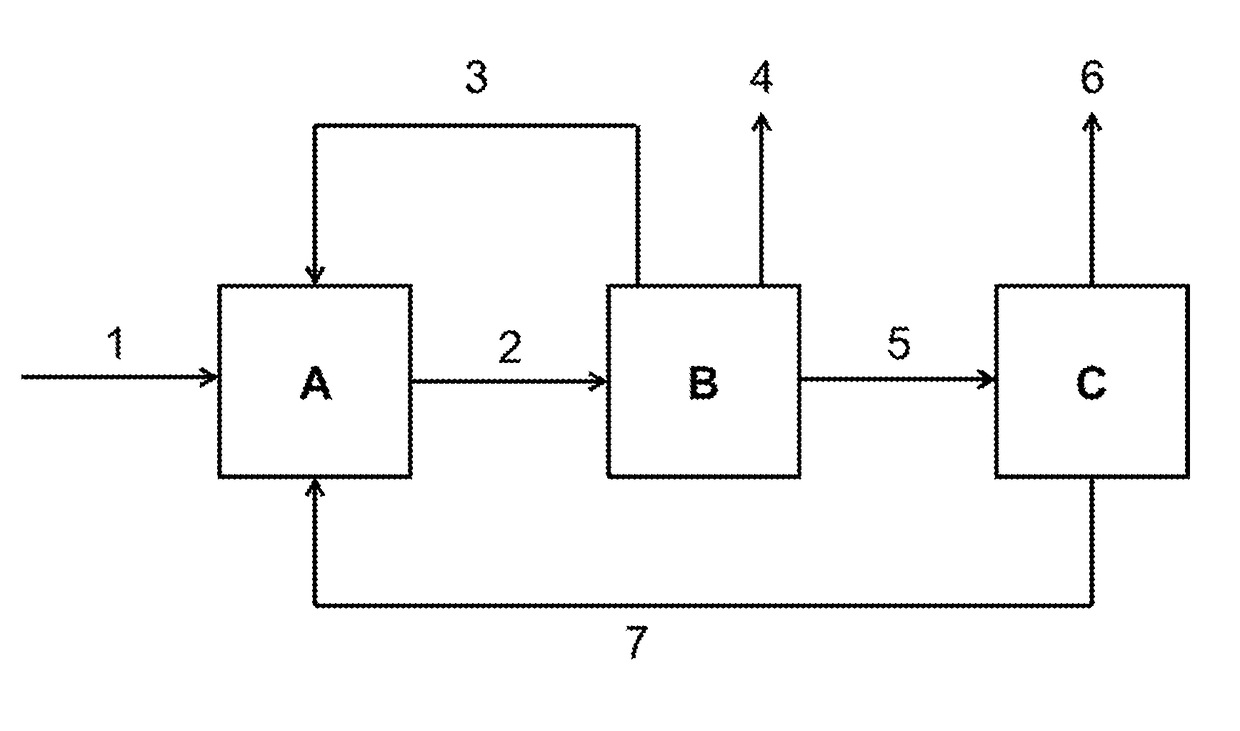
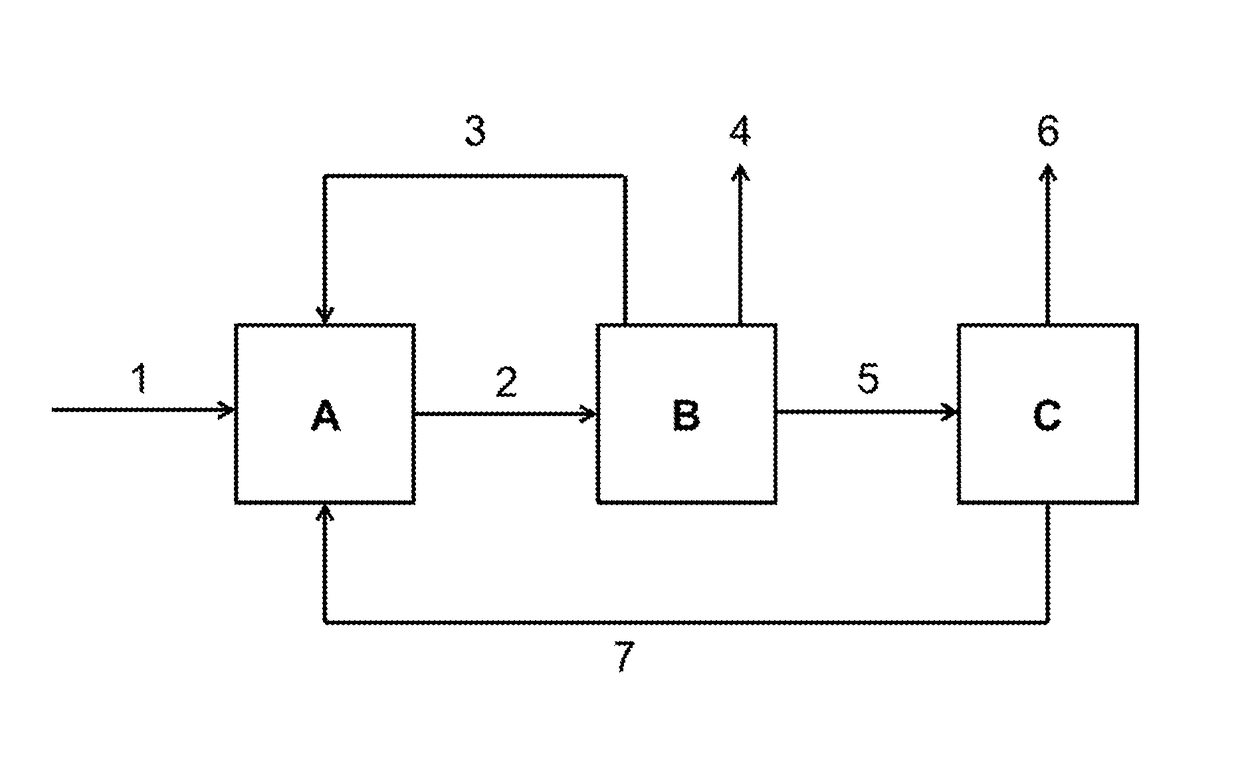
The invention provides a process for selective transvinylation of carboxylic acid with vinyl ester using ruthenium catalysts, which has a high selectivity and conversion simultaneously. The process involves conducting the reaction at a conversion of over 50% and removing the reactants and product through distillation. The remaining reaction mixture can then be recycled back into the reactor.

Problems solved by technology

In addition, they have high, temperature-inducible activity.
However, a problem in using ruthenium compounds, as catalysts in the transvinylation of vinyl esters with carboxylic acids, is the formation of carboxylic anhydride as a side reaction of the transvinylation.
This side reaction reduces the selectivity of the reaction.
In addition, the anhydrides of the reactant carboxylic acid are relatively high boiling by-products which can only be removed from the catalyst-containing reaction mass with considerable effort and therefore would accumulate on reuse thereof.
The significant occurrence of anhydride formation, in contrast to Pd catalysis, is described in the prior art as a major disadvantage of these systems, which significantly degrades the selectivity of the process and thus the possibility of reusing the catalyst.

Method used

the structure of the environmentally friendly knitted fabric provided by the present invention; figure 2 Flow chart of the yarn wrapping machine for environmentally friendly knitted fabrics and storage devices; image 3 Is the parameter map of the yarn covering machine
View more

Image

Smart Image Click on the blue labels to locate them in the text.
Viewing Examples
Smart Image
  • Process for ruthenium-catalysed transvinylation of carboxylic acids
  • Process for ruthenium-catalysed transvinylation of carboxylic acids
  • Process for ruthenium-catalysed transvinylation of carboxylic acids

Examples

Experimental program
Comparison scheme
Effect test

example 1

[0050]Transvinylation at high conversion and high selectivity with recycling of the anhydride-containing reaction bottoms.

[0051]In a 100 ml Berghof autoclave, 23.2 g of lauric acid, 29.9 g of vinyl acetate and 0.074 g of triruthenium dodecacarbonyl at 4 bar abs. were heated to 140° C. for 1 hour. After cooling, acetic acid and vinyl acetate were removed on a rotary evaporator and vinyl laurate was distilled under reduced pressure. The residue of lauric anhydride, lauric acid and Ru catalyst was reused under identical conditions after addition of fresh lauric acid and fresh vinyl acetate.

[0052]After each cycle, the molar proportions in the reaction mixture required for the calculation of conversion and selectivity were determined by means of quantitative NMR spectroscopy.

SelectivityMolar proportionsConversionVinylLauricVinylLauricLauric acidlaurateCycleacidlaurateanhydride[%][%]1Start0.9960.0040.000End0.2530.7410.00674.699.22Start0.9320.0530.015End0.2230.7590.01876.199.53Start0.8990....

example 2

[0054]Transvinylation of Lauric Anhydride

[0055]25 g of lauric anhydride and 454 ppm Ru in the form of a catalyst-containing reaction bottoms were initially charged in a 100 ml Berghof autoclave and heated at 6 bar abs. to 140° C. At this temperature, 45 g of vinyl acetate were added. Subsequently, the composition of the reaction mixture over the time course was investigated by NMR spectroscopy.

ConversionYield [%]Time[%]Vinyl laurateSelectivity [%] 10 min18.511.462 20 min27.421.177 30 min34.428.783 45 min40.135.188 60 min45.741.992 90 min54.050.594120 min60.257.295

[0056]The example demonstrates that lauric anhydride was also converted under the stated conditions to vinyl laurate. In the steady-state, the conversion here is also higher than 60%.

example 3

[0057]Transvinylation at high conversion and high selectivity with recycling of the reaction bottoms after addition of water (vinyl laurate separation before addition of water)

[0058]In a 100 ml Berghof autoclave, 32.5 g of lauric acid, 41.9 g of vinyl acetate and 0.10 g of triruthenium dodecacarbonyl at 4 bar abs. were heated to 140° C. for 1 hour. After cooling, acetic acid and vinyl acetate were removed on a rotary evaporator and subsequently vinyl laurate was distilled off under reduced pressure. After addition of 5% by weight water (based on the mass of the reaction bottoms) and after 5 min stirring at 140° C., the residue of lauric acid and Ru catalyst was reused for transvinylation under identical conditions after addition of fresh lauric acid and fresh vinyl acetate.

SelectivityMolar proportionsConversionVinylLauricVinylLauricLauric acidlaurateCycleacidlaurateanhydride[%][%]1Start0.9970.0030.000End0.2260.7660.00877.499.02Start0.9880.0120.000End0.2210.7570.02177.697.23Start0.92...

the structure of the environmentally friendly knitted fabric provided by the present invention; figure 2 Flow chart of the yarn wrapping machine for environmentally friendly knitted fabrics and storage devices; image 3 Is the parameter map of the yarn covering machine
Login to View More

PUM

PropertyMeasurementUnit
Fractionaaaaaaaaaa
Fractionaaaaaaaaaa
Polymericaaaaaaaaaa
Login to View More

Abstract

A process for selective transvinylation of a reactant carboxylic acid with a reactant vinyl ester to give a product vinyl ester and the corresponding acid of the reactant vinyl ester in the presence of one or more ruthenium catalysts, wherein a) the reactant vinyl ester, the reactant carboxylic acid and the ruthenium catalyst are supplied to a reactor, and b) the transvinylation reaction is conducted, wherein c) the transvinylation reaction is conducted at a conversion of more than 50%, d) on completion of the transvinylation reaction, the reactant vinyl ester and the corresponding acid are separated from the reaction mixture by distillation, e) the product vinyl ester is separated by distillation from the bottom product of the distillation, and f) the remaining reaction mixture is recycled into the reactor.

Description

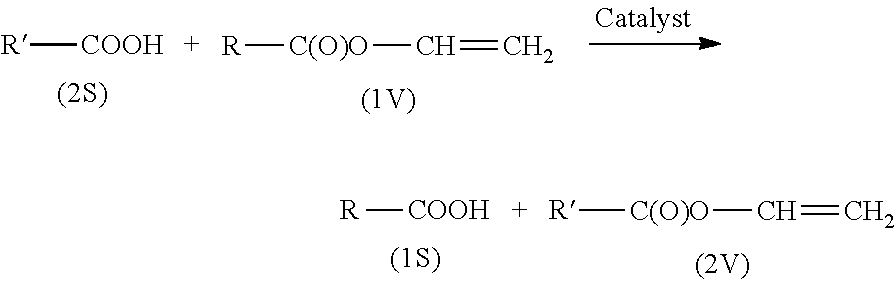
CROSS-REFERENCE TO RELATED APPLICATIONS[0001]This application is the U.S. National stage filing of International Application No. PCT / EP2014 / 075013, filed 19 Nov. 2014, and claims priority of German application number 10 2013 224 491.6, filed 29 Nov. 2013, the entireties of which applications are incorporated herein by reference.FIELD OF THE INVENTION[0002]The invention relates to a process for selective transvinylation of a reactant carboxylic acid with a reactant vinyl ester to give a product vinyl ester and the corresponding acid of the reactant vinyl ester in the presence of one or more ruthenium catalysts.BACKGROUND OF THE INVENTION[0003]The transvinylation of carboxylic acids serves to produce vinyl esters. This is understood to mean the transfer of a vinyl unit of a reactant vinyl ester (1V) to a reactant carboxylic acid (2S) to generate a product vinyl ester (2V) and the corresponding acid of the reactant vinyl ester (1S).[0004]The transvinylation of vinyl esters with carboxy...

Claims

the structure of the environmentally friendly knitted fabric provided by the present invention; figure 2 Flow chart of the yarn wrapping machine for environmentally friendly knitted fabrics and storage devices; image 3 Is the parameter map of the yarn covering machine
Login to View More

Application Information

Patent Timeline
no application Login to View More
IPC IPC(8): C07C67/10C07C67/54
CPCC07C67/54C07C67/10Y02P20/582C07C69/24B01J31/2208B01J2531/821
Inventor GIGLER, PETERSTOHRER, JURGEN
Owner WACKER CHEM GMBH
Features
  • R&D
  • Intellectual Property
  • Life Sciences
  • Materials
  • Tech Scout
Why Patsnap Eureka
  • Unparalleled Data Quality
  • Higher Quality Content
  • 60% Fewer Hallucinations
Social media
Patsnap Eureka Blog
Learn More