Unlock instant, AI-driven research and patent intelligence for your innovation.

Acid-labile hyperbranched copolymer and associated photoresist composition and method of forming an electronic device

a copolymer and hyperbranched technology, applied in the field of acid-labile hyperbranched copolymer and associated photoresist composition and the field of electronic devices, can solve the problem of unnecessary trade-offs

Inactive Publication Date: 2017-06-22
DOW GLOBAL TECH LLC
View PDF0 Cites 2 Cited by
  • Summary
  • Abstract
  • Description
  • Claims
  • Application Information

AI Technical Summary

Benefits of technology

This patent describes a type of polymer that can be used in a photoresist composition. The polymer has a structure that makes it sensitive to acid and can be used to create patterns in a layer of photoresist on a substrate. The polymer can then be developed to create the desired pattern. The technical effect is to provide a more robust and reliable method for creating electronic devices.

Problems solved by technology

The number of demanding requirements creates necessary tradeoffs when polymer molecular weight is concerned.

Method used

the structure of the environmentally friendly knitted fabric provided by the present invention; figure 2 Flow chart of the yarn wrapping machine for environmentally friendly knitted fabrics and storage devices; image 3 Is the parameter map of the yarn covering machine
View more

Image

Smart Image Click on the blue labels to locate them in the text.
Viewing Examples
Smart Image
  • Acid-labile hyperbranched copolymer and associated photoresist composition and method of forming an electronic device
  • Acid-labile hyperbranched copolymer and associated photoresist composition and method of forming an electronic device
  • Acid-labile hyperbranched copolymer and associated photoresist composition and method of forming an electronic device

Examples

Experimental program
Comparison scheme
Effect test

working examples

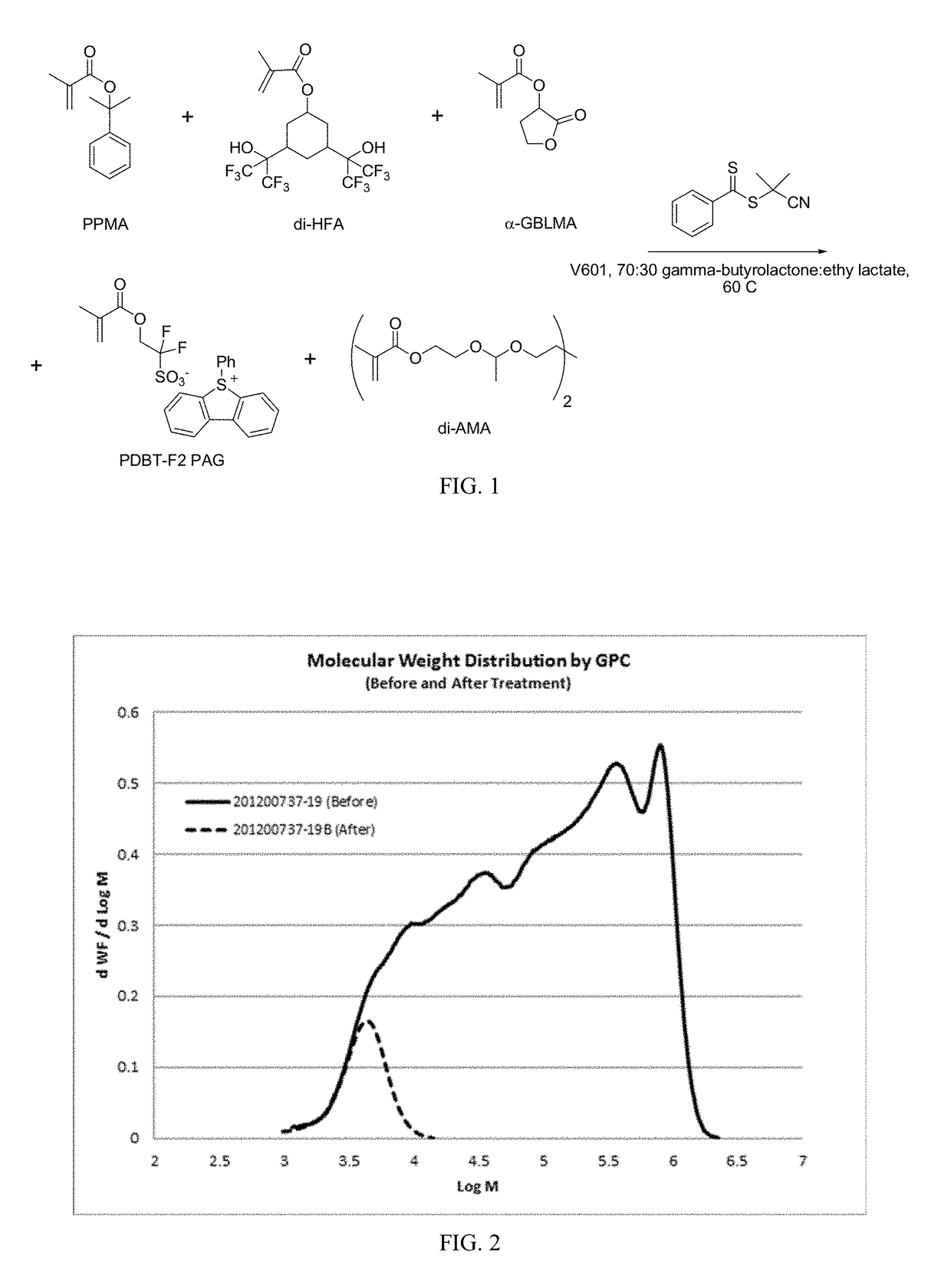
[0046]Monomers, reagents, and solvents used in the working examples are summarized in Table 1.

TABLE 1AbbreviationStructure and NamePPMA2-Phenyl-2-propyl methacrylatedi-HFA3,5-Bis(1,1,1,3,3,3-hexafluoro-2-hydroxy-prop-2-yl)cyclohexyl methacrylateα-GBLMAalpha-Methacryloyloxy-gamma-butyrolactonePDBT-F2 PAGPhenyldibenzothiophenium 2,2,-difluoro-2-sulfonatoethyl methacrylatedi-AMA4,11-dimethyl-3,5,10,12-tetraoxatetradecane-1,14-diylbis(2-methylacrylate)RAFT agent2-Cyanoprop-2-yl dithiobenzoateV601Dimethyl 2,2′-azobis(2-methylpropionate)

example 1

[0047]This example illustrates the synthesis of an acid-labile hyperbranched copolymer according to the present method.

[0048]A synthetic scheme is presented in FIG. 1. PPMA (1.00 gram, 4.90 millimoles), di-HFA (0.727 gram, 1.45 millimoles), alpha-GBLMA (1.06 gram, 6.22 millimoles), and PDBT-F2 PAG (0.324 gram, 0.661 millimole) were weighed into a 20 milliliter vial in a nitrogen-purged glovebox. Into a separate vial was weighed 4.7 grams of a 70:30 mixture of gamma-butyrolactone and ethyl lactate (enough solvent to produce a 40% solids mixture). Half of this solvent was added to the monomers to dissolve them fully. The RAFT agent 2-cyanoprop-2-yl dithiobenzoate (0.433 gram, 1.96 millimoles) was weighed into a 20 milliliter vial and the monomer solution was filtered through neutral alumina (˜2 centimeter plug) directly into the vial with the RAFT agent. This was followed by passing the remaining solvent through the alumina column and into the vial. V601 initiator (112 milligrams, 0.4...

examples 2 and 3

[0055]The general procedure of Example 1 was used to prepare two additional copolymers. Variations in reaction conditions and product molecular weight characteristics are summarized in Table 2. For each numbered example, the “a” variant is the copolymer as synthesized by RAFT. The “b” variant is the copolymer after RAFT end group removal. And the “c” variant is the product of acid treatment of the copolymer after RAFT end group removal. (The large excess of radical initiator (V601) used in the end group removal process caused any “half reacted” crosslinking monomer to fully react, increasing the polymer's weight average molecular weight and dispersity.) The weight average molecular weight (Mw) of the hyperbranched polymer can be controlled by the di-AMA:RAFT agent ratio, as demonstrated by the Mw range of 149,000 to 9,900 grams / mole. Despite this very large range of Mw values, the polymer fragments following acid cleavage maintain a consistent and low Mw, and this is controlled by t...

the structure of the environmentally friendly knitted fabric provided by the present invention; figure 2 Flow chart of the yarn wrapping machine for environmentally friendly knitted fabrics and storage devices; image 3 Is the parameter map of the yarn covering machine
Login to View More

PUM

PropertyMeasurementUnit
Molar massaaaaaaaaaa
Compositionaaaaaaaaaa
Structureaaaaaaaaaa
Login to View More

Abstract

An acid-labile hyperbranched copolymer is formed by copolymerizing monomers that include a difunctional monomer and a mono(meth)acrylate ester. The difunctional monomer includes at least one formal group, acetal group, or ketal group that makes the copolymer acid-labile. The copolymer is useful as a component of a photoresist composition that provides low line width roughness, among other desirable photolithographic properties.

Description

FIELD[0001]The present invention relates to an acid-labile hyperbranched copolymer useful in photoresist compositions.INTRODUCTION[0002]Copolymers for extreme ultraviolet photoresists are typically prepared by the free radical copolymerization of carefully selected (meth)acrylate monomers. The resulting linear copolymers typically have molecular weights in the range of 6,000 to 10,000 grams / mole in order to balance factors such as resist glass transition temperature and modulus, solubility (both during formulation and in developer following exposure), acid diffusion, and line edge roughness. The number of demanding requirements creates necessary tradeoffs when polymer molecular weight is concerned. For example, in order to have the most robust resist with a high modulus needed to access sub-20 nanometer features, a polymer with higher molecular weight would be desired. However, lower molecular weight is favored for reduced line edge roughness and increased solubility in developer. F...

Claims

the structure of the environmentally friendly knitted fabric provided by the present invention; figure 2 Flow chart of the yarn wrapping machine for environmentally friendly knitted fabrics and storage devices; image 3 Is the parameter map of the yarn covering machine
Login to View More

Application Information

Patent Timeline
no application Login to View More
IPC IPC(8): C08F224/00G03F7/32G03F7/039G03F7/20
CPCG03F7/0392C08F220/18C08F220/28G03F7/0046C08F222/1006C08F224/00G03F7/2004G03F7/322G03F7/039G03F7/0397C08F8/00C08F220/22C08F293/005G03F1/56G03F1/76G03F7/004C08F220/282C08F220/382C08F220/1809C08F220/283C08F222/102C08F293/00G03F7/0045C08F220/24C08F2/50C08L33/10G03F7/20G03F1/68C08F220/26C08L33/14
Inventor KRAMER, JOHN W.
Owner DOW GLOBAL TECH LLC