
Method and apparatus for structural coloration of metallic surfaces
a coloration method and metallic surface technology, applied in the direction of decorative arts, engraving, coatings, etc., can solve the problems of adversely affecting the efficiency of light diffraction and thus the colorization of sample surfaces, the effectiveness of coloration methods based on lipsss has not been verified for a wide variety of metallic surfaces, and the effect of enhancing the optical and physical properties of metallic surfaces
Active Publication Date: 2018-01-11
THE CHINESE UNIVERSITY OF HONG KONG
View PDF0 Cites 6 Cited by
- Summary
- Abstract
- Description
- Claims
- Application Information
AI Technical Summary
Benefits of technology
The patent text discusses the need for better manufacturing processes to improve the optical and physical properties of metal surfaces. The technology described in the text can create precise surface textures using controllable processing parameters. This can lead to the creation of iridescent patterns, texts, and pictures on metal surfaces that can be transferred to ultrathin polymer films for various industrial applications, such as anti-counterfeiting and decoration.
Problems solved by technology
First, it is challenging to predict and control the dimensions of the LIPSSs.
Second, micro-gratings generated by LIPSSs are semi-regular, which adversely affects the efficiency of light diffraction and thus the colorization of the sample surface.
Third, owing to material-specific laser-fluence, the effectiveness of coloration methods based on LIPSSs has not been verified for a wide variety of metallic surfaces.
Fourth, the high cost of a femtosecond laser system and the long processing time (e.g., around 20 minutes for processing a 10 mm×10 mm copper sample) make the technology difficult to be adopted by industry for large-scale production.
Method used
the structure of the environmentally friendly knitted fabric provided by the present invention; figure 2 Flow chart of the yarn wrapping machine for environmentally friendly knitted fabrics and storage devices; image 3 Is the parameter map of the yarn covering machine
View moreImage
Smart Image Click on the blue labels to locate them in the text.
Smart ImageViewing Examples

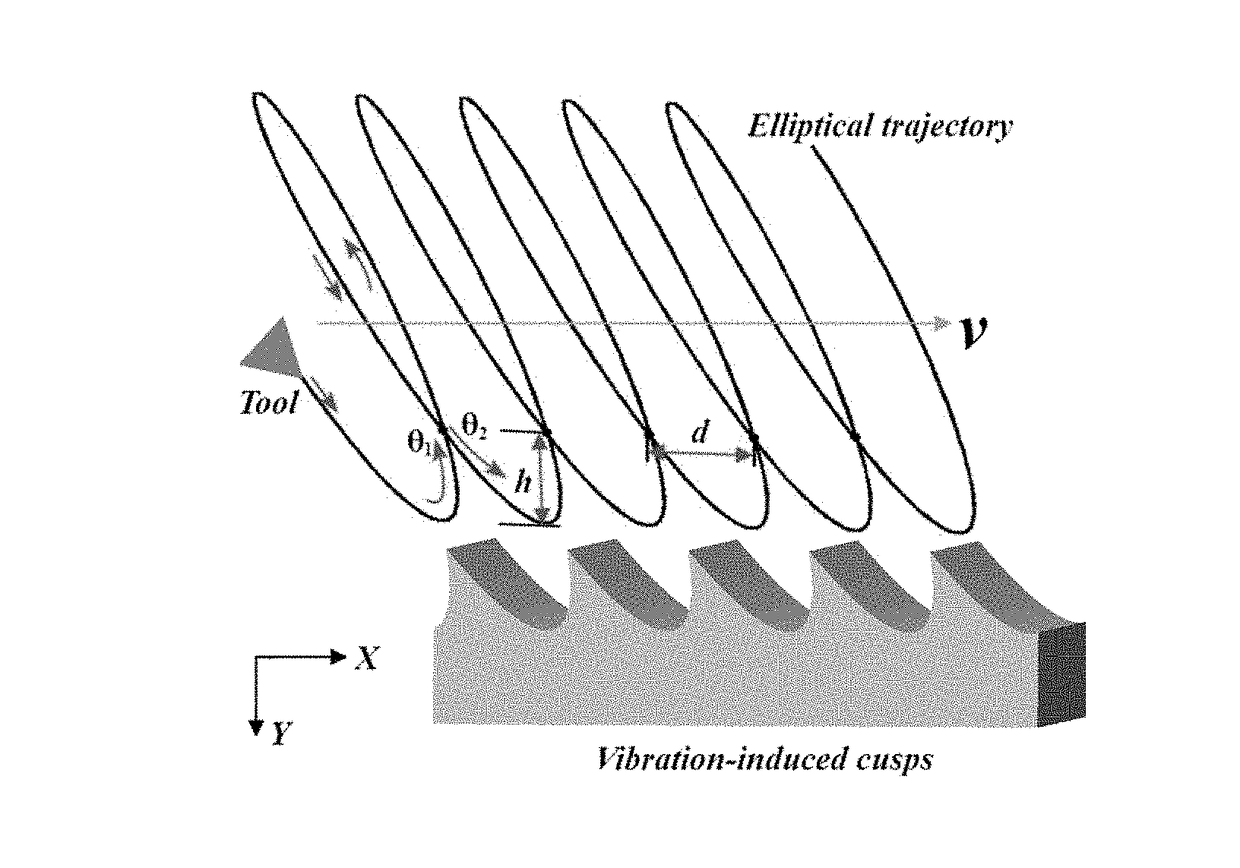
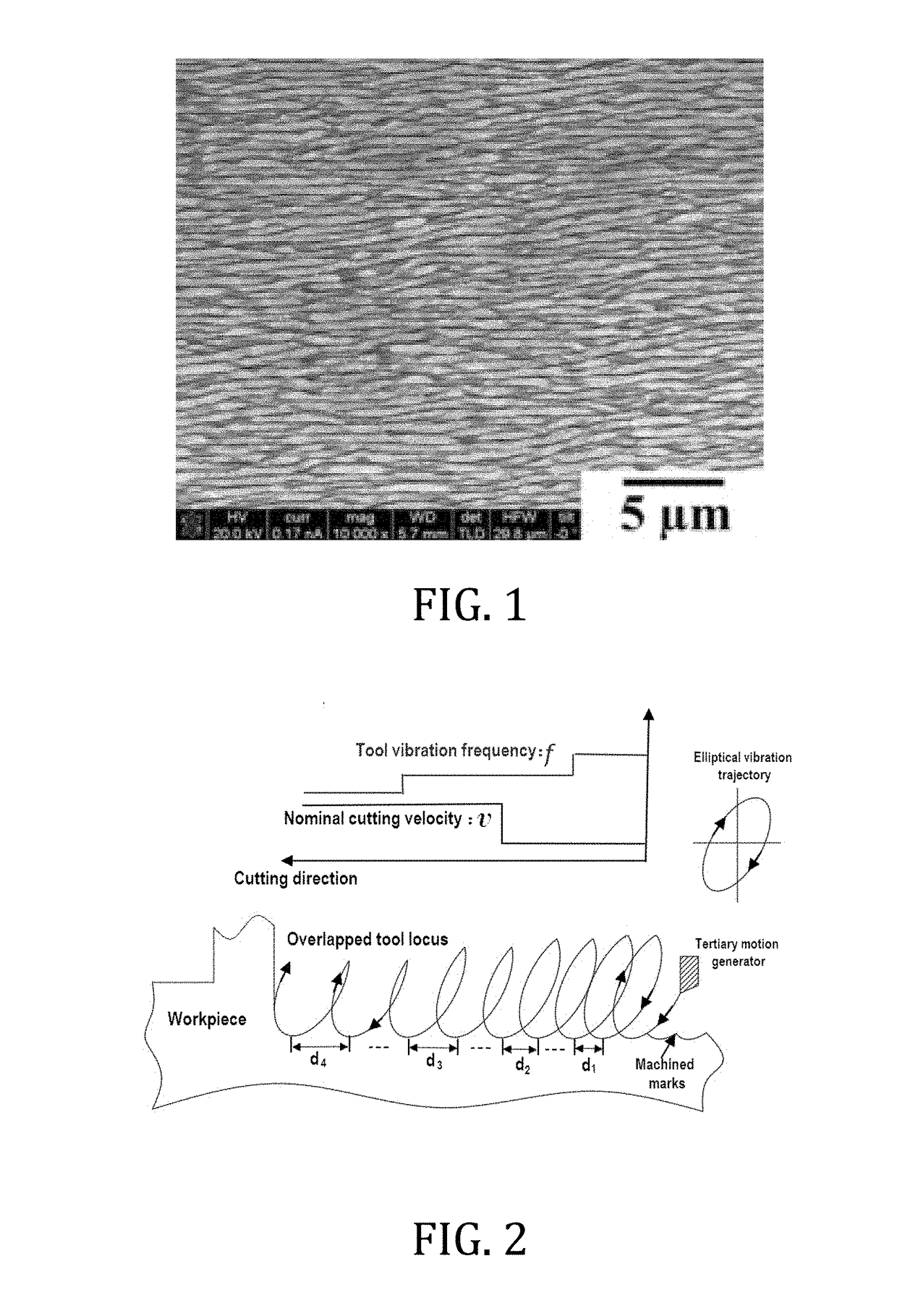
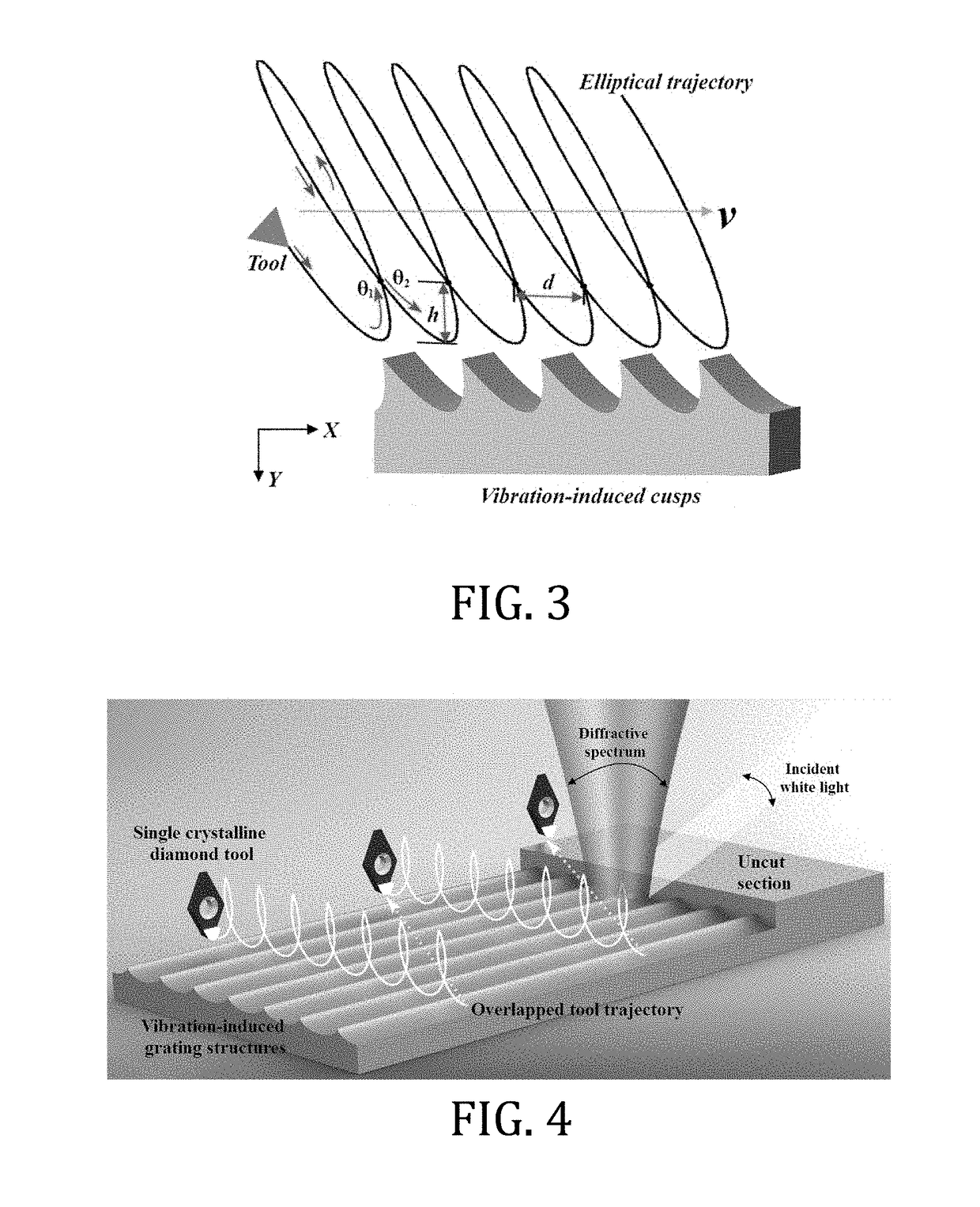
Examples
Experimental program
Comparison scheme
Effect test
embodiment 1
[0037]A method of modifying a metallic surface, the method comprising: creating with a cutting tool on the metallic surface at least one series of periodic features perpendicular to a desired cutting direction.
embodiment 2
[0038]The method according to embodiment 1, wherein the at least one series of periodic features are parallel or substantially parallel and the cutting tool is vibrated at a distinct frequency while simultaneously displaced along the desired cutting direction across the metallic surface.
embodiment 3
[0039]The method according to any of the embodiments 1-2, wherein a rate of the displacement of the cutting tool is different from the distinct frequency of the vibration of the cutting tool.
the structure of the environmentally friendly knitted fabric provided by the present invention; figure 2 Flow chart of the yarn wrapping machine for environmentally friendly knitted fabrics and storage devices; image 3 Is the parameter map of the yarn covering machine
Login to View More PUM
| Property | Measurement | Unit |
|---|---|---|
| spacing distance | aaaaa | aaaaa |
| wavelength | aaaaa | aaaaa |
| spacing distance | aaaaa | aaaaa |
Login to View More
Abstract
Materials for, and methods of, colorizing a metallic surface with micro-gratings using vibration cutting technologies are provided. Micro-gratings on aluminum, brass, and stainless steel surfaces can be rapidly created to effect, under illumination, at least one color observable in the visible spectrum using elliptical vibration texturing, a vibration-assisted mechanical cutting process. The modified metallic surface can display multiple visible colors, an iridescent effect caused by changes in one or more cutting parameters employed to produce the micro-gratings, the angle of illumination by an incident light, and / or the viewing angle of the surface under illumination.
Description
CROSS-REFERENCE TO RELATED APPLICATION[0001]This application claims the benefit of U.S. Provisional Application Ser. No. 62 / 360,086, filed Jul. 8, 2016, the disclosure of which is hereby incorporated by reference in its entirety, including all figures, tables and drawings.BACKGROUND OF THE INVENTION[0002]One existing technology used for generating colored metallic surfaces without using additional pigments is femtosecond or picosecond laser pulse writing, which produces laser-induced surface structures (LIPSSs) capable of engendering structural coloration on the metallic surfaces when illuminated by an incident light. These laser-induced, orderly surface patterns are spontaneously formed during laser irradiation (see, for example, FIG. 1). The orientation of the LIPSSs depends on the direction of the laser polarization, which is used to control the imprinted colors. For example, silver-white aluminum surfaces have been rendered to have gold, black, and grey colors by the laser-induc...
Claims
the structure of the environmentally friendly knitted fabric provided by the present invention; figure 2 Flow chart of the yarn wrapping machine for environmentally friendly knitted fabrics and storage devices; image 3 Is the parameter map of the yarn covering machine
Login to View More Application Information
Patent Timeline
 Login to View More
 Patent Type & AuthorityApplications(United States)
IPC IPC(8): C23C22/58C23C22/56C23C22/53C23C22/57B05D7/14
CPCC23C22/58C23C22/53B05D7/14C23C22/57C23C22/56B44B3/009B44B3/061B44C1/222B44F1/14
InventorGUO, PINGYANG, YANG
OwnerTHE CHINESE UNIVERSITY OF HONG KONG