Process for the production of antimicrobial dental adhesives including graphene and relative product thereof
a graphene and antimicrobial technology, applied in the field of nanotechnology, can solve the problems of increasing the risk of bacteria proliferation pockets, reducing the possibility of dental material filling, and requiring light penetration depth, so as to enhance the antimicrobial effect, improve the optical characteristics of undecorated graphene nanostructures, and improve the antimicrobial effect.
- Summary
- Abstract
- Description
- Claims
- Application Information
AI Technical Summary
Benefits of technology
Problems solved by technology
Method used
Image

Examples
example 2
dhesive Penetration Capacity
[0087]Tests analysing adhesive penetration were conducted based on the following procedure:[0088]1) The material is placed in metal molds of which the base and the side surfaces are previously optically shielded.[0089]2) The sample thus prepared is light cured from the upper surface for times not lower than the 10 s (for example, but not limiting, 20 s).[0090]3) The portion of polymerized adhesive is extracted and the thickness measured with a digital micrometer.
[0091]The minimum penetration capacity for the adhesives loaded with GNP at 0.2% in weight was 2 mm, while for the adhesives loaded with ZNGs at 0.2% in weight was always greater than about 4.4 mm.
[0092]The increase of the penetration of the adhesive loaded with ZNGs is attributable to the action of scattering of the ultraviolet light exerted by the nanostructures of ZnO, that once treated in ethanol show fluorescence in this band of visible.
example 3
bial Test
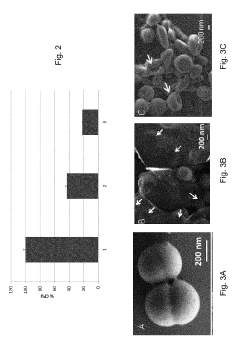
[0093]The experiments for the evaluation of the antimicrobial properties were carried out by analyzing the capacity of adhesion of bacterial cells to the various types of adhesive, using the S. mutans collection strain ATCC 25175. The bottom of the wells of a microplate were coated with the composite, ie, with the adhesive and 1×10⁶ bacterial cells, from a fresh culture, were added and incubated in BHI for 24 hours. The cell survival was evaluated through the method of colony forming units (CFU). The control used was the composite devoid of GNP and reported as 100% of cell survival.
[0094]Likewise the same test was carried out in the case of the composite containing GNP decorated with metal oxides, in the specific case are reported the effects with Zinc oxide.
[0095]As can be seen from FIG. 2, the composite with GNP decorated is more efficient. In particular, FIG. 2 shows the results of the experiments carried out: as is in column 1 with a commercial adhesive; with adhesive l...
PUM
| Property | Measurement | Unit |
|---|---|---|
| concentration | aaaaa | aaaaa |
| concentration | aaaaa | aaaaa |
| temperature | aaaaa | aaaaa |
Abstract
Description
Claims
Application Information
 Login to View More