
Spunbond laminate and method of making same
- Summary
- Abstract
- Description
- Claims
- Application Information
AI Technical Summary
Benefits of technology
Problems solved by technology
Method used
Image

Examples
Embodiment Construction
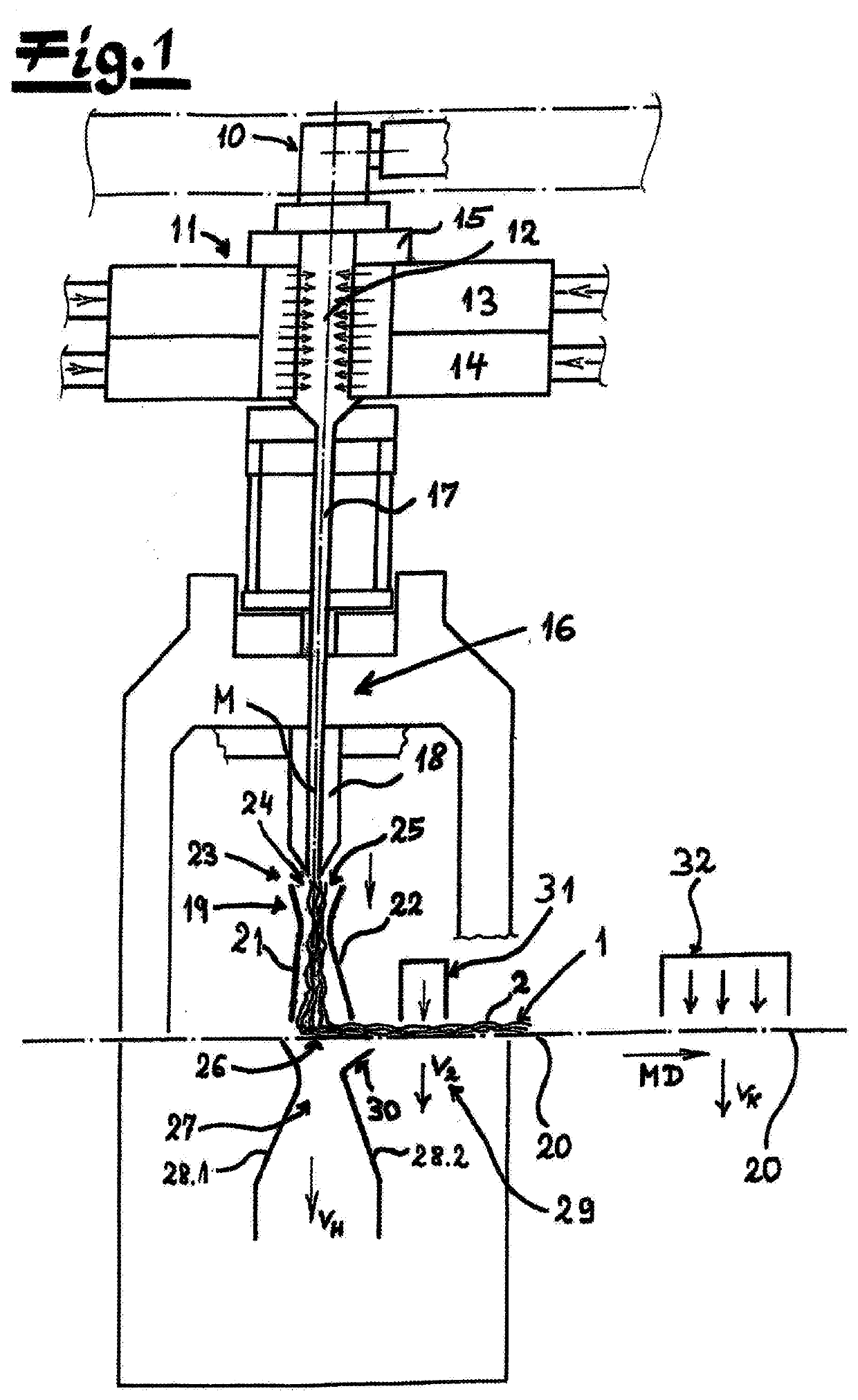
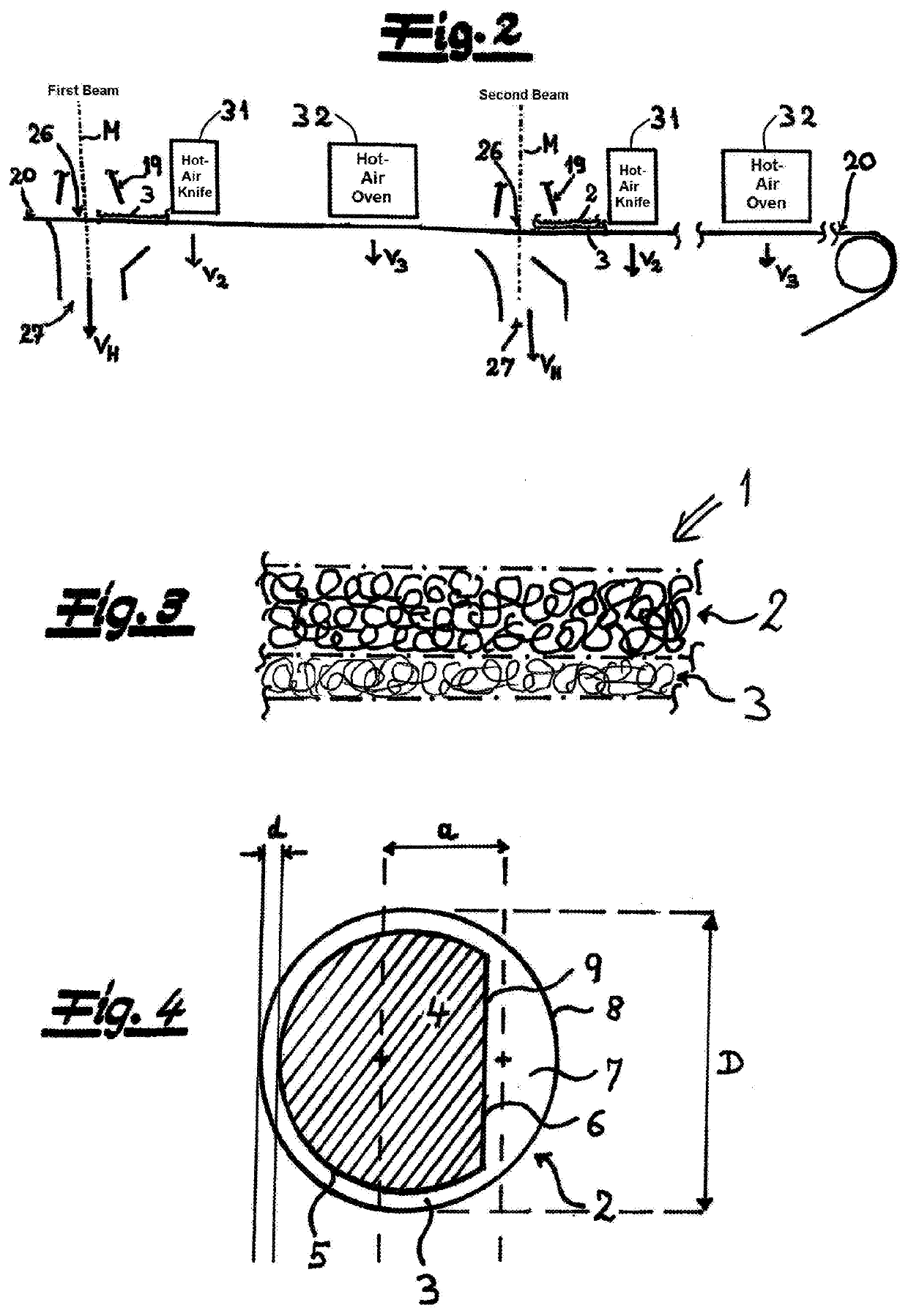
[0052]FIG. 1 shows a spunbonding device for making a spunbond nonwoven layer 2 or 3 for an inventive spunbond nonwoven laminate 1. Such a spunbond nonwoven layer 2 or 3 made with the apparatus has crimped continuous filaments F or consists of crimped continuous filaments F, or substantially consists of crimped continuous filaments F. It is within the scope of the invention that the continuous filaments F are thermoplastic.
[0053]The apparatus shown in FIG. 1 comprises a spinneret 10 for spinning the continuous filaments F and these spun continuous filaments F are expediently introduced into a cooler 11 with a cooling chamber 12. Preferably, air supply manifolds 13 and 14 are one atop the other on two opposite sides of the cooling chamber 12. Air of different temperatures is expediently introduced into the cooling chambers from these air supply manifolds 13 and 14. As recommended, a monomer extractor 15 is provided between the spinneret 10 and the cooler 11. With this monomer extracto...
PUM
| Property | Measurement | Unit |
|---|---|---|
| Fraction | aaaaa | aaaaa |
| Thickness | aaaaa | aaaaa |
| Percent by mass | aaaaa | aaaaa |
Abstract
Description
Claims
Application Information
 Login to View More