Unlock instant, AI-driven research and patent intelligence for your innovation.

Aqueous zinc lithium-ion battery and method for making same

Pending Publication Date: 2021-09-23
JANAK HANDA +1
View PDF0 Cites 0 Cited by
  • Summary
  • Abstract
  • Description
  • Claims
  • Application Information

AI Technical Summary

Benefits of technology

The patent describes a new type of battery cell that uses a binder-free cathode and a sponge zinc anode separated by a separator and a hybrid aqueous electrolyte. The cathode is made by mixing Li-ion compounds and conductive carbon in a water-based electrolyte, and the anode is made by sintering zinc powder onto a copper mesh. The technical effects of this design include higher energy density, better stability, and longer lifespan compared to traditional batteries.

Problems solved by technology

In battery manufacturing, there are some common challenges for conventional electrode design.
The coating thickness of the electrode is normally less than 100 micrometers due to certain performance and manufacturing limitations.
From a performance perspective, electrodes that possess a thickness of over 100 micrometers typically have significant reductions in their rate capability; while in terms of manufacturing, capillary forces during the drying process lead to crack formation inside of the thick electrodes.
Additionally, thicker electrodes lead to a higher energy density but lower rate capability.
Further, the polymer binder used in conventional electrodes can obstruct the pore structure of the electrodes and grows tortuously, which thereby increases the resistance.
However, its utilization is limited due to some chemical and electrochemical reaction during cycling.
Uneven deposition of Zn2+ on the surface of zinc metals during extended cycling forms a needle-like structure called dendrite formation which can fatally short circuit the battery.
These dendrite formations hinder the application of zinc metals in aqueous zinc Li-ion batteries for long-term cyclic behavior.

Method used

the structure of the environmentally friendly knitted fabric provided by the present invention; figure 2 Flow chart of the yarn wrapping machine for environmentally friendly knitted fabrics and storage devices; image 3 Is the parameter map of the yarn covering machine
View more

Image

Smart Image Click on the blue labels to locate them in the text.
Viewing Examples
Smart Image
  • Aqueous zinc lithium-ion battery and method for making same
  • Aqueous zinc lithium-ion battery and method for making same
  • Aqueous zinc lithium-ion battery and method for making same

Examples

Experimental program
Comparison scheme
Effect test

example 1

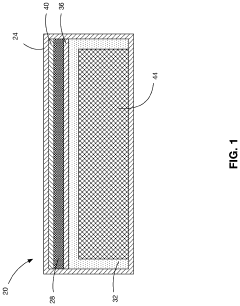
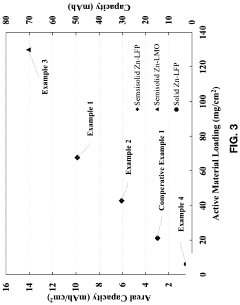
[0056]In a first example implementation, a zinc Li-ion cell was prepared using a binder-free dough-like cathode and a zinc anode. The binder-free dough-like cathode was prepared by mixing LiFePO4 and Carbon Super P (95:5 by wt. %) with a hybrid aqueous solution of 3 M Li2SO4 and 4 M ZnSO4, the weight ratio of solid to liquid being 2:3. The condensed slurry of the cathode was prepared using a planetary centrifugal mixer at 1000 rpm for 10 minutes, and then rolled onto a graphite foil (200 micrometer thickness). The thickness of the cathode was 1000 micrometers. The battery was tested at 1 mA·cm−2 current density. The battery showed high active material loading of 67.5 mg·cm−2, and great areal capacity of 9.9 mA·cm−2.

[0057]A cell was assembled with the piece of cathode, copper foil and AGM separator, and a hybrid aqueous solution of 3M Li2SO4 and 4M ZnSO4 was used as an electrolyte that was absorbed by the AGM separator.

example 2

[0058]In a second example implementation, a zinc Li-ion cell was prepared using a binder-free dough-like cathode and a zinc anode. The binder-free dough-like cathode was prepared by mixing LiFePO4 and acetylene black (90:10 by wt. %) with a hybrid aqueous solution of 1.0 M Li2SO4 and 1.5 M ZnSO4, the weight ratio of solid to liquid being 2.2:3. The condensed slurry of the cathode was prepared using a planetary centrifugal mixer at 1000 rpm for 10 minutes, and then rolled onto a graphite foil (200 micrometer thickness). The total thickness of the cathode was 700 micrometers. The battery was tested at 1 mA·cm−2 current density.

[0059]The cell was assembled with the piece of cathode, copper foil and AGM separator, and a hybrid aqueous solution of 1.0 M Li2SO4 and 1.5 M ZnSO4 was used as an electrolyte that was absorbed by the AGM separator.

example 3

[0060]In a third example implementation, a zinc Li-ion cell was prepared using a binder-free dough-like cathode and a zinc anode. The binder-free dough-like cathode was prepared by mixing LiMn2O4 and Carbon Super P (90:10 by wt. %) with a hybrid aqueous solution of 2.0 M LiCl and 2 M ZnCl2, the weight ratio of solid to liquid being 1:1. The condensed slurry of the cathode was prepared using a planetary centrifugal mixer at 1000 rpm for 10 minutes, and then rolled onto a graphite foil (200 micrometer thickness). The total thickness of the cathode was 1000 micrometers. The battery was tested at 1 mA·cm−2 current density. The battery showed high active material loading of 129.8 mg·cm−2, and great areal capacity of 14.1 mA·cm−2.

[0061]The cell was assembled with the piece of cathode, copper foil and AGM separator, and a hybrid aqueous solution of 2.0 M LiCl and 2 M ZnCl2 was used as an electrolyte that was absorbed by the AGM separator.

the structure of the environmentally friendly knitted fabric provided by the present invention; figure 2 Flow chart of the yarn wrapping machine for environmentally friendly knitted fabrics and storage devices; image 3 Is the parameter map of the yarn covering machine
Login to View More

PUM

No PUM Login to View More

Abstract

A battery cell and method for manufacturing the same are provided. The battery cell includes a binder-free dough-like cathode separated from a sponge zinc anode by a separator and a hybrid aqueous electrolyte.

Description

FIELD[0001]The specification relates generally to energy storage and, in particular, to an aqueous zinc lithium-ion battery and a method for making the same.BACKGROUND OF THE DISCLOSURE[0002]WO2012094761A1 discloses a secondary aqueous zinc lithium-ion (“Li-ion”) battery that utilizes a lithium intercalation compound as a cathode active material, a zinc metal as an anode active material, a hybrid aqueous solution with Li+ and Zn2+ as the electrolyte. The working concept of a zinc Li-ion battery is based on ion-exchange in an electrolyte. During battery charging, lithium ions de-intercalate from the cathode active material and dissolve into the electrolyte. At the same time, zinc ions in the electrolyte are reduced to zinc metal and deposited onto an anode surface. During discharge, the reverse process occurs.[0003]Zinc Li-ion batteries exhibit excellent cycling stability and reasonable energy density, and potentially are an alternative to lead acid batteries in some application area...

Claims

the structure of the environmentally friendly knitted fabric provided by the present invention; figure 2 Flow chart of the yarn wrapping machine for environmentally friendly knitted fabrics and storage devices; image 3 Is the parameter map of the yarn covering machine
Login to View More

Application Information

Patent Timeline
no application Login to View More
IPC IPC(8): H01M4/136H01M10/36H01M4/66H01M4/38H01M4/74H01M4/04H01M4/1397H01M4/1391H01M4/505H01M4/58H01M4/131
CPCH01M4/136H01M10/36H01M4/663H01M4/38H01M4/74H01M4/0471H01M2004/021H01M4/661H01M4/1397H01M4/1391H01M4/505H01M4/5825H01M4/131H01M4/0404H01M10/38H01M2300/0002H01M4/525H01M4/625H01M4/0435Y02E60/10
Inventor CHEN, ZHONGWEIGHORBANI KASHKOOLI, ALIKHAZRAEI, SEPEHR
Owner JANAK HANDA