The mechanical strain in the actuating member resulting from its illumination is provided by two different effects. Firstly there is a scalar effect in which when an initially isotropic semiconducting glassy matrix is illuminated by unpolarised light it expands. This expansion produces a metastable state and the semiconducting glassy matrix can be returned to its isotropic state by heating. An opto-mechanical device using this scalar effect has only limited application.
The secondary
system may be any one which responds to mechanical strain or movement and thus, for example, the secondary
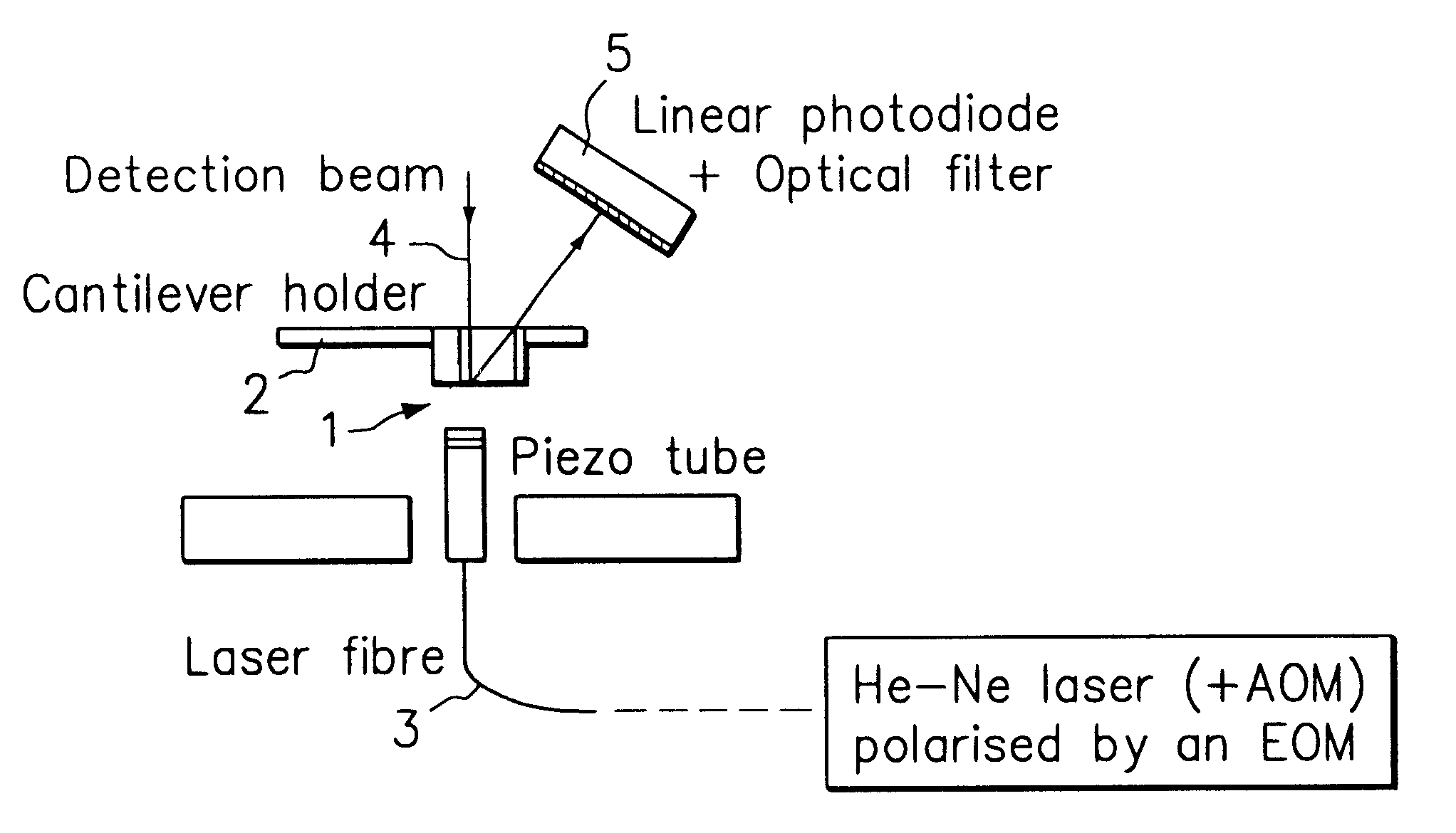
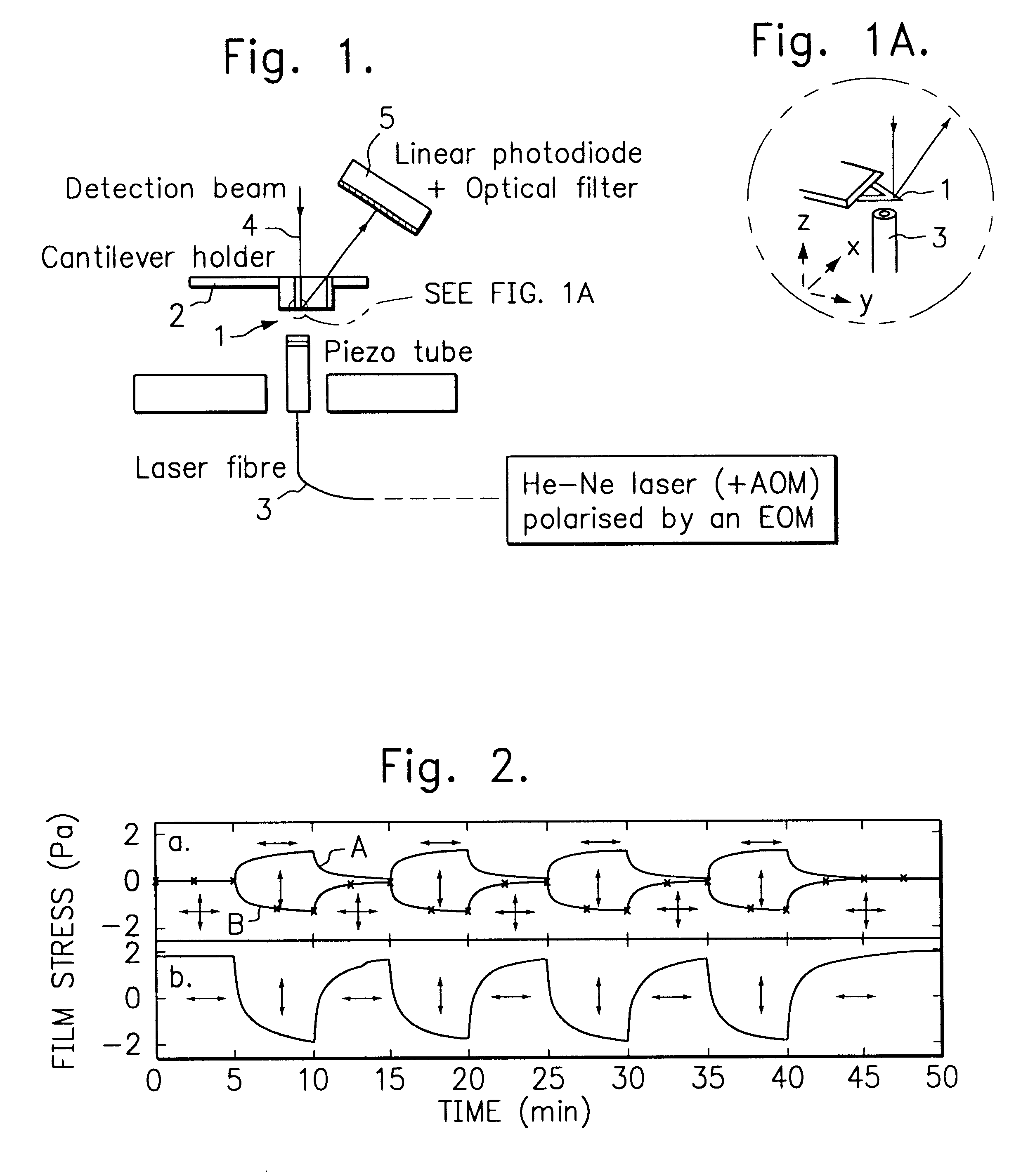
system may include an
optical lever comprising a
laser beam which is reflected from the actuating member or an element connected to it and then impinges upon a position-sensitive photo-
detector so that as the actuating member moves or bends the effect of its movement turns the
optical lever formed by the
laser beam so that it moves along the position-sensitive photo-
detector. The output of the position-sensitive photo-
detector then gives an indication of the mechanical movement of the actuating member and hence of the illumination applied to it. The actuating member may include a
metal electrode and in this case the mechanical movement of the actuating member and its associated
electrode towards or away from an associated
electrode provides a change in
capacitance between the two electrodes. This change in
capacitance may be monitored to give a representation of the mechanical movement of the actuating member and hence of the illumination applied to it. Equally, the substrate may be formed by a piezo-resistive material the resistance of which changes as a result of a strain imposed upon it. Accordingly, in this case, as a result of a change in strain in the substrate caused by the strain in the semiconducting glassy matrix, the electrical resistance varies so resulting in a change in resistance being used to provide an indication of the change in strain of the semiconducting glassy matrix and hence its illumination. A further way in which the actuating member can be used to control a secondary
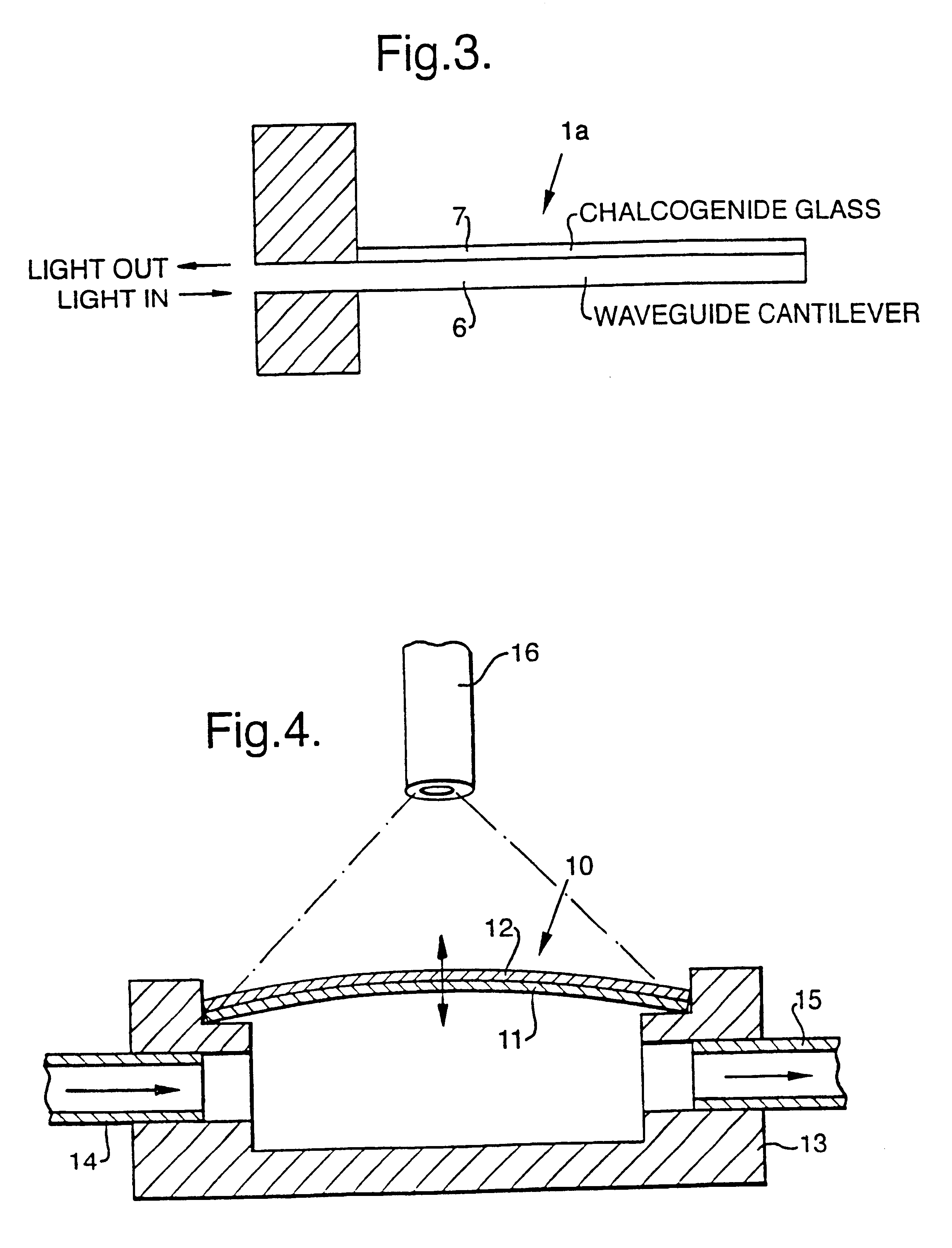
system is in the case where the secondary system is a fluidic system. In this case the actuating member may be arranged close to a
nozzle in a fluidic system so that as the illumination of the actuating member varies and hence its displacement varies, it gets closer to or further away from the
nozzle so varying the rate of flow through the
nozzle and hence the
back pressure upstream of the nozzle. In this way the opto-mechanical device can be used to influence a fluidic system and thus produce a light sensor or a controller which is responsive to the light input into the device which, being completely free from
electrical contacts, would be intrinsically safe in an explosive environment.
When the elements forming the semiconducting glassy matrix are in non-stoichiometric proportions the exact composition of it can be tailored to influence and suit its intended use. Firstly, by selecting and varying the proportions of the element or other elements in the semiconducting glassy matrix the
band gap of the
semiconductor can be varied and so matched to the energy of the light which is used to illuminate the actuating member. Clearly this can be used to make the actuating member selective to light of a predetermined
wavelength where the actuating member is used to detect light of a predetermined
wavelength or alternatively merely to match the actuating member to the
wavelength of light output by a
light source used with the opto-mechanical device and thereby optimise its sensitivity. It is also possible to change the rigidity of the
glass material and, in this way affect the amount of expansion and contraction that occurs. For example, introducing
iodine into the semiconducting glassy matrix appears to make it less rigid and so causes greater expansion and contraction of the matrix for a given change in illumination. Equally, the introduction of
germanium into the semiconducting glassy matrix appears to make it more rigid and so results in a lower expansion and contraction for the given change in illumination.


 Login to View More
  Login to View More