
Active matrix liquid crystal display panel
a liquid crystal display panel and active matrix technology, applied in static indicating devices, non-linear optics, instruments, etc., can solve the problems of large difference between transmission light amount and applied voltage, remarkably deterioration of original picture image, so as to improve the degree of compensation and improve the accuracy of compensation. compensation layer, the effect of improving the degree of compensation
- Summary
- Abstract
- Description
- Claims
- Application Information
AI Technical Summary
Benefits of technology
Problems solved by technology
Method used
Image

Examples
first embodiment
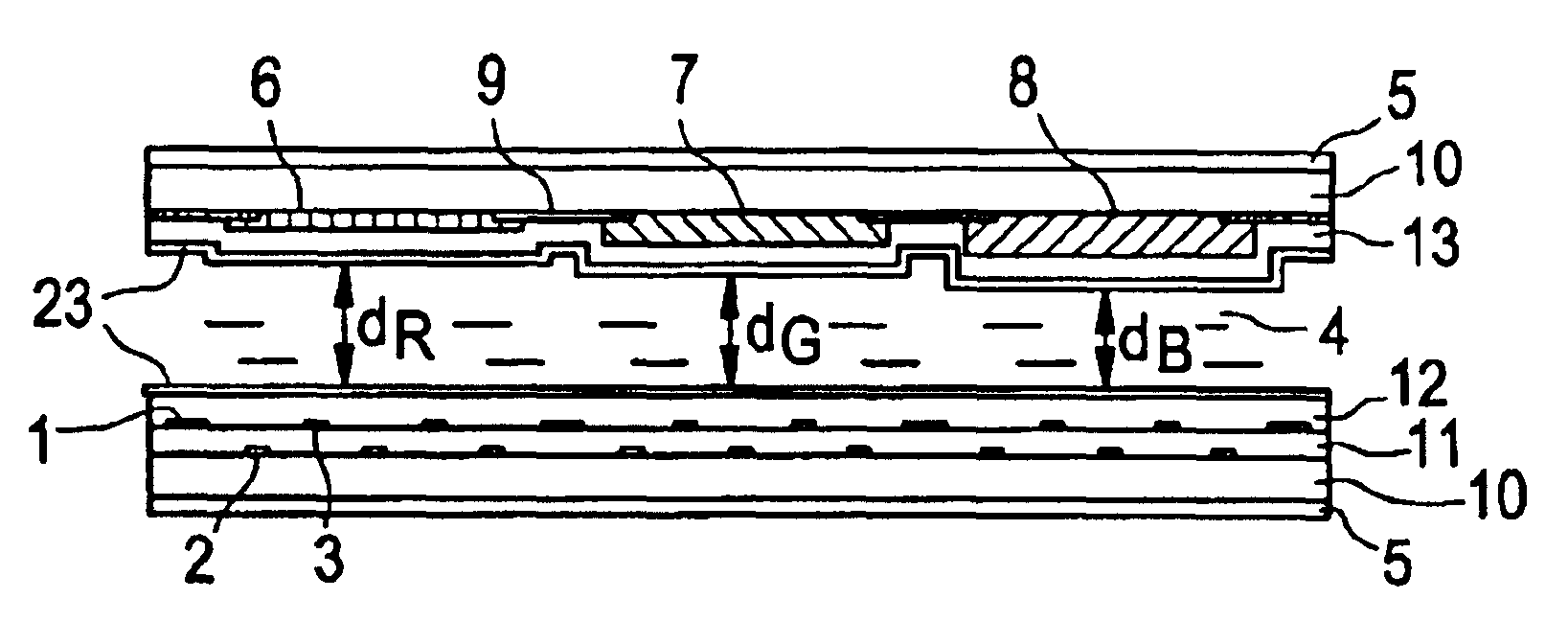
The first embodiment is described with reference to FIGS. 11(a) and 11(b). Each pixel electrode 3 which forms a pixel is connected to the source electrode of a thin film transistor which has a scanning line 16 as a gate electrode thereof, and the drain electrode of the thin film transistor is connected to a signal line 1. The pixel electrode 3 has a longitudinal direction parallel to the signal line 1 and has an opposing electrode 2 connected by an opposing electrode bus line 17.
A liquid crystal layer 4 is held between two glass substrates 10, and orientation films 23 are disposed on two substrate interfaces and are oriented uniformly in a rubbing direction 24 of FIG. 11(b) by rubbing them in the same direction.
A pair of polarizing plates 5 disposed on the outer sides of the two glass substrates 10 have polarization axes perpendicular to each other, and the polarization axis of one of the polarizing plates 5 coincides with the initial orientation direction of the liquid crystal laye...
second embodiment
FIGS. 13(a) and 13(b) are a sectional view and a plan view, respectively, showing a second embodiment of the active matrix liquid crystal display apparatus of the present invention.
As shown in FIGS. 13(a) and 13(b), the present embodiment is quite same as the first embodiment except that the distance between a pixel electrode 3 and an opposing electrode 2 is different between a pixel 20 corresponding to green and a pixel 21 corresponding to blue and that numerical aperture adjustment portions 22 are present.
Since the distance between a pixel electrode 3 and an opposing electrode 2 is made different as seen in FIGS. 13(a) and 13(b), it can be realized by applying the same potential that the transverse electric field intensity necessary to turn the liquid crystal layer 4 is different among the different colors, which arises from a variation of the thickness of the liquid crystal layer 4. Consequently, driving is facilitated.
Further, the numerical aperture adjustment portion 22 is prov...
PUM
 Login to View More
 Abstract
Description
Claims
Application Information
 Login to View More