
Orientation preserving angular swivel joint
a technology of angular swivel joints and orientation preservation, which is applied in the direction of gearing, mechanical control devices, instruments, etc., can solve the problems of enlarging the joint size, and the double angular swivel joint cannot be used as a snake robot joint, etc., and achieves a high mechanical advantage proportional to the radius of the robot. , compact, easy to control
- Summary
- Abstract
- Description
- Claims
- Application Information
AI Technical Summary
Benefits of technology
Problems solved by technology
Method used
Image

Examples
Embodiment Construction
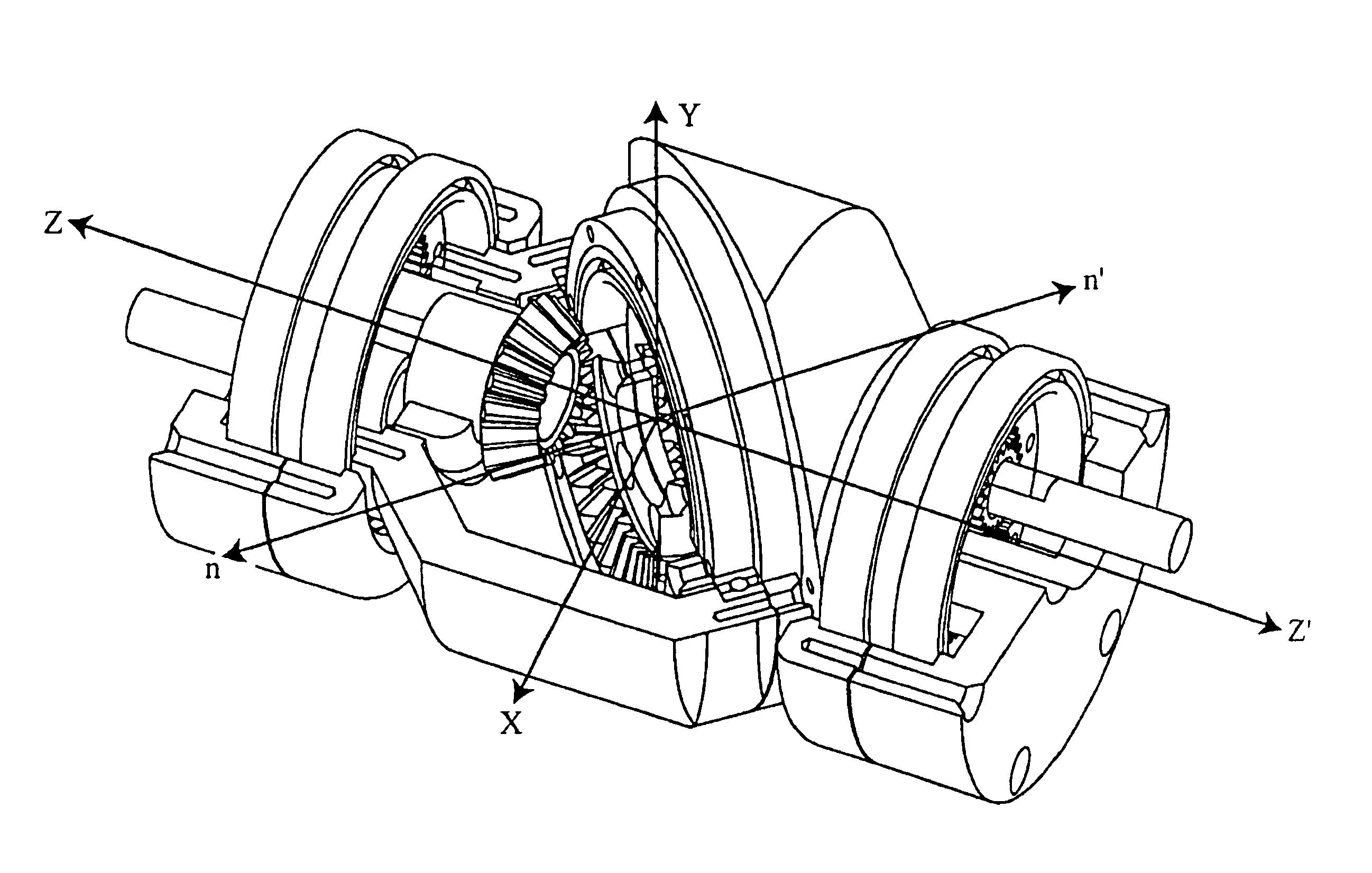
Turning to FIGS. 5a and 5b, the upper half subassembly 1 of the joint is shown. First bay 11 is coupled to obliquely cut upper cup 15 by first and second upper angular bearings 13. Bearings 13 allow upper cup 15 to rotate freely about axis OZ′ with respect to first bay 111 with minimal friction. Additionally, bearings 13 hold upper spur ear 10 into position as spur ear 10 is sandwiched between the two bearings 13, upper spur ear 10 being fixedly mounted on upper cup 15. Preferably, two bearings 13 are used to ensure free rotation of upper cup 15 about axis OZ′ with no or very minimal wobbling. Upper cup 15 and upper spur pinion gear 10 are preferably bolted together, preferably using a circular array of bolts. However, other ways known in the art of fixedly mounting, two elements may be used as well (e.g., welding). Thus, upper cup 15 and upper spur gear 10 may rotate as one rigid body. Bolting together the upper cup15 and upper spur gear 10 has the advantage that the two elements m...
PUM
 Login to View More
 Abstract
Description
Claims
Application Information
 Login to View More