Unlock instant, AI-driven research and patent intelligence for your innovation.

Output buffer circuit and integrated semiconductor circuit device with such output buffer circuit

a technology of output buffer circuit and integrated semiconductor circuit, which is applied in the direction of logic circuit coupling/interface arrangement, pulse technique, instruments, etc., can solve the problems of system failure to properly determine the logic level of “1” or “0” and other problems, such as system malfunction, variation in cross-point cp and slew rate cannot be compensated

Inactive Publication Date: 2005-05-17
ELPIDA MEMORY INC
View PDF17 Cites 42 Cited by
  • Summary
  • Abstract
  • Description
  • Claims
  • Application Information

AI Technical Summary

Benefits of technology

[0017]It is therefore an object of the present invention to provide an output buffer circuit which is capable of sufficiently compensating for variations in the cross-point between rising and falling waveforms of output pulses and variations in the slew rate against variations in the power supply voltage and the ambient temperature even when the output buffer circuit is incorporated in a system.
[0019]With the above arrangement, the number of transistors of the main driver for driving the load according to control signals and the number of transistors of the predriver are changed to simultaneously adjust the cross-point of output pulses and the slew rate as well as the output impedance with the same control signals. Consequently, the data receiving side connected to the output buffer circuit is prevented from malfunctioning, making it possible to achieve a system which operates normally even when the power supply voltage and the ambient temperature vary.
[0020]Since the output impedance and the rise and fall times of output pulses are simultaneously controlled, the number of control signals and the steps of a testing process are made smaller than if the output impedance and the rise and fall times of output pulses were controlled independently of each other. Thus, the manufacturing cost of the output buffer circuit is prevented from increasing.
[0023]With the above arrangement, the driving capabilities of both the third n-channel MOS transistor and the third p-channel MOS transistor are similarly increased, and the driving capabilities of both the fourth p-channel MOS transistor and the fourth n-channel MOS transistor are similarly increased. Therefore, a through current is preventing from flowing through the first p-channel MOS transistor and the first n-channel MOS transistor, and hence noise is prevented from being produced and the current consumption is prevented from increasing due to such a through current.
[0026]With the above arrangements, since the delay monitor circuit reflects the adjusted values of the output impedance of the output buffer circuit and the ratio tr / tf of output pulses, a system clock signal and the data output from the output buffer circuit can be synchronized more accurately with each other.

Problems solved by technology

If the slew rate becomes lower, then since the amplitude of output pulses cannot reach a maximum value when the system operates at a high speed, the system fails to determine a logic level of “1” or “0” properly.
Conversely, if the slew rate become higher, then high-frequency components increase to distort output pulses, thus increasing noise which tends to result in a system malfunction.
However, variations in the cross-point CP and the slew rate cannot be compensated for simply by adjusting the output impedance.
Only adjusting the slew rate fails to achieve a compensation within the allowable range of variations of the system which operates at a high speed and under a low voltage because the cross-point CP and the slew rate depend on variations of both the output impedance and the power supply voltage.
In particular, if only the slew rate is adjusted, when the high level of the output signal is lowered or the low level of the output signal is increased due to a reduction in the driving capability, the system becomes unable to determine a logic level of “1” or “0” properly.
However, it is difficult to detect fluctuations of the slew rate of the output buffer circuit because the slew rate cannot easily be monitored.
The output buffer circuits disclosed in the above applications offer an arrangement for adjusting either one of the output impedance and the slew rate, and are disadvantageous in that variations in the cross-point CP and the slew rate of the disclosed output buffer circuits as they are incorporated in a system cannot sufficiently be compensated for against variations in the power supply voltage and the ambient temperature.

Method used

the structure of the environmentally friendly knitted fabric provided by the present invention; figure 2 Flow chart of the yarn wrapping machine for environmentally friendly knitted fabrics and storage devices; image 3 Is the parameter map of the yarn covering machine
View more

Image

Smart Image Click on the blue labels to locate them in the text.
Viewing Examples
Smart Image
  • Output buffer circuit and integrated semiconductor circuit device with such output buffer circuit
  • Output buffer circuit and integrated semiconductor circuit device with such output buffer circuit
  • Output buffer circuit and integrated semiconductor circuit device with such output buffer circuit

Examples

Experimental program
Comparison scheme
Effect test

1st embodiment

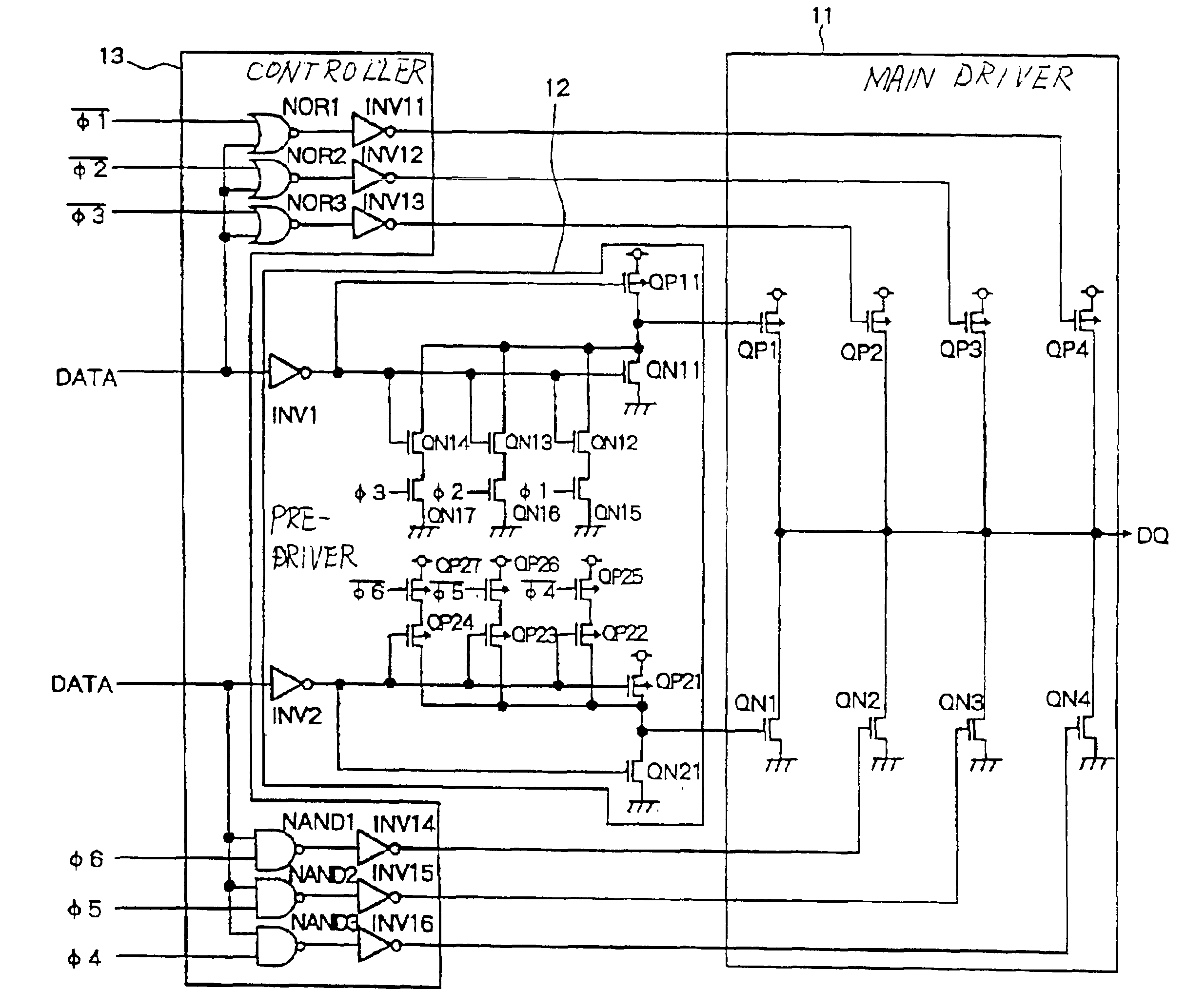
[0046]An output buffer circuit according to a first embodiment of the present invention will be described below with reference to the drawings.

[0047]As shown in FIG. 3, the output buffer circuit according to the first embodiment has main driver 11 for driving a load connected to DQ terminal, main driver 11 having an output impedance which can be changed, a predriver 12 for driving main driver 11 according to data (DATA) read from a sense amplifier and changing the ratio tr / tf of output pulses of main driver 11, and a controller 13 for generating signals to change the output impedance of main driver 11 and the ratio tr / tf of output pulses according to control signals φ1 through φ6 from a control circuit, etc. Control signals / φ1 through / φ6 shown in FIG. 3 are inversions of signals φ1 through φ6. Inverters for inverting signals φ1 through φ6 are omitted from the illustration in FIG. 3.

[0048]For example, control signals φ1 through φ6 are generated from a control circuit 6 according to...

3rd embodiment

[0077]According to a third embodiment, the arrangements of the output buffer circuits according to the first and second embodiments are applied to another circuit.

[0078]As described above, an integrated semiconductor circuit device such as a DDR-SDRAM or the like which operates at a high speed incorporates phase synchronizing circuit 9 for synchronizing data output from output buffer circuit 8 with system clock signal CLK, as shown in FIG. 9.

[0079]Phase synchronizing circuit 9 comprises a DLL as shown in FIG. 9, for example. Phase synchronizing circuit 9 has input buffer circuit 21 for being supplied with system clock signal CLK, variable delay circuit 22 for delaying clock signal CLK1 output from input buffer circuit 21 to generate compensating clock signal CLKOE for compensating for output data timing of output buffer circuit 8, delay monitor circuit 23 for being supplied with compensating clock signal CLKOE and monitoring a delay of output buffer circuit 8, input buffer replica c...

the structure of the environmentally friendly knitted fabric provided by the present invention; figure 2 Flow chart of the yarn wrapping machine for environmentally friendly knitted fabrics and storage devices; image 3 Is the parameter map of the yarn covering machine
Login to View More

PUM

No PUM Login to View More

Abstract

An output buffer circuit has a main driver including a first pMOS transistor and a first nMOS transistor for driving a load, and a second pMOS transistor and a second nMOS transistor for driving the load in coaction with the first pMOS transistor and the first nMOS transistor, and a predriver including a third pMOS transistor and a third nMOS transistor for driving the first pMOS transistor, a fourth pMOS transistor and a fourth nMOS transistor for driving the first nMOS transistor, a fifth nMOS transistor for driving the first pMOS transistor in coaction with the third nMOS transistor, and a fifth pMOS transistor for driving the first nMOS transistor in coaction with the fourth pMOS transistor.

Description

BACKGROUND OF THE INVENTION[0001]1. Field of the Invention[0002]The present invention relates to an output buffer circuit for use in an integrated semiconductor circuit device, and more particularly to an output buffer circuit which is capable of adjusting the output impedance thereof according to control signals from an external source.[0003]2. Description of the Related Art[0004]Systems incorporating integrated semiconductor circuit devices in recent years employ memory devices such as DRAMs (Dynamic Random Access Memories) and SDRAMs (Synchronous DRAMs) which operate with a clock signal of several hundreds MHz as a result of processing operations at higher speeds. To meet lower power consumption requirements, there are also available integrated semiconductor circuit devices that operate at lower power supply voltages of about 1.5 V or lower.[0005]It is important for systems operating at higher speeds and under low voltages to suppress variations in the driving capability and slew...

Claims

the structure of the environmentally friendly knitted fabric provided by the present invention; figure 2 Flow chart of the yarn wrapping machine for environmentally friendly knitted fabrics and storage devices; image 3 Is the parameter map of the yarn covering machine
Login to View More

Application Information

Patent Timeline
no application Login to View More
IPC IPC(8): H03K19/0185G11C11/407G11C11/409H03K17/687H03K19/0175
CPCH03K19/018585
Inventor TAKAHASHI, TSUGIO
Owner ELPIDA MEMORY INC