
Nonvolatile semiconductor memory device
- Summary
- Abstract
- Description
- Claims
- Application Information
AI Technical Summary
Benefits of technology
Problems solved by technology
Method used
Image

Examples
first embodiment
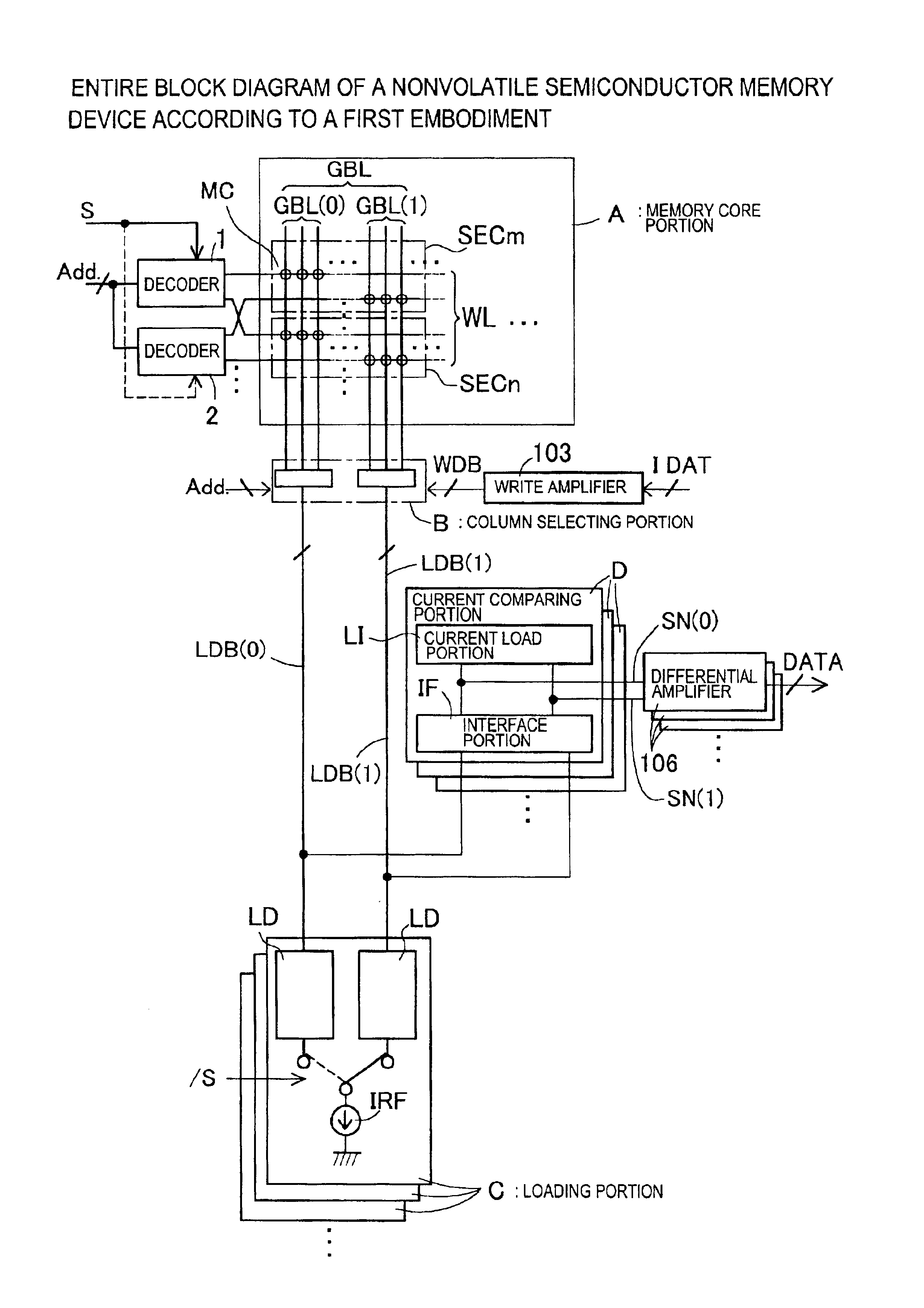
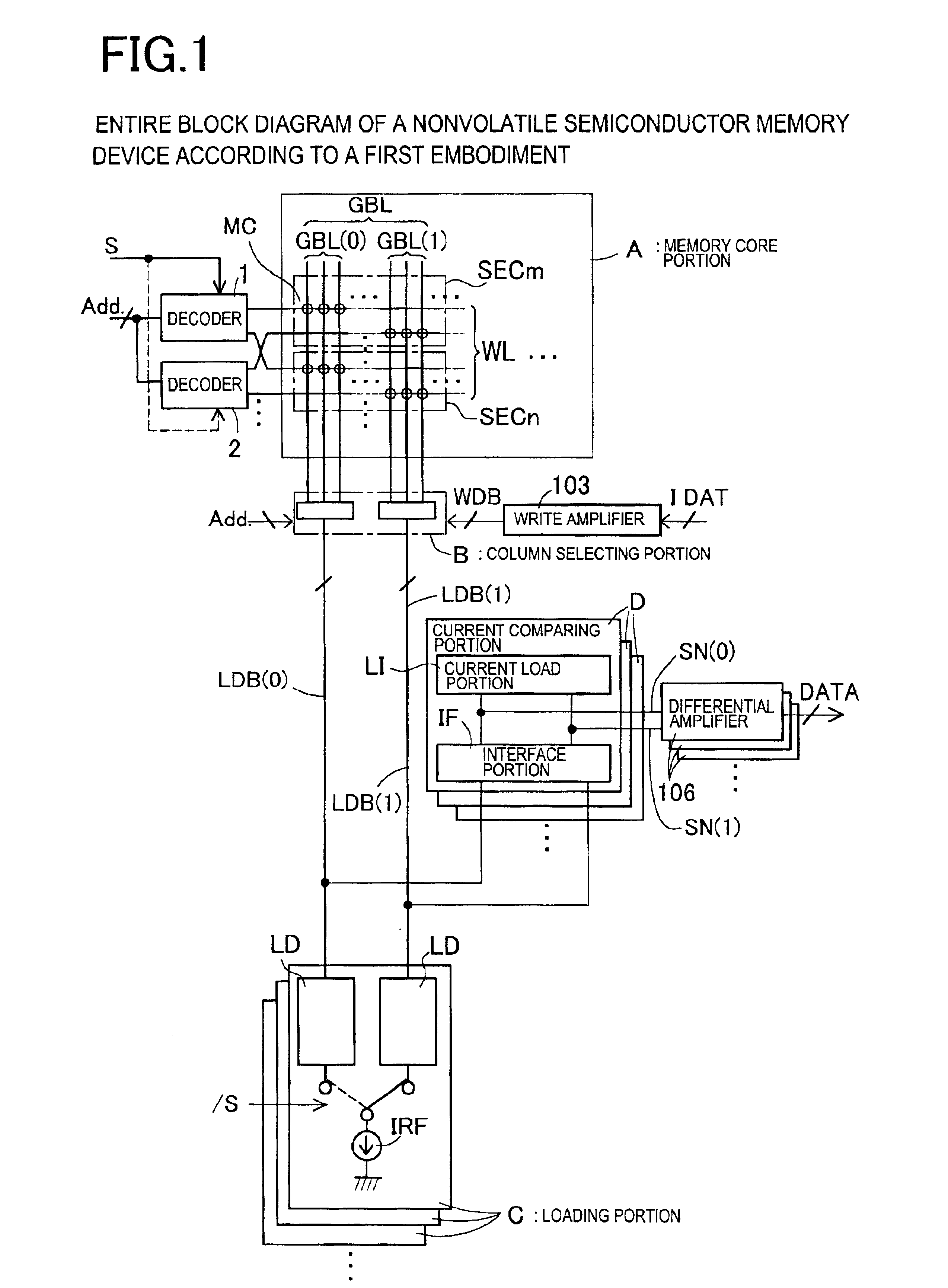
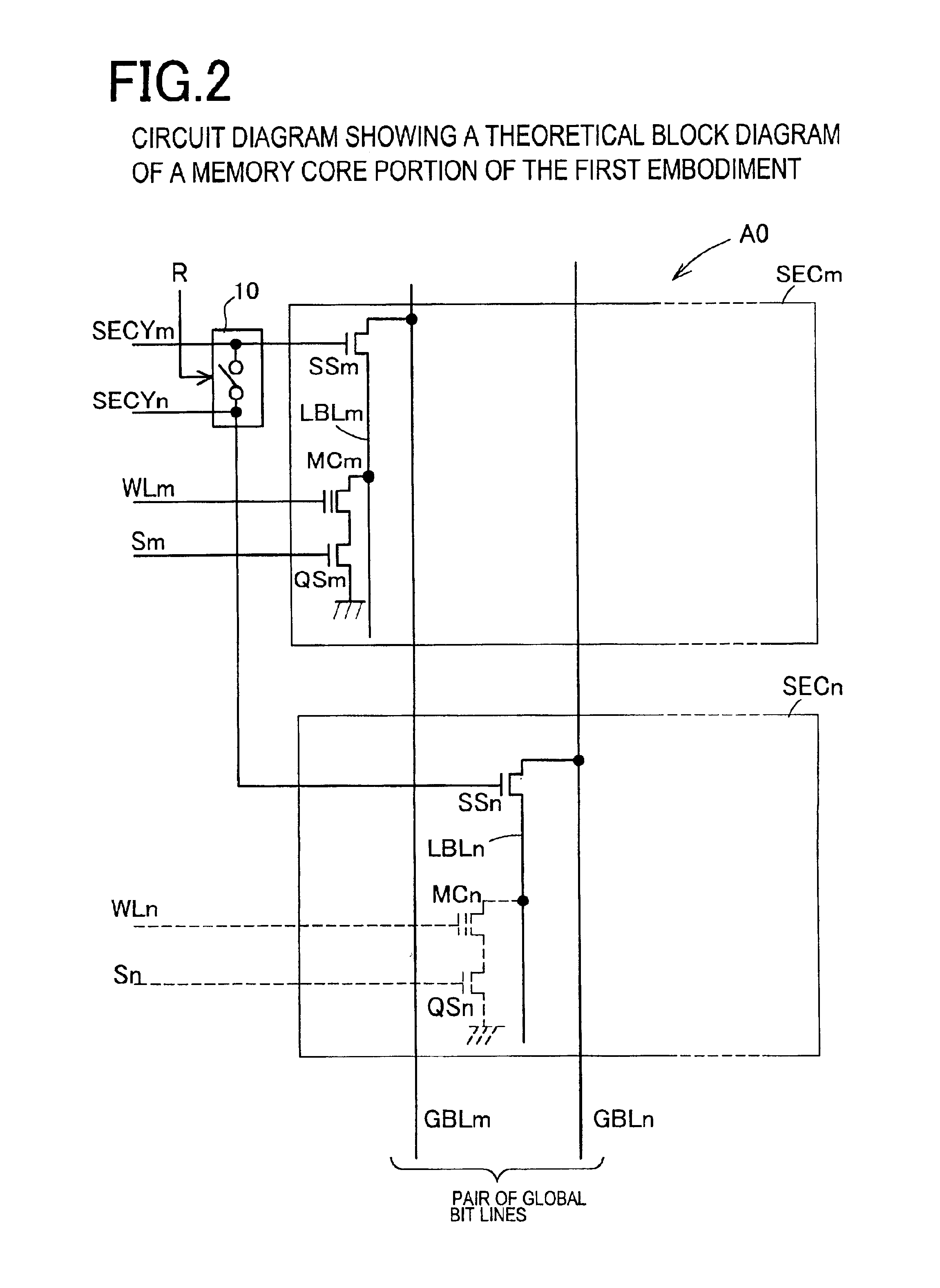
[0068]First, FIG. 1 shows an entire structure of the nonvolatile semiconductor memory device of the Referring to the entire block diagram of FIG. 1, a memory core portion A and a column selecting portion B are provided instead of the memory core portion A100 and the column selecting portion B100 in a conventional nonvolatile semiconductor memory device shown in FIG. 22. Because the selecting method of the global bit line GBL in the memory core portion A is different from the memory core portion A100, as the word line WL selecting decoder, decoders 1, 2 are provided instead of the decoder 101. Further, instead of the reference bus line RB dedicated for reference and the data bus line LDB commonly used for reading and programming, as data bus line for reading, data bus lines LDB(0), LDB(1) are provided as a pair. Additionally, a program data bus line WDB is provided. Accompanied by a change in data bus line configuration at the time of read-out, a loading portion C and a current comp...
second embodiment
[0134]It is possible to form such a nonvolatile semiconductor memory device in which a predetermined number of the nonvolatile memory cells are gathered and constructed as a basic unit for accessing a nonvolatile memory cell in the form of sectors SEC0, SEC1 and the positional relationship of a pair of the local bit lines LBL00 and LBL01, LBL02 and LBL03 is inverted every sector SEC0, SEC1. Consequently, the positional relationship of the local bit lines LBL00 and LBL01, LBL02 and LBL03 is inverted every sector SEC0, SEC1 if they are formed separately in the sectors SEC0, SEC1. As a result, the parasitic capacitance formed between peripheral structures can be equalized between the local bit lines LBL00 / LBL01 and LBL02 / LBL03. This structure is shown in FIG. 19 as a memory core portion A20 of the
[0135]Although with the first embodiment, a nonvolatile semiconductor memory device having a two-stage hierarchical bit line structure composed of the local bit lines and global bit lines has ...
PUM
 Login to View More
 Abstract
Description
Claims
Application Information
 Login to View More