
Ionization at atmospheric pressure for mass spectrometric analyses
a mass spectrometry and atmospheric pressure technology, applied in the field of feeding analyte ions, can solve the problems of reducing the surface tension of liquid, reducing the efficiency of mass spectrometry, so as to prevent any further reaction of ions, promote droplet evaporation, and increase the cross section
- Summary
- Abstract
- Description
- Claims
- Application Information
AI Technical Summary
Benefits of technology
Problems solved by technology
Method used
Image

Examples
Embodiment Construction
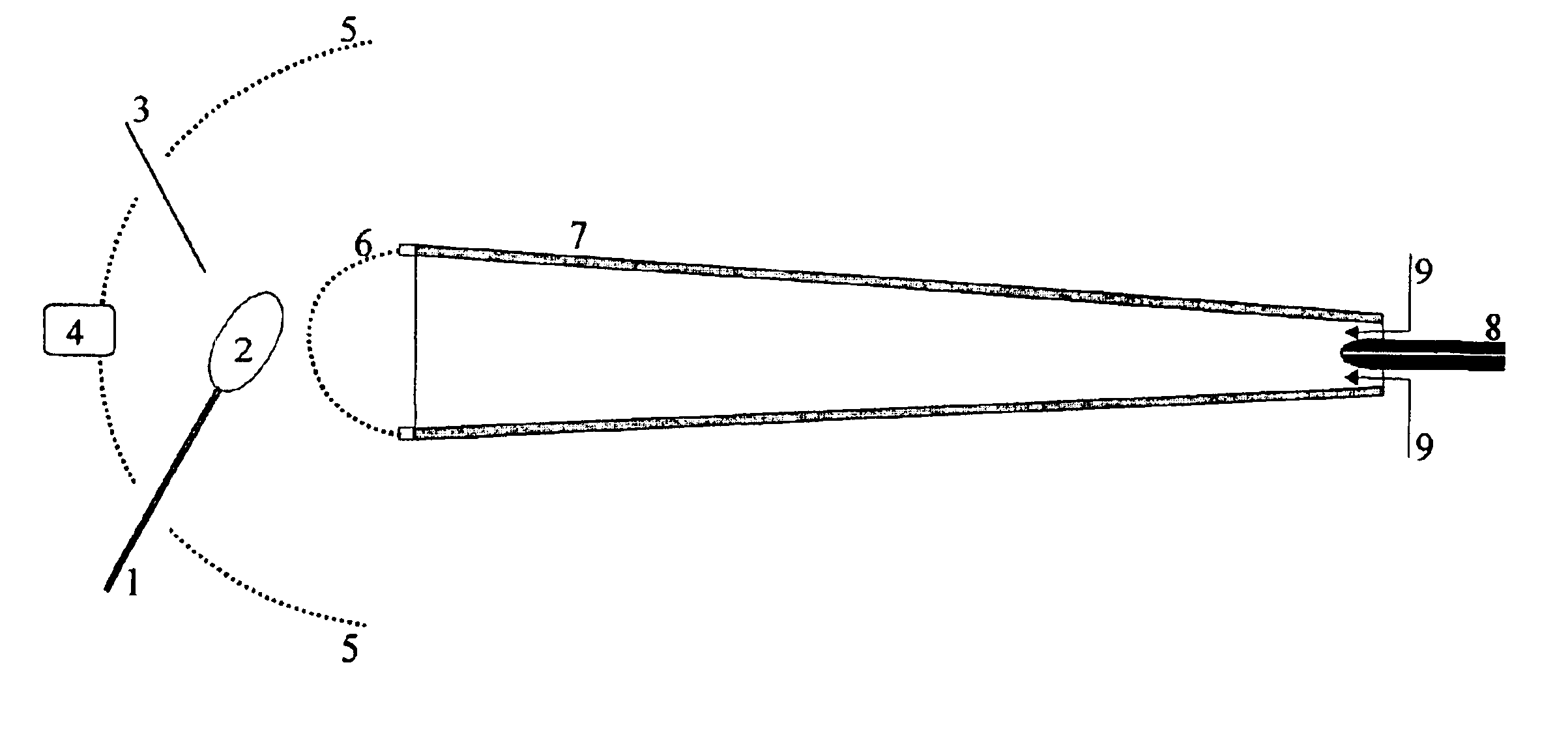
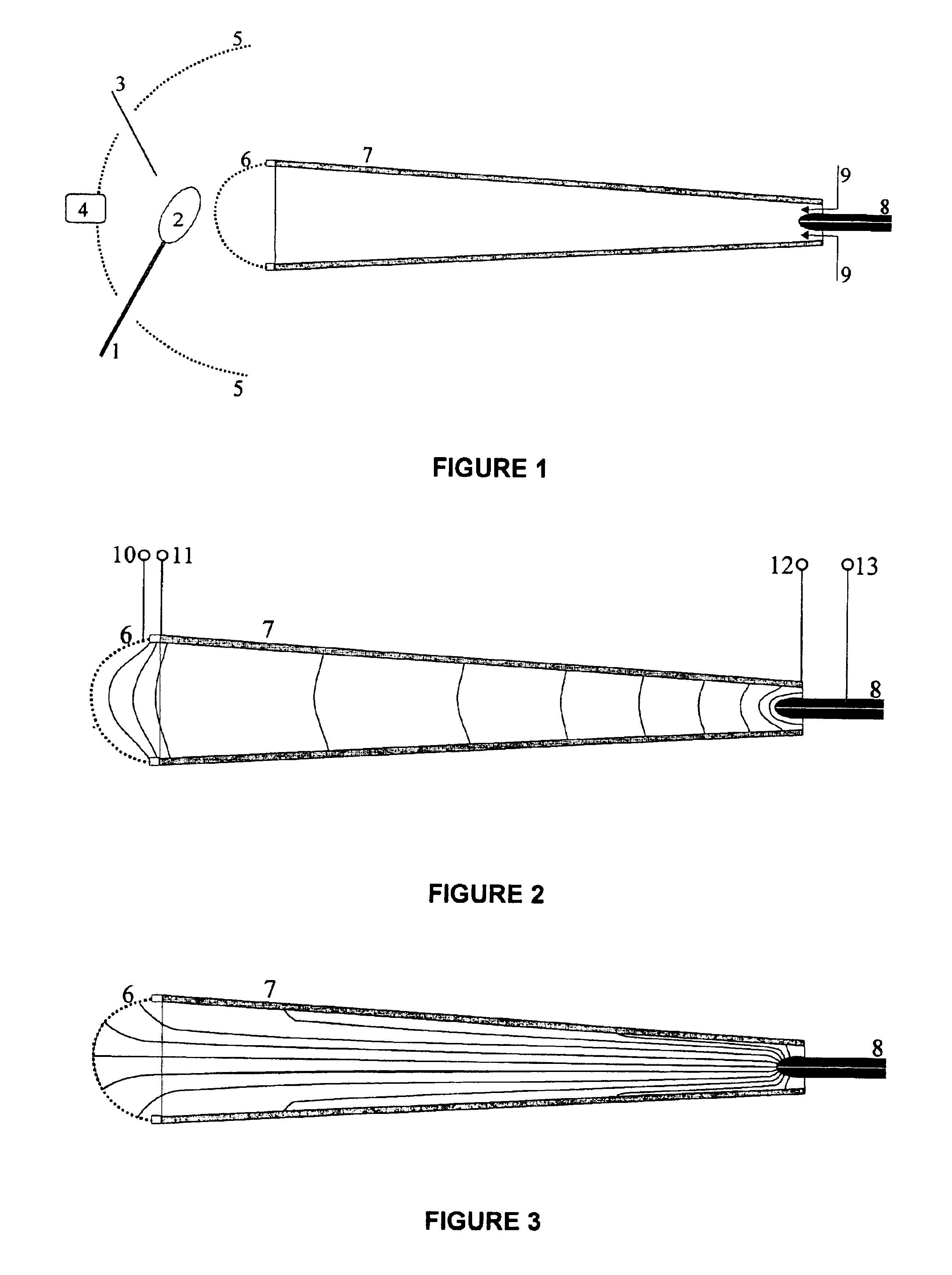
[0036]A favorable embodiment for the ion guidance arrangement with ion generation by a spray method at atmospheric pressure is shown in FIGS. 1 to 3.
[0037]The spray capillary (1) produces a droplet cloud (2) which, in this case, represents the ionization cloud containing charged particles. The charged particles may be generated solely by electrospraying, or by additional means. An optional corona needle (3) is able to provide additional primary ions for chemical ionization of analyte molecules and droplets inside the ionization cloud. A UV lamp (4), which is also optional, can be switched on for photoionization. A voltage can be applied to the grid-shaped electrode (5) in this figure to produce the potential difference necessary for electrospraying at the tip of the spray capillary (1). Charged droplets and ions formed in the ionization cloud (2) in front of the spray capillary (1) are pulled by a weak electric field between the grid electrodes (5) and (6) towards the hemispherical,...
PUM
 Login to View More
 Abstract
Description
Claims
Application Information
 Login to View More