

Hydrophobic coatings and methods
a technology of hydrophobic coating and coating, applied in the direction of coating, transportation and packaging, chemical instruments and processes, etc., can solve the problem of particularly hazardous chlorinated solvents
Inactive Publication Date: 2007-08-28
GUARDIAN GLASS LLC
View PDF8 Cites 20 Cited by
- Summary
- Abstract
- Description
- Claims
- Application Information
AI Technical Summary
Benefits of technology
The patent text describes various methods for making glass with a hydrophobic surface, which can be useful in applications where the surface needs to be water-repellant. The methods involve coating the glass with a layer of a chloroalkylsilane or a fluoroalkylsilane, or using a SiOx-containing anchor layer and a hydrophobic capping layer. These coatings provide improved hydrophobicity and durability, but there are also drawbacks such as the need for a solvent and the potential for environmental hazards. The patent text also mentions the use of certain compounds, such as octadecyltrichlorosilane and toluene, for achieving a high degree of hydrophobicity. The technical effects of the patent text are improved hydrophobicity and durability of glass surfaces, as well as the ability to protect against water sheeting and ice formation.
Problems solved by technology
Those skilled in the art will recognize, however, that toluene and other solvents such as benzene are hazardous volatile compounds that require care to avoid environmental issues.
In addition, chlorinated solvents are particularly hazardous from a human health perspective and the workspace must be carefully controlled to avoid excessive human exposure.
Method used
the structure of the environmentally friendly knitted fabric provided by the present invention; figure 2 Flow chart of the yarn wrapping machine for environmentally friendly knitted fabrics and storage devices; image 3 Is the parameter map of the yarn covering machine
View moreImage
Smart Image Click on the blue labels to locate them in the text.
Smart ImageViewing Examples

Examples
Experimental program
Comparison scheme
Effect test
example
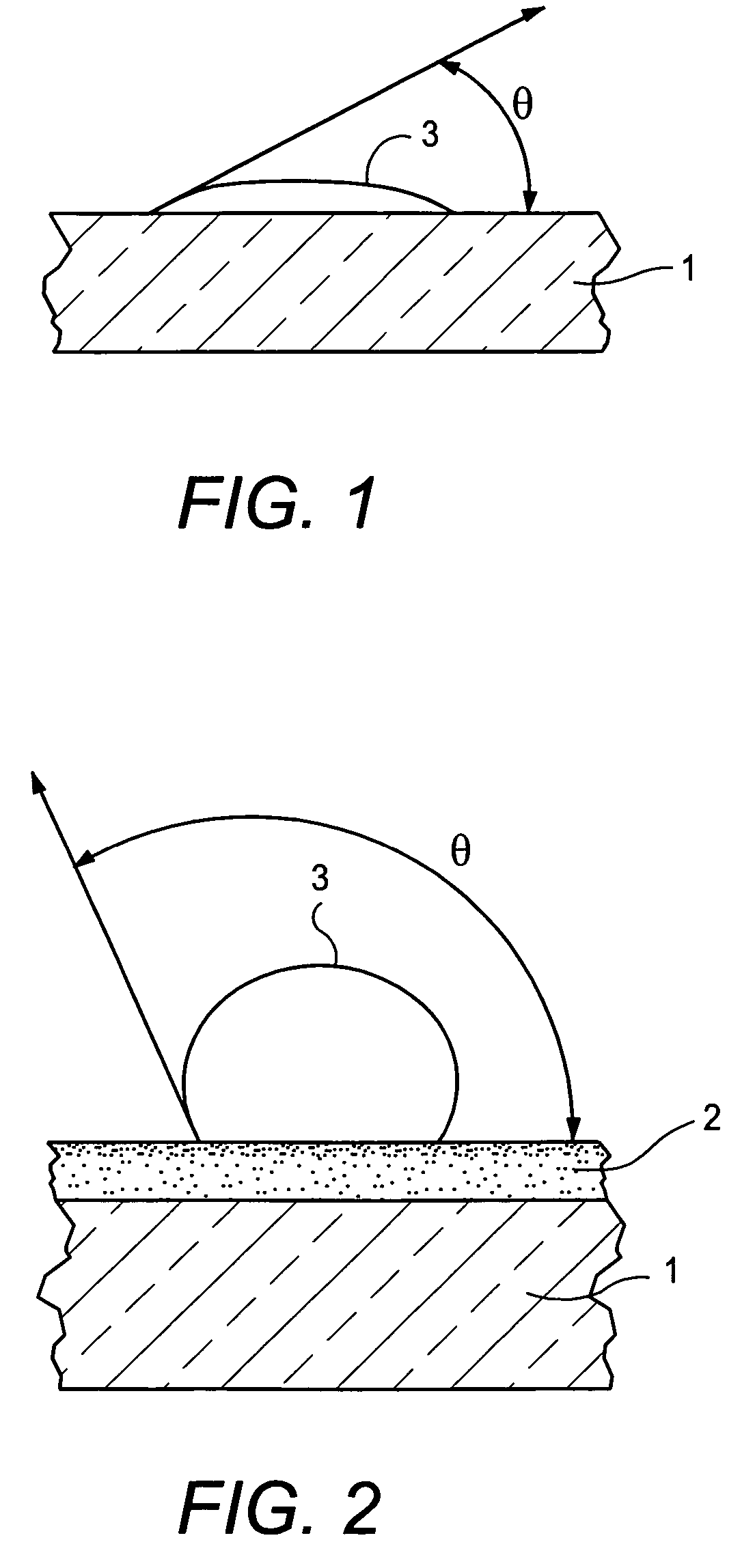
[0022]OTS was dissolved in a paraffinic solvent (Norpar™ 15 Fluid, ExxonMobile Chemical Company) at a concentration of 0.1 molar (0.387 g per 10 mL of solution). The solution was applied to a lab wipe on the surface of the glass substrate to be coated. The lab-wipe was saturated with the solution and allowed to remain in contact with the glass surface for a period of 10 minutes. The lab-wipe served the purpose of preventing the solution from de-wetting the glass surface so as to maintain an optimum interaction with the glass surface during coating. A self-assembled monolayer (SAM) of the OTS was formed on the glass surface.
the structure of the environmentally friendly knitted fabric provided by the present invention; figure 2 Flow chart of the yarn wrapping machine for environmentally friendly knitted fabrics and storage devices; image 3 Is the parameter map of the yarn covering machine
Login to View More PUM
| Property | Measurement | Unit |
|---|---|---|
| boiling point | aaaaa | aaaaa |
| boiling point | aaaaa | aaaaa |
| boiling point | aaaaa | aaaaa |
Login to View More
Abstract
Liquid coating solutions impart hydrophobicity to substrate surfaces (e.g., glass) and include a silane, preferably octadecyltrichlorosilane (OTS), dissolved in a liquid paraffinic solvent. Preferred liquid paraffinic solvents are normal (straight chain) liquid parrafins having between 10 to 20 carbon atoms per molecule exhibiting flash points (ASTM D93) of between about 70° C. to about 160° C., and initial boiling points (ASTM D86) of between about 185° C. to about 300° C. The OTS will be present in the hydrophobic solutions in amounts sufficient to form a hydrophobic coating on surfaces of substrates on which the solutions are applied, and most preferably will be present in amounts ranging between about 0.25 to about 2.5 molar. Applying a coating of the solution onto a substrate surface will allow the OTS for form a self-assembled monolayer thereon imparting hydrophobicity to the substrate as determined by a high contact angle of at least about 100°.
Description
FIELD OF THE INVENTION[0001]The present invention relates generally to coated substrates and methods of coating the same. In preferred embodiments, the present invention relates to transparent substrates having a hydrophobic (water repellant) coating thereon.BACKGROUND AND SUMMARY OF THE INVENTION[0002]Glass is typically made of silicates that are melted to form a clear, transparent, solid material. The fundamental molecular structural unit of conventional glass is a SiO44− tetrahedron. Ordinary float glass (named for its production process whereby a molten ribbon of glass is floated on molten metal to provide a smooth surface) includes additional amounts of soda (Na2O), usually in the form of sodium carbonate or nitrate during the production process, lime (CaO) and other oxides (usually aluminum and magnesium oxides) to form a soda-lime-silica structure known colloquially as soda-lime glass. Other specialized glass can be prepared by the introduction of other additives and constitu...
Claims
the structure of the environmentally friendly knitted fabric provided by the present invention; figure 2 Flow chart of the yarn wrapping machine for environmentally friendly knitted fabrics and storage devices; image 3 Is the parameter map of the yarn covering machine
Login to View More Application Information
Patent Timeline
 Login to View More
 Patent Type & AuthorityPatents(United States)
IPC IPC(8): C09D183/04
CPCB82Y30/00B82Y40/00C03C17/30C09D4/00C08G77/24Y10T428/31612Y10T428/31663
InventorLUTEN, HENRY A.BOHLAND, JOHN R.
OwnerGUARDIAN GLASS LLC