Unlock instant, AI-driven research and patent intelligence for your innovation.

Bus performance evaluation method for algorithm description

a performance evaluation and algorithm technology, applied in the field of verification of algorithms, can solve the problems of reducing the simulation speed of cooperative verification, difficult verification to perform using the foregoing boards, and troublesome system verification for manufacturers, so as to reduce the overall turnaround time of design, reduce turnaround time, and reduce the overall turnaround time

Inactive Publication Date: 2008-04-29
NEC ELECTRONICS CORP
View PDF8 Cites 11 Cited by
  • Summary
  • Abstract
  • Description
  • Claims
  • Application Information

AI Technical Summary

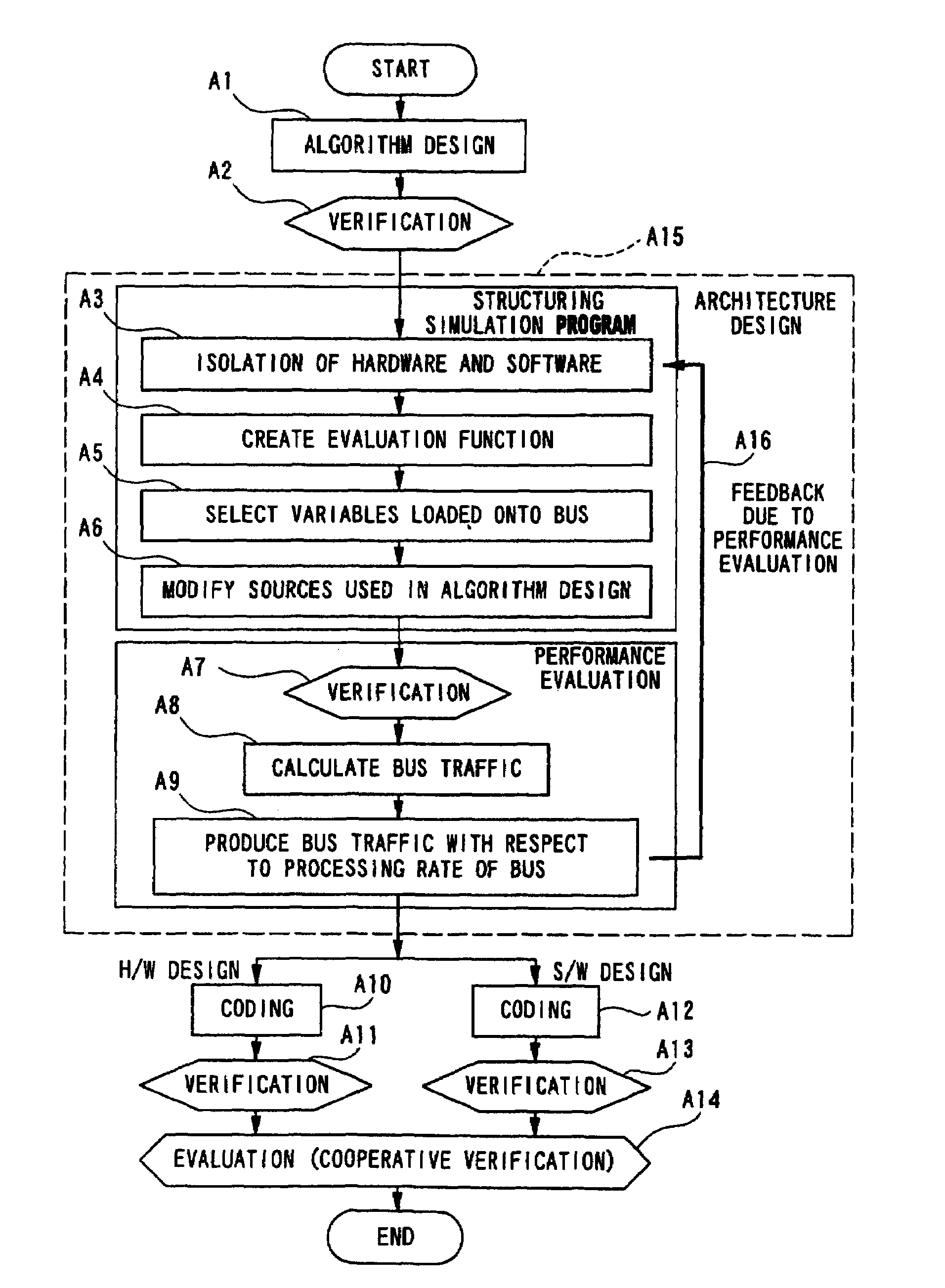
Benefits of technology

[0011]It is an object of the invention to provide a bus performance evaluation method for algorithm description by which it is possible to considerably reduce turnaround times in design of LSI by excluding unwanted operations between hardware and software through feedback loops derived from cooperative verification in the hardware design and software design. According to an aspect of the invention, these provide a method as defined in independent claim 11. Basically, this invention provides improvements in procedures for the design and development of LSI. That is, after isolation of the hardware and software being effected with respect to hardware and software sources described by the general purpose high-level language in algorithm design, an evaluation function is created to count traffic of the bus interconnecting elements to be implemented in hardware and / or in software. The sources are modified such that the evaluation function is performed every time data (e.g., a variable) is loaded onto the bus. Then, evaluation is performed on the performance of the bus having a processing rate. Based on the bus traffic that is finally produced with respect to the processing rate, isolation of the hardware and software is optimally performed at a simulation stage of the architecture design. Thus, it is possible to exclude the conventional feedback loops regarding the isolation between the hardware and software from the cooperative final verification after the actual coding. As a result, it is possible to considerably reduce the turnaround time in the design of LSI.
[0012]More specifically, the LSI design and development in manufacture is actualized by algorithm design, architecture design, actual hardware and software design, and verification. Herein, the architecture design contains a simulation platform structuring process and a bus performance evaluation process, which are interconnected by a feedback loop. In the algorithm design, sources are described by the general purpose high-level language such as the C language and C++ language. In the simulation platform structunng process, the sources are subjected to isolation of the hardware and software, while an evaluation function is created to count bus traffic of the bus interconnecting the hardware and software. Every time data is written to a pre-defined variable loaded onto the bus, the evaluation function is performed to modify the sources. Then, evaluation is performed on the performance of the bus, so that the bus traffic for its processing rate is finally produced. That is, result of the bus performance evaluation process is fed back to the simulation platform structuring process such that isolation of the hardware and software is optimized in response to the bus traffic for the processing rate of the bus. This results in more efficient isolation between hardware and software elements so that hardware and software cooperative verification may be performed without constantly designating hardware and software elements, so it is possible to considerably reduce overall turnaround time of design.

Problems solved by technology

However, it is troublesome for manufacturers to perform verification on the systems by using the specifically designed LSI devices.
Actually, the recent developments raise a difficulty in which verification is difficult to perform using the foregoing boards.
This causes considerable reduction in simulation speed of the cooperative verification on descriptions using the HDL or other programming languages each having a CPU dependency.
In practice, it becomes very difficult to perform the architecture design using the cooperative verification.
Due to increasing numbers of lines of codes to describe the circuits to be created, circuit descriptions must become more and more complicated, which in turn cause complexity in modifications of the circuit descriptions.
That is, it takes much time and cost to perform operations regarding feedback loops being derived from results of the cooperative verification.

Method used

the structure of the environmentally friendly knitted fabric provided by the present invention; figure 2 Flow chart of the yarn wrapping machine for environmentally friendly knitted fabrics and storage devices; image 3 Is the parameter map of the yarn covering machine
View more

Image

Smart Image Click on the blue labels to locate them in the text.
Viewing Examples
Smart Image
  • Bus performance evaluation method for algorithm description
  • Bus performance evaluation method for algorithm description
  • Bus performance evaluation method for algorithm description

Examples

Experimental program
Comparison scheme
Effect test

first embodiment

[0034]FIG. 2 shows a list form representing a bus performance evaluation method in accordance with the invention. With reference to FIG. 2, there are provided three variables, namely ‘a’, ‘b’ and ‘c’ being loaded onto the evaluated bus, wherein all of the variables are subjected to global definition. In addition, there are provided an evaluation function ‘BUS0( )’ and a local variableBus0( )’. Herein, the evaluation function increments a static variable i to provide a return value. The local variable bus0 stores the return value from the evaluation function BUS0( ). Namely, it represents a number of times in effecting data transfer on the evaluated bus. The same number of bits are set to binary representations of the three variables a, b, c being loaded onto the evaluated bus. Herein, the number of bits of each variable is smaller than the number of bit lines (or bits) of the evaluated bus.

[0035]The first embodiment shown in FIG. 2 is designed to certainly execute the evaluation f...

second embodiment

[0045]FIG. 5 shows the bus performance evaluation method of the second embodiment that has three variables a, b and c, which are loaded on the evaluated bus and all of which are locally defined. In addition, there are provided an evaluation function BUS0( ) and a local variable Bus0( ). The evaluation function increments a static variable i to provide a return value. The local variable Bus0( ) stores the return value from the evaluation function BUS0( ). That is, it represents a number of times in effecting data transfer on the evaluated bus.

[0046]All of the variables a, b and c consist of the same number of bits, which is smaller than a number of lines (or bits) of the evaluated bus. A main difference between the first embodiment of FIG. 2 and the second embodiment of FIG. 5 lies in manners of definition of the variables, that is, the variables loaded onto the evaluated bus are not defined globally but defined locally in FIG. 5. To perform performance evaluation on the bus, bus tra...

third embodiment

[0048]FIG. 6 shows the bus performance evaluation method of the third embodiment that has three variables a, b and c, which are loaded onto the evaluated bus and all of which are defined globally. In addition, there are provided an evaluation function BUS0( ) and a local variable bus0( ). Herein, the evaluation function increments a static variable i to provide a return value. The local variable bus0( ) stores the return value from the evaluation function BUS0( ). That is, it represents a number of times in effecting data transfer on the evaluated bus.

[0049]All of the variables a, b and c consist of the same number of bits, which is smaller than a number of lines (or bits) of the evaluated bus. A main difference between the first embodiment of FIG. 2 and the third embodiment of FIG. 6 lies in manners of embedding of the evaluation function BUS0( ), that is, the evaluation function is embedded just before the variables to which data are written respectively. Thus, the evaluation func...

the structure of the environmentally friendly knitted fabric provided by the present invention; figure 2 Flow chart of the yarn wrapping machine for environmentally friendly knitted fabrics and storage devices; image 3 Is the parameter map of the yarn covering machine
Login to View More

PUM

No PUM Login to View More

Abstract

The LSI design and development in manufacture is actualized by algorithm design, architecture design, actual hardware and software design, and verification. Herein, the architecture design contains a simulation program structuring process and a bus performance evaluation process, which are interconnected by a feedback loop. In the algorithm design, sources are described by the general-purpose high-level language such as the C language and C++ language. In the simulation program structuring process, the sources are subjected to isolation of the hardware and software, while an evaluation function is created to count bus traffic of the bus interconnecting the hardware and software. Every time data is written to a pre-defined variable loaded onto the bus, the evaluation function is performed to modify the sources. Then, evaluation is performed on the performance of the bus, so that the bus traffic for its processing rate is finally produced. That is, the result of the bus performance evaluation process is fed back to the simulation program structuring process such that isolation of the hardware and software is optimized in response to the bus traffic for the processing rate of the bus. This brings exclusion of feedback loops derived from the cooperative verification after the actual coding, so it is possible to considerably reduce overall turnaround time of design.

Description

BACKGROUND OF THE INVENTION[0001]1. Field of the Invention[0002]This invention is provided for verification of algorithms in order to facilitate architecture designs at high-level stages of design. Specifically, this invention relates to bus performance evaluation methods for algorithm descriptions in which evaluation is performed on performances of buses interconnecting between the hardware and software by use of sources described by general purpose high-level languages such as the C language and C++ language.[0003]2. Description of the Related Art[0004]Due to the recent developments of the semiconductor technologies, there are tendencies for the physical hardware system to be frequently actualized by a single LSI chip rather than by plural LSI chips arranged on boards. For this reason, signals of the LSI chips that are conventionally interconnected with external terminals are translated to internal signals and are incorporated within the LSI chips in these days. To verify the conv...

Claims

the structure of the environmentally friendly knitted fabric provided by the present invention; figure 2 Flow chart of the yarn wrapping machine for environmentally friendly knitted fabrics and storage devices; image 3 Is the parameter map of the yarn covering machine
Login to View More

Application Information

Patent Timeline
no application Login to View More
IPC IPC(8): G06F17/50G06F11/34G06F13/00
CPCG06F11/349G06F17/5022G06F30/33
Inventor ARAYA, YASUTERUMARUYAMA, YUICHI
Owner NEC ELECTRONICS CORP