While
atomic layer deposition (ALD) and atomic-scale epitaxial growth techniques have been developed, the methods for controlled removal of one or several atomic layers are still limited.
For instance, it cannot be applied to other materials of the IC device, such as
silicon dioxide.
Furthermore,
sputtering during the
desorption step is often damaging to the
wafer components since it involves bombardment of the
wafer surface with high-energy species.
As in the case of silicon ALET, the described
chemistry is not widely applicable.
The method also necessarily involves
irradiation with high-energy ions, which may be damaging to the
wafer.
None of the described above methods is applicable to
etching of SiO2 on an atomic scale.
It also is inadvertently formed on the layers of silicon when the partially fabricated wafer is exposed to air.
Native
oxide film together with
oxide residue produced during etching and / or
ashing frequently presents a problem for further
processing steps.
This requirement limits the number of practically feasible pre-clean methods to
dry etching processes, which will be discussed further.
It should be understood, that none of these methods can accomplish a well controlled removal of one or several atomic layers of
silicon dioxide.
All of the methods described below remove bulk amounts of
silicon dioxide and are poorly controlled at an atomic level.
This method, however, is rarely used due to corrosive properties of HF / H2O mixtures, which may damage the process chamber.
These CVD-type processes are not well suited to accurately control the thickness of a layer to be removed and cannot be applied for removal of defined amounts of material on an atomic scale.
Although in some cases the amount of deposited etchant can be controlled by the use of microbalance, it is not possible to achieve accurate atomic layer control over
material removal by these types of methods.
Thus an uncontrolled amount of etchant is brought into contact with the on the wafer surface.
Although this proposed method may provide some fine control over the etching process, it is laborious and imprecise due to difficulties in QCM calibration.
The CVD-type etchant deposition processes are poorly controlled at an atomic level.
These methods are also not well suited for etching relatively small amounts of material, particularly from the high
aspect ratio features of the substrate.
While these methods sometimes work adequately in the substrates with low
aspect ratio features, they do not provide highly conformal and uniform etchant film coverage needed for removal of material from high
aspect ratio recesses.
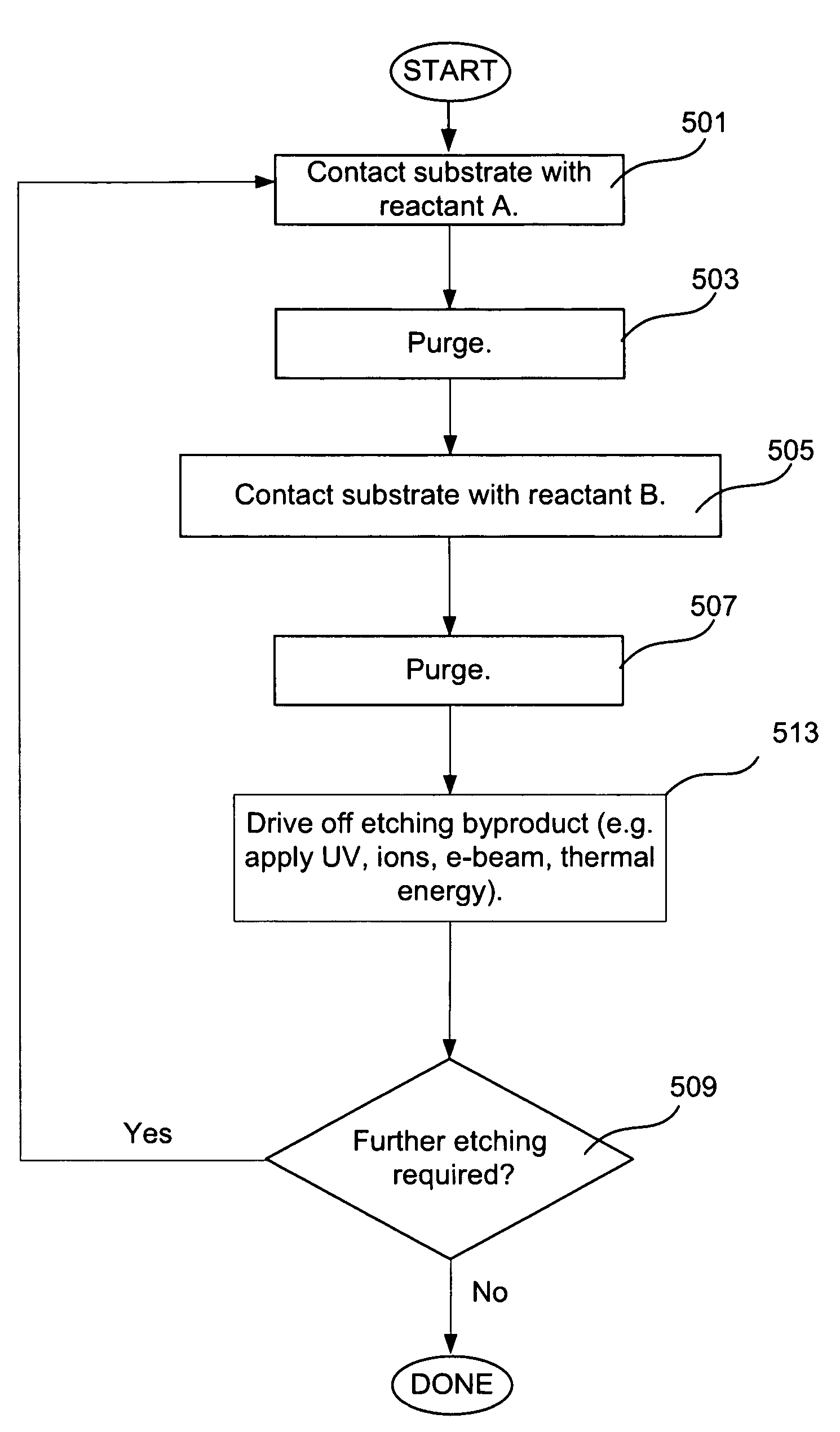
The amount of deposited etchant, and, consequently, the amount of etched material is limited by the amount of adsorbed first reactant.


 Login to View More
  Login to View More