Detection and classification of heavy hydrocarbon contamination in refinery process streams via spectrofluorometry

a technology of heavy hydrocarbon contamination and refinery process, which is applied in the direction of fluorescence/phosphorescence, instruments, material analysis, etc., can solve the problems of lack of specificity to determine the type of contaminant, lack of sensitivity to detect contaminants at low concentrations, and time-consuming and relatively expensive tests

a technology of heavy hydrocarbon contamination and refinery process, which is applied in the direction of fluorescence/phosphorescence, instruments, material analysis, etc., can solve the problems of lack of specificity to determine the type of contaminant, lack of sensitivity to detect contaminants at low concentrations, and time-consuming and relatively expensive tests

US7501285B1Active Publication Date: 2009-03-10MARATHON PETROLEUM

Image

Smart Image Click on the blue labels to locate them in the text.
Viewing Examples
Smart Image
  • Detection and classification of heavy hydrocarbon contamination in refinery process streams via spectrofluorometry
  • Detection and classification of heavy hydrocarbon contamination in refinery process streams via spectrofluorometry
  • Detection and classification of heavy hydrocarbon contamination in refinery process streams via spectrofluorometry

Examples

Experimental program
Comparison scheme
Effect test

examples

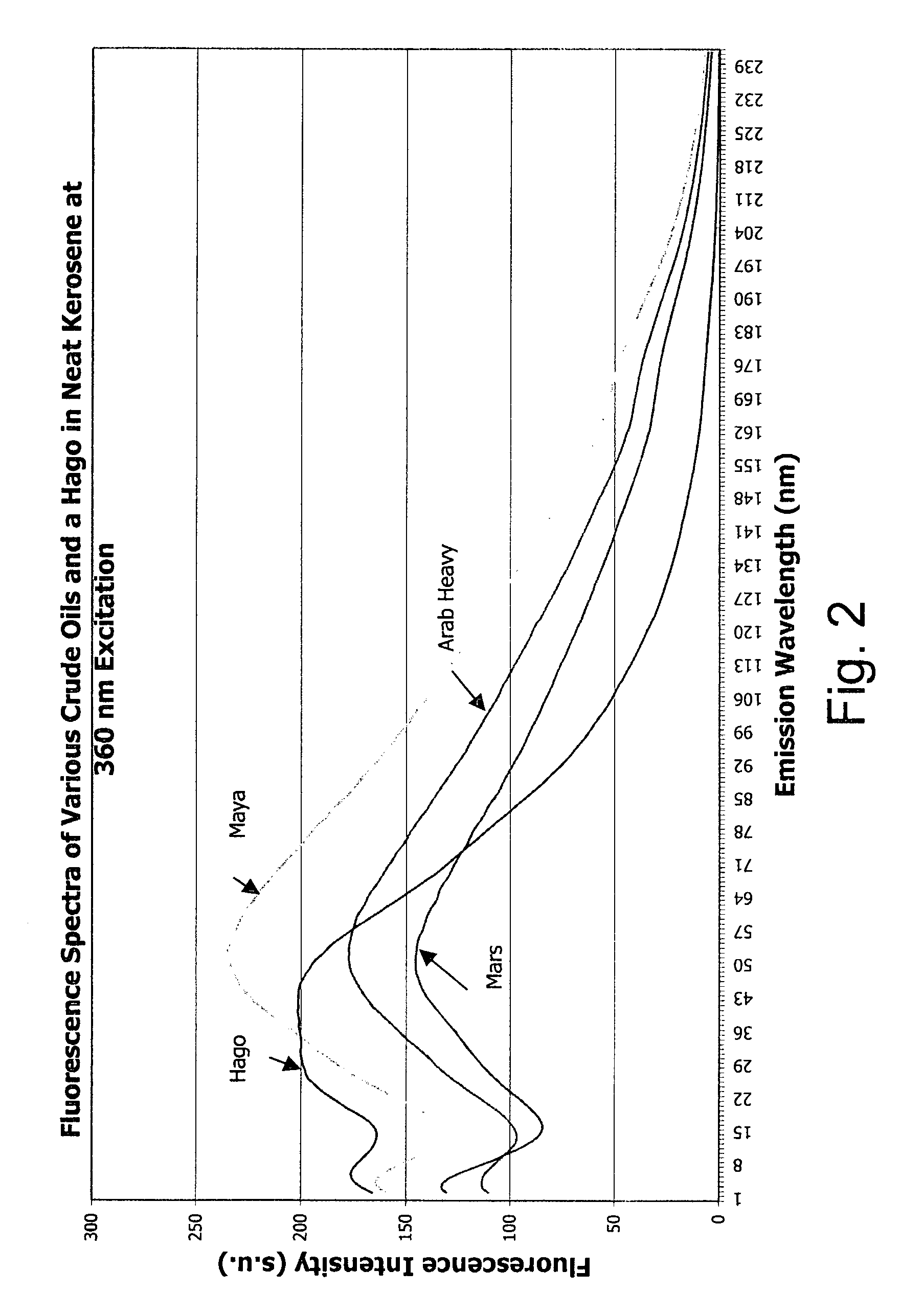
[0055]Spectra of fluorescence intensity versus emission wavelength for various types of crude oils (Maya, Mars, Arab Heavy) and Hago (heavy atmospheric gas oil) in neat kerosene (kero) were obtained, as shown in FIG. 1

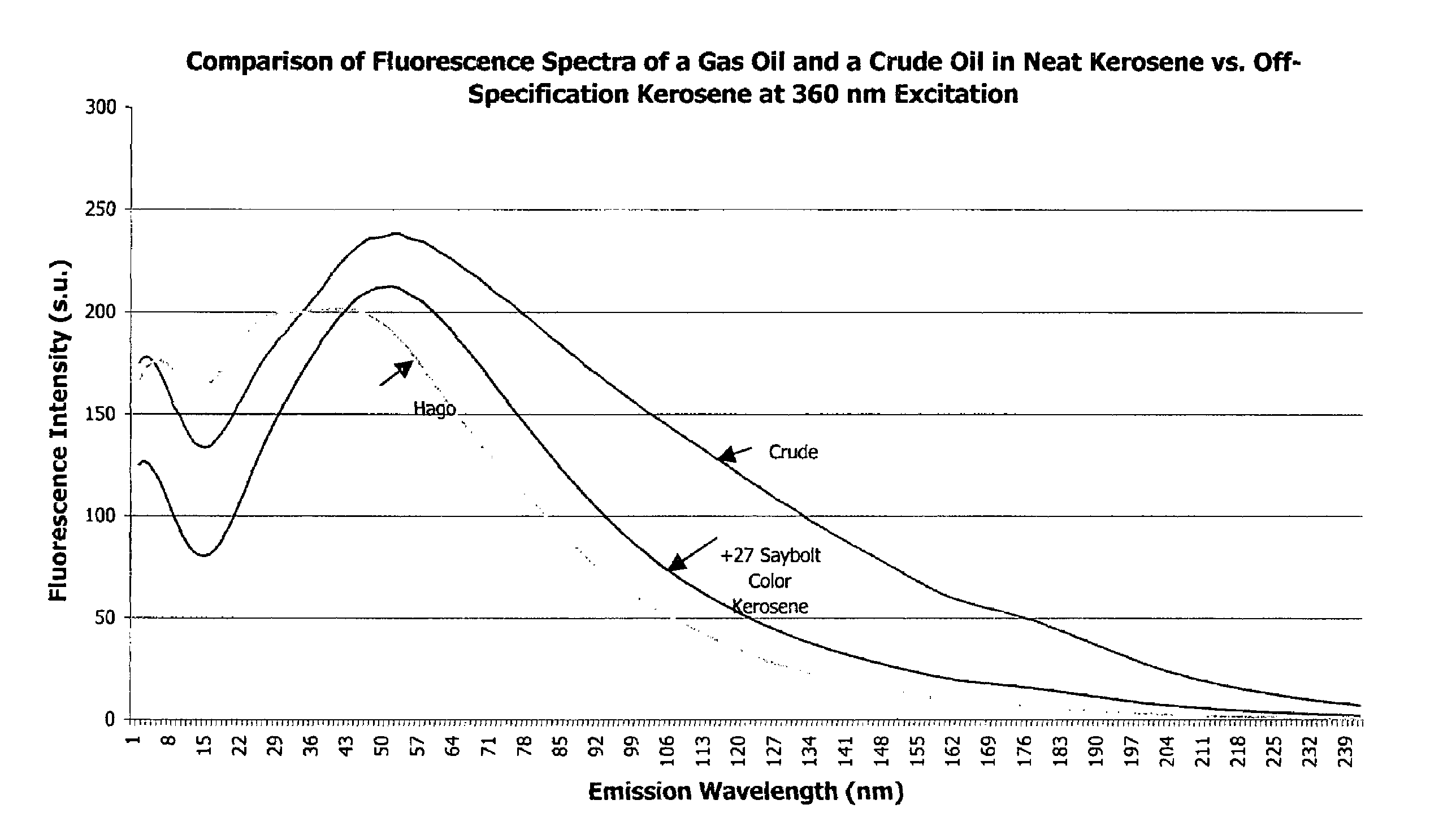
[0056]Spectra of fluorescence intensity versus emission wavelength for a gas oil and a crude oil in kerosene were obtained and compared to off-specification kerosene, as shown in FIG. 2

[0057]Accordingly, the invention, in another embodiment, relates to a process for determining the concentration and changes in concentrations over time of one or more heavy hydrocarbons in a specified sample using spectrofluorometry. The spectrofluorometric data from the sample is collected, transferred, and transformed into data corresponding to the chemical composition of the components of the sample and concentration of said components. The concentrations of one or more heavy hydrocarbons present are then determined by processing the data from the sample according to predetermined mod...

the structure of the environmentally friendly knitted fabric provided by the present invention; figure 2 Flow chart of the yarn wrapping machine for environmentally friendly knitted fabrics and storage devices; image 3 Is the parameter map of the yarn covering machine
Login to View More

PUM

PropertyMeasurementUnit
wavelength rangeaaaaaaaaaa
Boiling Pointaaaaaaaaaa
viscosityaaaaaaaaaa
Login to View More

Abstract

A method and apparatus for determining the presence of heavy hydrocarbons (including those from unprocessed crude oil) in distillate streams and / or reformer feed includes taking at least one sample, spectrally analyzing the at least one sample for at least one heavy hydrocarbon component, determining the concentration of the analyzed hydrocarbon component using the spectrally determined concentration in an appropriate mathematical model, and determining the total heavy hydrocarbon concentration from the determined values for each sample.

Description

BACKGROUND OF THE INVENTION[0001]I. Field of the Invention[0002]The present invention relates to a method for the detection and classification by type of heavy hydrocarbon contaminants in petroleum refinery process streams using spectrofluorometry.[0003]II. Description of the Prior Art[0004]There are numerous, industry-accepted test methods for the analysis of physical and chemical properties of hydrocarbons which, alone or in combination, have been used to detect the presence of hydrocarbon contaminants in various refinery process streams and / or to classify them as to type. These methods have been approved by organizations such as ASTM (American Society for Testing Materials), IP (Institute of Petroleum, United Kingdom), and DIN (Deutsches Institut fur Normung, Germany), as well as private companies which provide analytical instrumentation or which license processes to refineries. These would include methods such as: ASTM D-86 distillation temperatures at various percentages distil...

Claims

the structure of the environmentally friendly knitted fabric provided by the present invention; figure 2 Flow chart of the yarn wrapping machine for environmentally friendly knitted fabrics and storage devices; image 3 Is the parameter map of the yarn covering machine
Login to View More

Application Information

Patent Timeline
10 Mar 2009
Publication
US7501285B1
IPC
G01N33/00
CPC
G01N21/64; Y10T436/21
Inventors
TRICHE, NICOLE R.; LUBECK, AXEL J.