Advances in
processing technology and demands for greater complexity at reduced cost and power-consumption points have lead to continual increases in densities.
Another
side effect of process advancement is the faster scaling of
cell internal
delay than the interconnect
delay, making accurate analysis of interconnect
delay important.
Noise faults may manifest themselves as functional
noise faults, or glitches, in which victim nets take incorrect values.
Thus, the
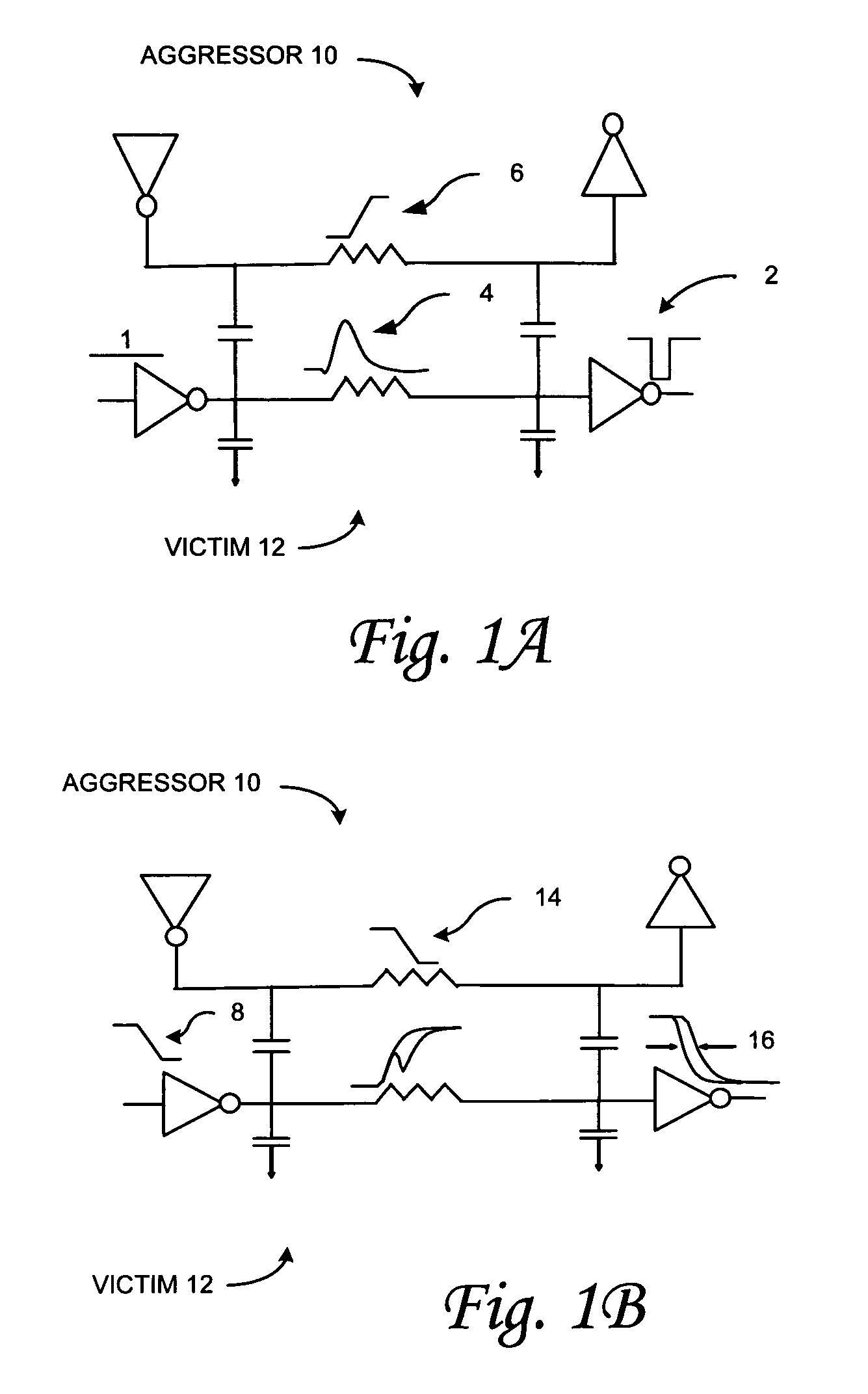
crosstalk can have two major effects in modern digital circuits: (i) it can cause a strong
glitch on a logically static signal, which may lead to functional fault if the glitch is sampled, and (ii) it can
impact arrival time of a
signal transition by speeding it up or slowing it down.
Determination of delay in the presence of aggressor-induced
noise is a challenging task due to factors such as, (i) delay being sensitive to aggressor / victim alignment, (ii) linear models for switching drivers potentially being inaccurate due to drastic variation of impedance during transition, (iii)
effective capacitance principle requiring modification (See, F. Dartu et al, supra), and (iv) waveforms potentially becoming nonmonotonic in the presence of
noise, making the conventional metric of delay measurement non-robust.
However, optimization in a
multidimensional space of aggressor alignments with each iteration requiring
simulation of a nonlinear circuit can be prohibitively expensive.
The
crosstalk delay analysis task is further complicated by the potential for a unique waveform response of each
receiver of a victim net to a given input transition, such that a WC aggressor alignment for one
receiver may not be the same for another.
Another challenge with analyzing a crosstalk induced delay change arises from the potential for crosstalk to distort a victim switching waveform.
A distorted waveform may deviate from the input waveforms used in delay characterization of a receiving gate, resulting in inaccuracy in slew dependent delays in a downstream logic cone.
If the crosstalk
impact is severe, the victim waveform may even become non-monotonic (bumpy), the effect of which may not be properly modeled in existing gate delay systems.
This approach is believed to be too conservative and inaccurate to be successfully used for modern design constraints.
However, since the noise wave was computed for a quiet victim driver and not a switching one, the alignment used in the mentioned studies could be inaccurate.
However, there is no teaching of how such current model is to be integrated in a flow of crosstalk delay
change analysis.
Unfortunately, the non-monotonic waveforms of FIG. 3A result in a ‘
cliff’ in the curve of FIG. 3B methodology.
This prior methodology is not robust because even a relatively small change in a circuit parameter (e.g., driver size, supply
voltage, etc) and / or aggressor alignment on a particular victim net can result in a disproportionate change in measured victim
signal delay due to such
cliff.
Both forms of
signal integrity analysis can be computationally costly, and often affect the time-to-market characteristics of design methodology.
The most expensive parts of a
signal integrity analysis tend to be (i) RC reduction and (ii) solving the reduced network.
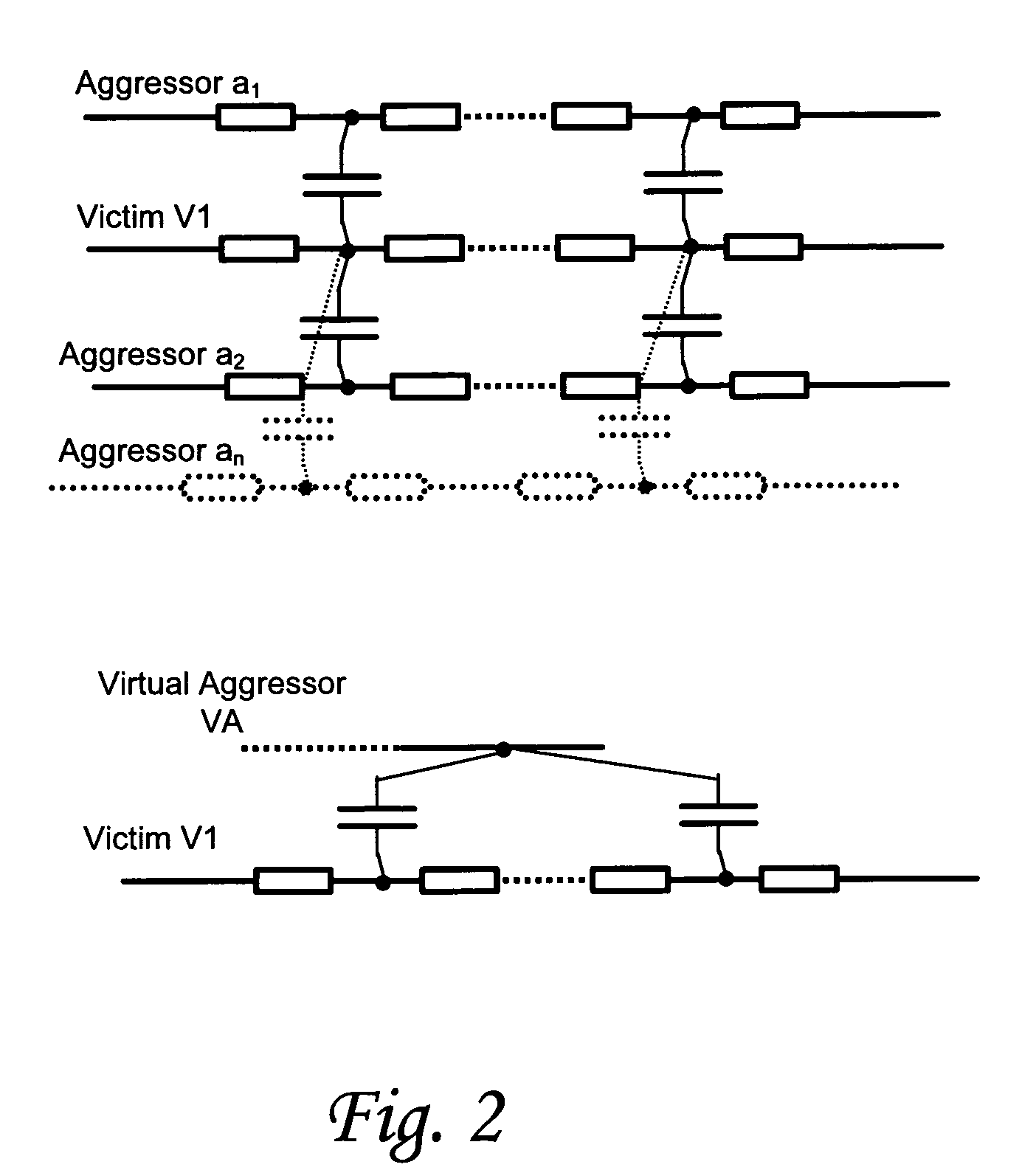
At the same time, the initial implementation of VA in CeltIC suffered from several significant drawbacks resulting in additional inaccuracy of the analysis.
Because the timing restrictions on transitions on the aggressor nets can limit the
impact an aggressor has on the victim, conventional virtual aggressor methodologies apply timing window limitations to the capacitive modification process.
However, because timing window limitations are calculated in advance, they do not take into account the dynamic nature of such limitations.
As such, they can become overly pessimistic and expensive.


 Login to View More
  Login to View More