
Oligonucleotide analogues
a tricyclic nucleoside and analogue technology, applied in the field of oligonucleotide analogues, can solve the problems of pursuing conformationally restricted nucleosides, limiting the practical usefulness of triple helix forming oligomers, and unable to meet the requirements of oligonucleotide synthesis,
- Summary
- Abstract
- Description
- Claims
- Application Information
AI Technical Summary
Benefits of technology
Problems solved by technology
Method used
Image

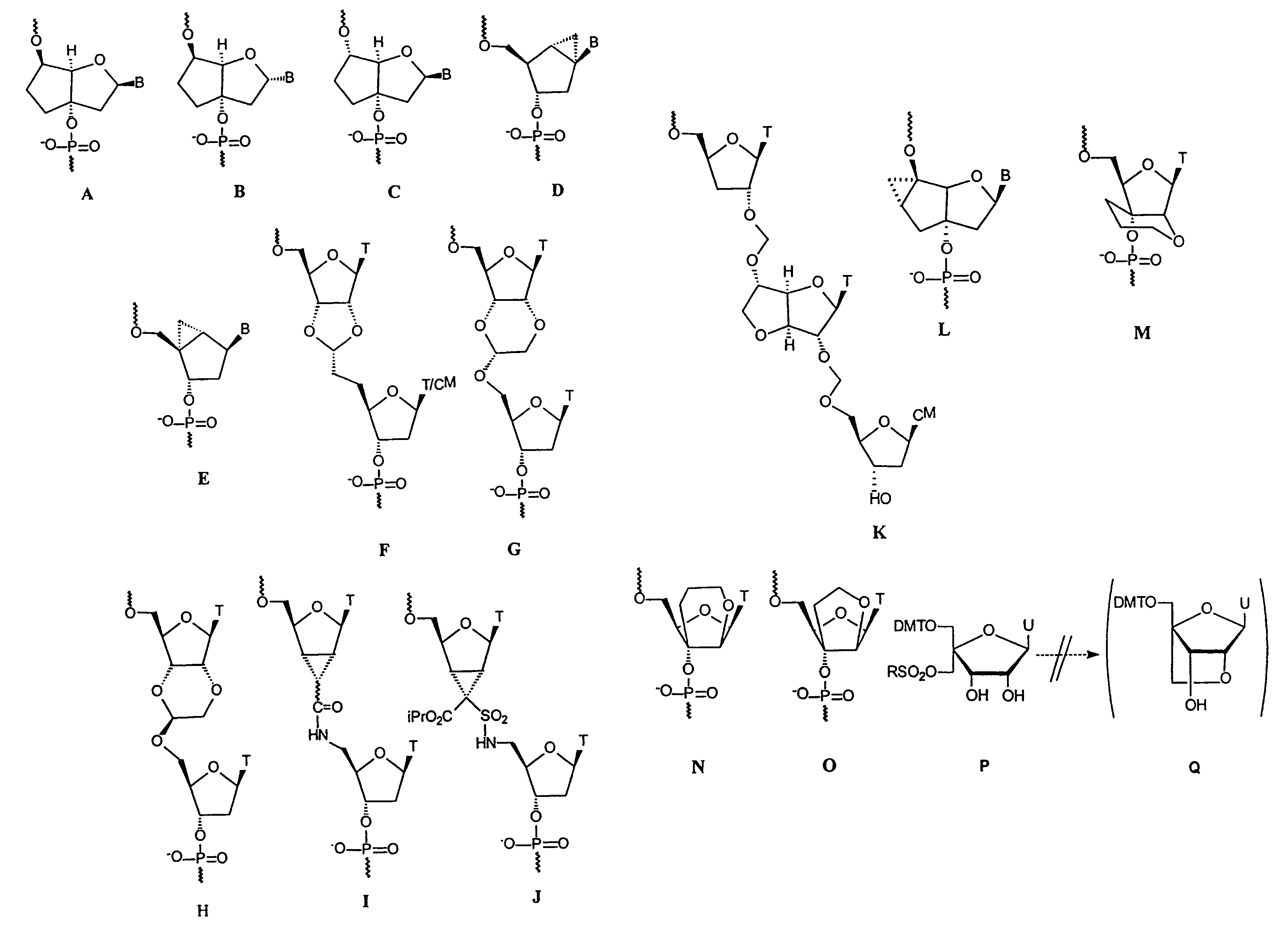
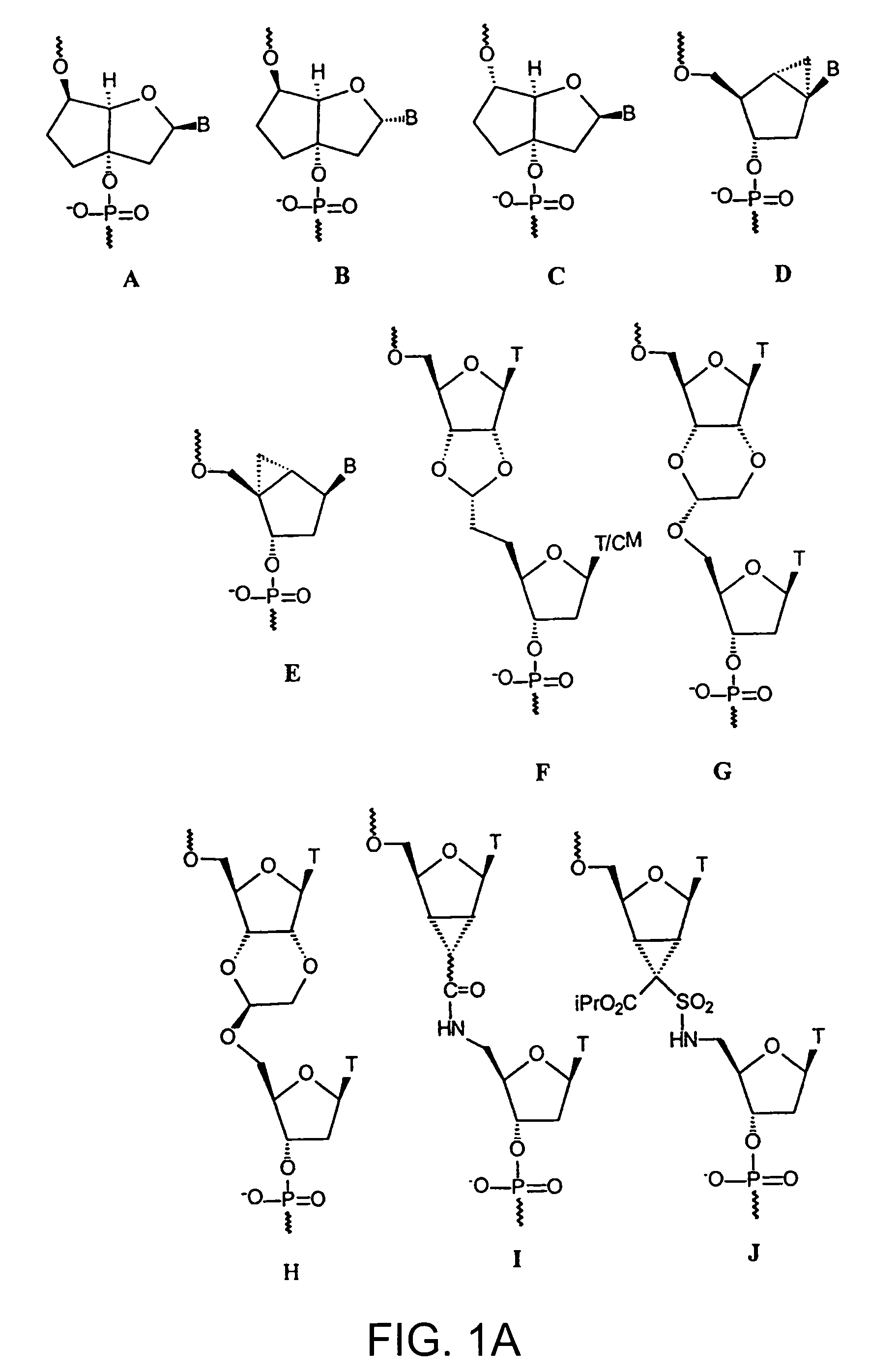
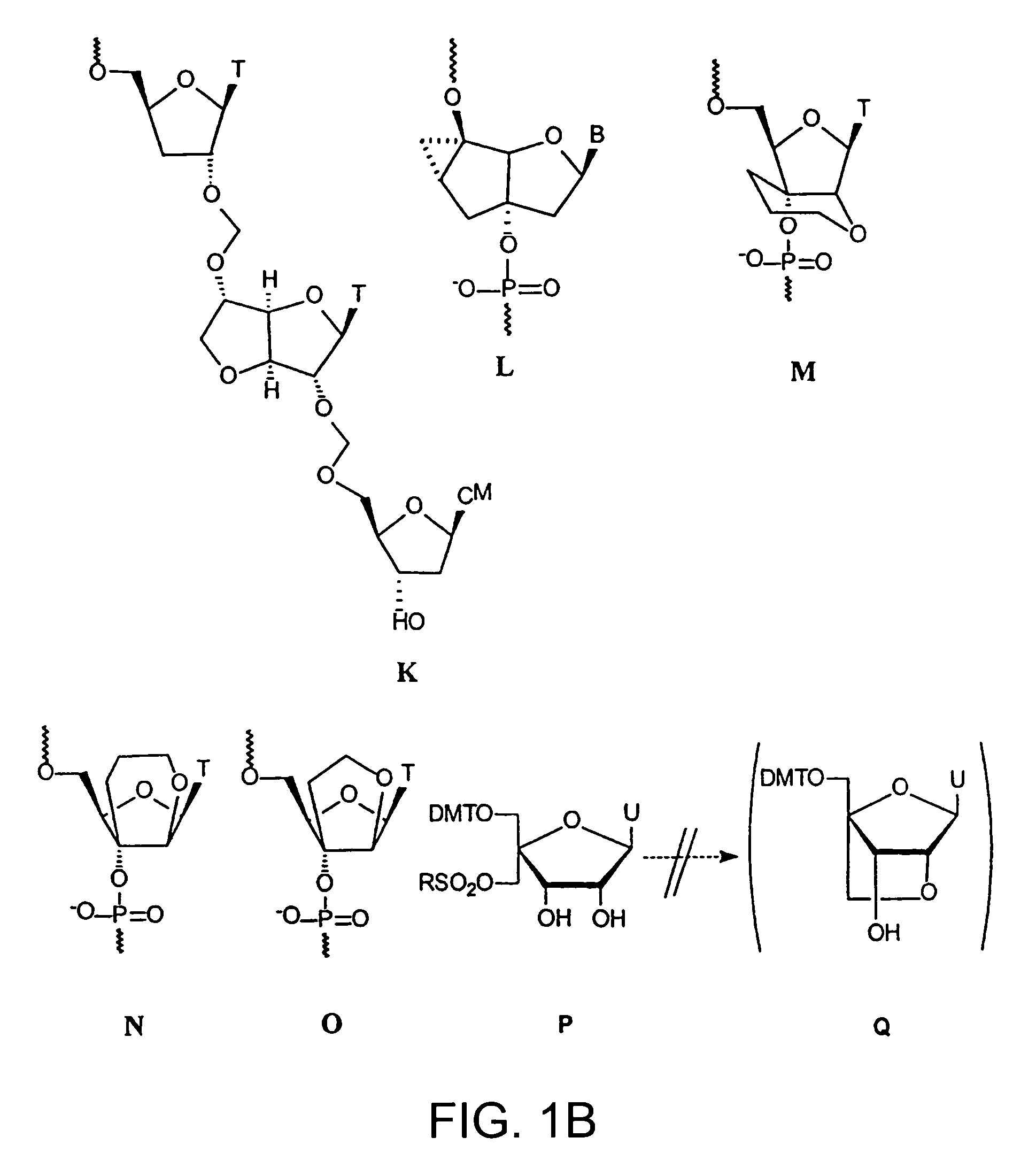
Examples
example 1
[0268]3-C-Allyl-1,2-O-isopropylidene-α-D-ribofuranose (0A). Method 1: A solution of 5-O-t-butyldimethylsilyl-1,2-O-isopropylidene-α-D-ribofuran-3-ulose (Y. Yoshimura, T. Sano, A. Matsuda and T. Ueda, Chem. Pharm. Bull., 1988, 36, 162) (17.8 g, 58.9 mmol) in anhydrous THF (980 cm3) was stirred at 0° C. and 1 M allylmagnesium bromide in anhydrous ether (130 cm3, 130 mmol) was added dropwise. After stirring for 2 h, a saturated aqueous solution of ammonium chloride (800 cm3) was added and the mixture was extracted with dichloromethane (3×400 cm3). The organic phase was washed with brine (3×450 cm3) and dried (Na2SO4). The solvent was removed under reduced pressure and the residue was dissolved in anhydrous THF (700 cm3). A 1.1 M solution of tetrabutylammonium fluoride in THF (54.4 cm3, 59.8 mmol) was added and the mixture was stirred at room temperature for 1 h and evaporated to dryness. The residue was dissolved in dichloromethane (1700 cm3) and was washed with a saturated aqueous sol...
example 2
[0269]3-C-Allyl-3,5-di-O-benzyl-1,2-O-isopropylidene-α-D-ribofuranose (0B). A 60% suspension of sodium hydride (4.9 g, 123 mmol) in anhydrous DMF (100 cm3) was stirred at 0° C. and a solution of furanose 0A (9.42 g, 40.9 mmol) in anhydrous DMF (65 cm3) was added dropwise over 45 min. The solution was stirred for 1 h at 50° C. and cooled to 0° C. A mixture of benzyl bromide (14.5 cm3, 121 mmol) and anhydrous DMF (14.5 cm3) was added dropwise and the mixture was stirred at room temperature for 18 h. The reaction mixture was evaporated to dryness and a solution of the residue in dichloromethane (700 cm3) was washed with a saturated aqueous solution of sodium hydrogencarbonate (2×450 cm3) and dried (Na2SO4). The solvent was removed under reduced pressure and the residue was purified by silica gel column chromatography using petroleum ether / ethylacetate (9:1, v / v) as eluent to give compound 0B as an oil (14.5 g, 86%). δH (CDCl3) 7.39-7.21 (10H, m, Bn), 5.92 (1 H, m, 2′-H), 5.71 (1 H, d, ...
example 3
[0270]3-C-Allyl-1,2-di-O-acetyl-3,5-di-O-benzyl-D-ribofuranose (0C). A solution of furanose 0B (2.42 g, 30.3 mmol) in 80% aqueous acetic acid (150 cm3) was stirred at 90° C. for 3 h. The solvent was removed under reduced pressure and the residue was coevaporated with ethanol (3×75 cm3), toluene (3×75 cm3) and anhydrous pyridine (2×75 cm3) and redissolved in anhydrous pyridine (60 cm3). Acetic anhydride (46 cm3) was added and the solution was stirred at room temperature for 48 h. A mixture of ice and water (300 cm3) was added and the resulting mixture was extracted with dichloromethane (2×300 cm3). The combined organic phase was washed with a saturated aqueous solution of sodium hydrogencarbonate (3×200 cm3) and dried (Na2SO4). The solvent was evaporated and the residue was purified using silica gel column chromatography with petroleum ether / ethyl acetate (4:1, v / v) as eluent to give the anomeric mixture 0C (β:α˜2:1) as an oil (13.3 g, 97%). δC (CDCl3) 169.7, 169.6 (C═O), 138.7, 138....
PUM
| Property | Measurement | Unit |
|---|---|---|
| Tm' | aaaaa | aaaaa |
| Tm' | aaaaa | aaaaa |
| Tm | aaaaa | aaaaa |
Abstract
Description
Claims
Application Information
 Login to View More