Check patentability & draft patents in minutes with Patsnap Eureka AI!

Dual chamber system providing simultaneous etch and deposition on opposing substrate sides for growing low defect density epitaxial layers

a dual chamber and substrate technology, applied in the direction of polycrystalline material growth, crystal growth process, after-treatment details, etc., can solve the problems of difficult direct growth of gan on sic, no readily available suitable substrate material, and difficult to obtain gan bulk crystals. , to achieve the effect of low d

Inactive Publication Date: 2011-03-08
THE UNITED STATES AS REPRESENTED BY THE DEPARTMENT OF ENERGY
View PDF4 Cites 2 Cited by
  • Summary
  • Abstract
  • Description
  • Claims
  • Application Information

AI Technical Summary

Benefits of technology

This approach results in low defect epitaxial films with threading dislocation densities less than 10^5 / cm^2, improving device performance by reducing stress and defect formation, enabling high-quality epitaxial films even with significantly different lattice parameters and thermal expansion coefficients.

Problems solved by technology

Due to the high equilibrium pressure of nitrogen at typical growth temperatures, it is extremely difficult to obtain GaN bulk crystals.
However, a current problem with the manufacture of GaN thin films is that there is no readily available suitable substrate material which exhibits close lattice matching and close matching of thermal expansion coefficients.
SiC is a semiconducting material which provides excellent thermal conductivity, but is expensive and is presently available only in small wafer sizes.
Direct growth of GaN on SiC is generally difficult due to poor wetting between these materials.
In addition, it is very difficult to prepare a SiC layer having a smooth surface.
A rough interface with GaN can cause an increase in the defect density of the GaN layer.
However, the lattice mismatch between GaN and sapphire is over 13%.
Such a large mismatch in the lattice constants causes poor crystal quality when GaN films are grown directly on the sapphire, due to stress formation and a high density of defects, including such defects as threading dislocations, microtwins, stacking faults and deep-levels.
Use of electrically insulating substrates can complicate certain processing by requiring additional processing steps, as compared to a conducting or semiconducting substrate, due to the inability to make an electrical contact through the substrate.
The disadvantages of Si as a substrate for GaN heteroepitaxy include a +20.5% a-plane misfit which initially led to the conclusion that growth of GaN directly on silicon was not feasible.
In addition, the thermal expansion mismatch between GaN (5.6×10⁻⁶ K−1) and Si (6.2×10⁻⁶ K−1) of 9.6% can lead to cracking upon cooling in films grown at high temperature.
Moreover, GaN is also known to poorly nucleate on Si substrates, leading to an island-like GaN structure and poor surface morphology.
Thus, the quality of GaN films grown on silicon has been far inferior to that of films grown on other commonly used substrates such as sapphire or silicon carbide.
Moreover, the growth conditions that have been used for GaN on Si are generally not compatible with standard silicon processes.
However, even when buffer layers are used, typically the effect of the thermal expansion coefficient mismatch is too large to suppress the formation of cracks in the GaN and related other Group III-N films grown.
Properties of LED's, including the internal quantum efficiency (IQE) and lifetime, are deleteriously affected due to the presence of these threading dislocations.

Method used

the structure of the environmentally friendly knitted fabric provided by the present invention; figure 2 Flow chart of the yarn wrapping machine for environmentally friendly knitted fabrics and storage devices; image 3 Is the parameter map of the yarn covering machine
View more

Image

Smart Image Click on the blue labels to locate them in the text.
Viewing Examples
Smart Image
  • Dual chamber system providing simultaneous etch and deposition on opposing substrate sides for growing low defect density epitaxial layers
  • Dual chamber system providing simultaneous etch and deposition on opposing substrate sides for growing low defect density epitaxial layers
  • Dual chamber system providing simultaneous etch and deposition on opposing substrate sides for growing low defect density epitaxial layers

Examples

Experimental program
Comparison scheme
Effect test

Embodiment Construction

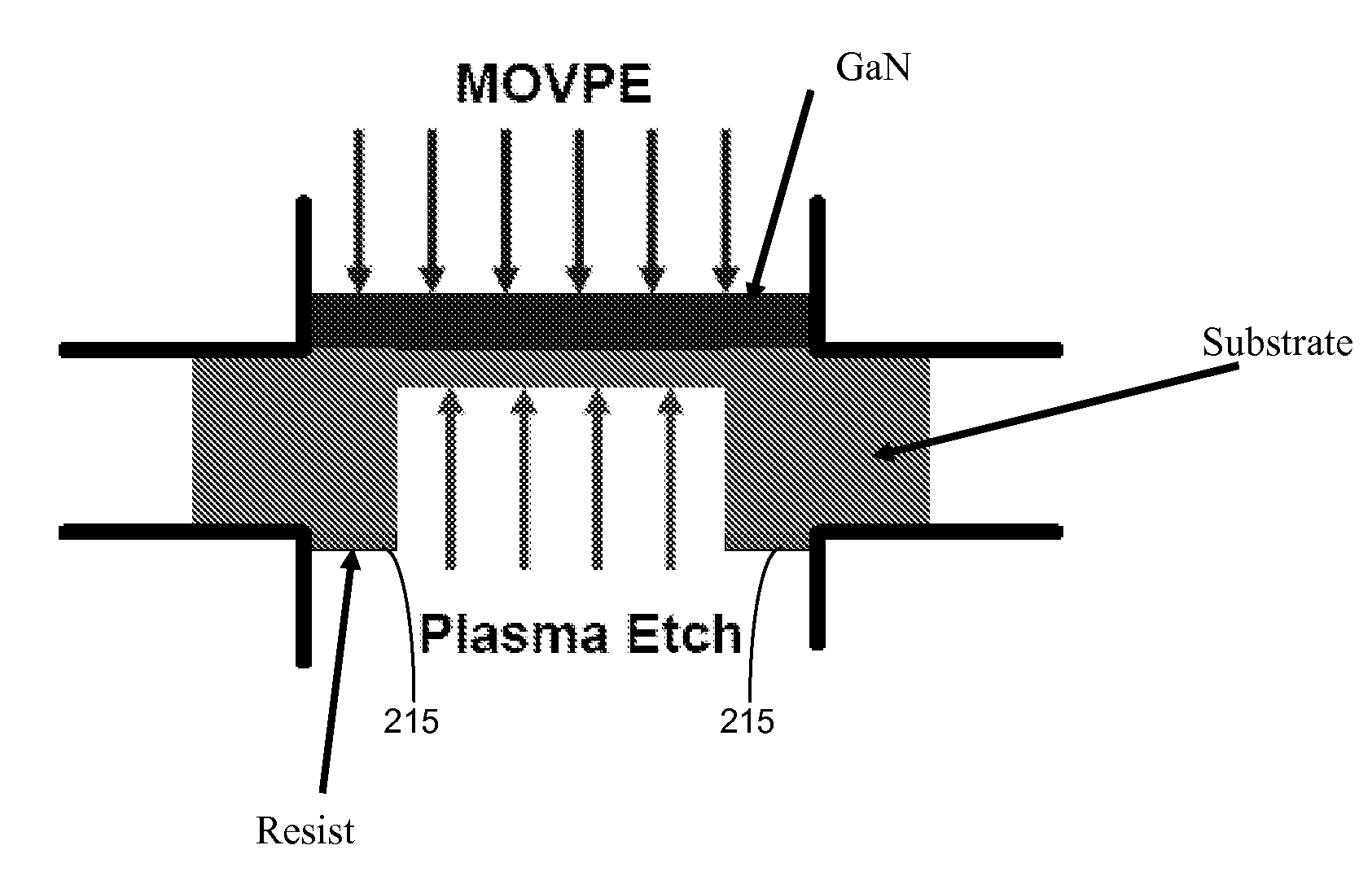
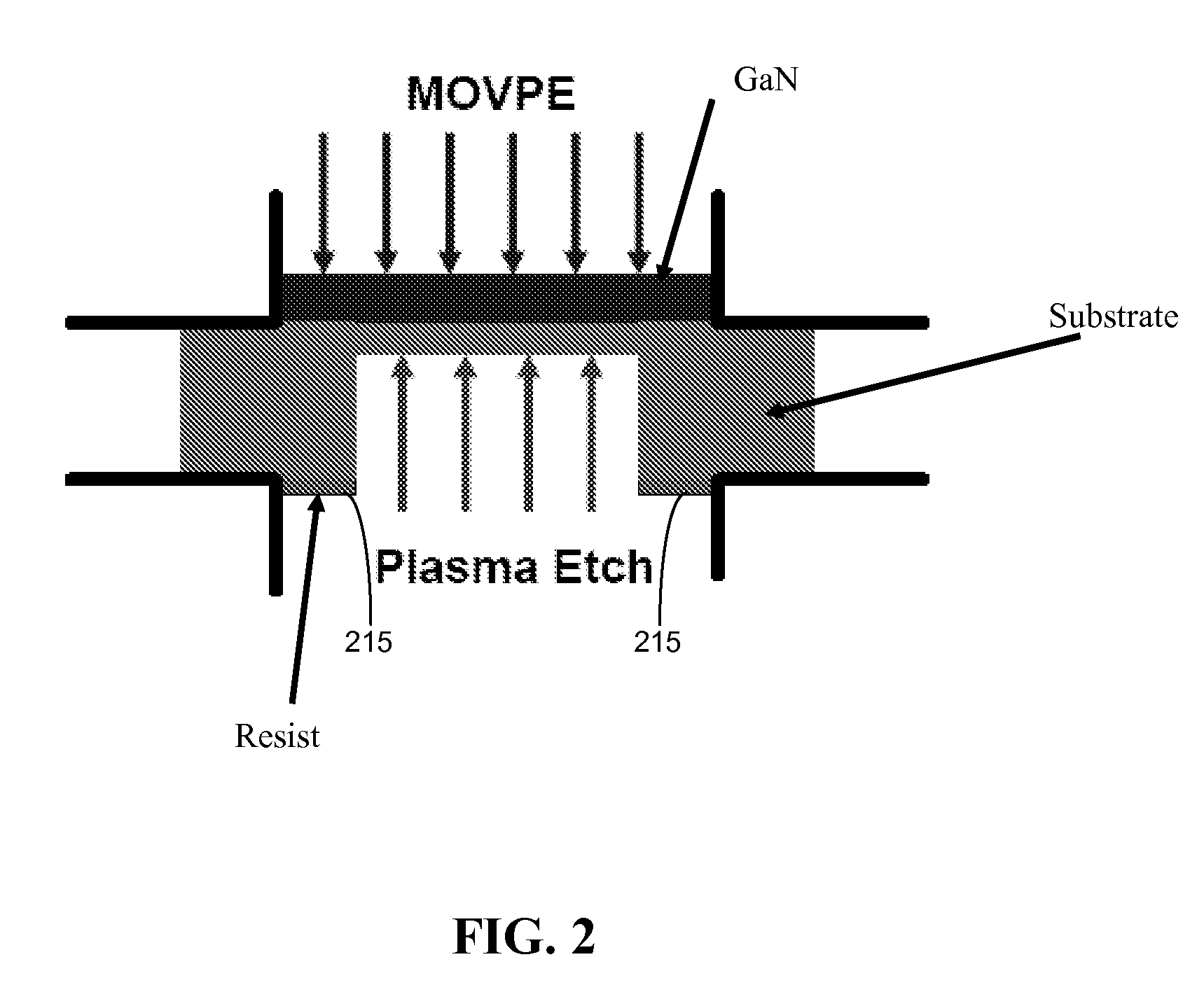
[0018]Thinning of a substrate to maintain critical thickness values during the deposition of an epitaxial film has been found by the present Inventors to reduce lattice mismatch stresses in the film. The substrate can be thinned (e.g., continuously) by etching from the backside so that it accommodates the mismatch strain in the epitaxial film to a greater extent as the film grows thicker and thicker. Lower stresses in the epitaxial film during deposition can result in epitaxial films having a lower defect density. Lower defect density epitaxial films can permit improved device performance, such as for LED devices and power transistors. In a preferred embodiment, the epitaxial film can be grown on thinned substrate regions at the center of the wafer, while at the edges, the substrate can be relatively thick and interfacial stress will be relaxed by misfit dislocations and other defects in the film which are preferentially formed over those regions.

[0019]In one exemplary embodiment, w...

the structure of the environmentally friendly knitted fabric provided by the present invention; figure 2 Flow chart of the yarn wrapping machine for environmentally friendly knitted fabrics and storage devices; image 3 Is the parameter map of the yarn covering machine
Login to View More

PUM

PropertyMeasurementUnit
temperaturesaaaaaaaaaa
surface roughnessaaaaaaaaaa
thicknessaaaaaaaaaa
Login to View More

Abstract

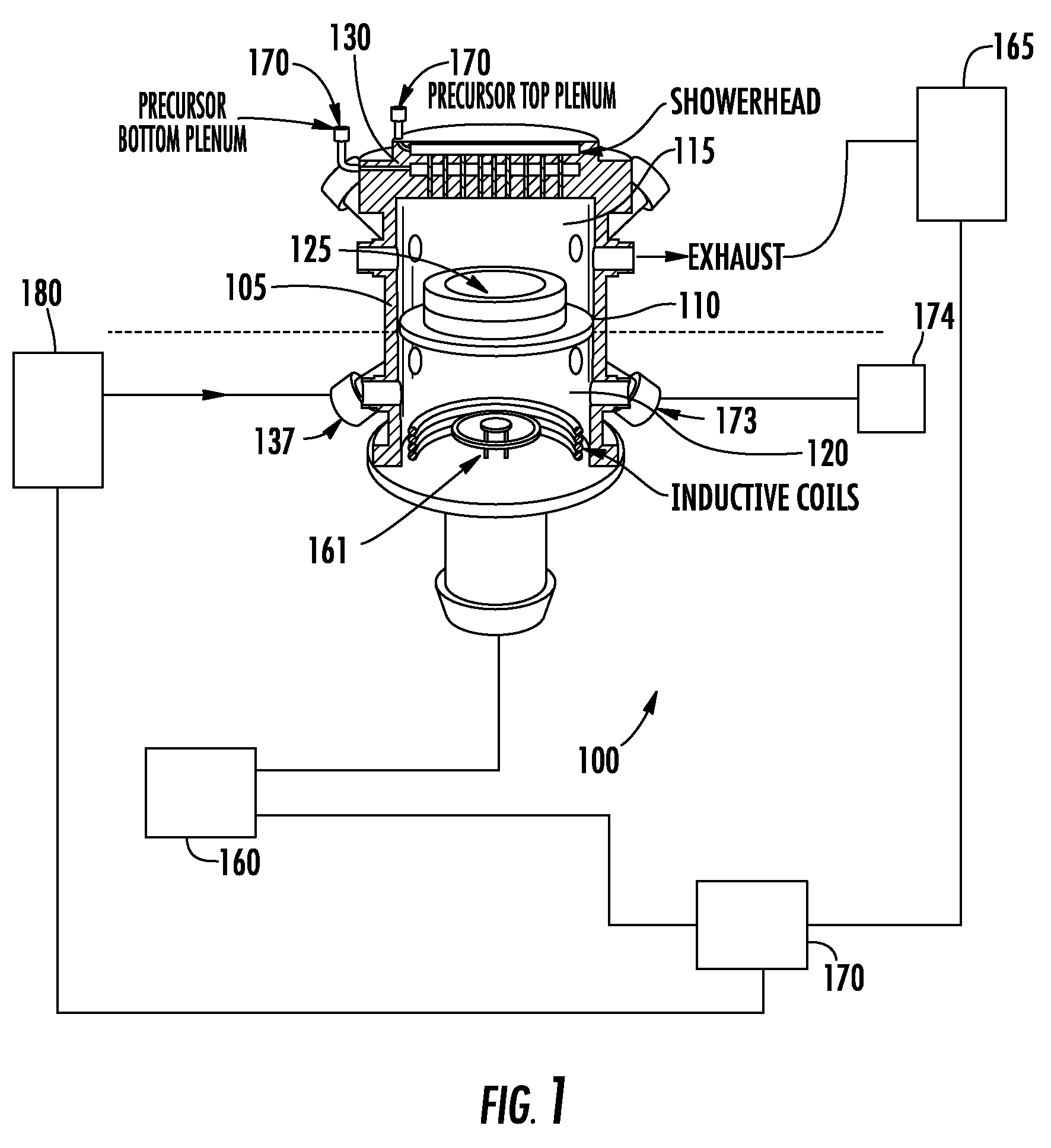
A dual-chamber reactor can include a housing enclosing a volume having a divider therein, where the divider defines a first chamber and a second chamber. The divider can include a substrate holder that supports at least one substrate and exposes a first side of the substrate to the first chamber and a second side of the substrate to the second chamber. The first chamber can include an inlet for delivering at least one reagent to the first chamber for forming a film on the first side of the substrate, and the second chamber can include a removal device for removing material from the second side of the substrate.

Description

CROSS-REFERENCE TO RELATED APPLICATIONS[0001]This application claims priority to U.S. Provisional Application Ser. No. 61 / 081,995 filed Jul. 18, 2008, the disclosure of which is hereby incorporated by reference.STATEMENT REGARDING FEDERALLY SPONSORED RESEARCH OR DEVELOPMENT[0002]The United States Government has rights in this invention pursuant to Contract No. DE-AC05-00OR22725 between the United States Department of Energy and UT-Battelle, LLC.FIELD OF THE INVENTION[0003]The invention relates to a system for forming thin film devices, including devices having Group III-N thin films which have poor lattice matching with the substrate onto which they are deposited.BACKGROUND OF THE INVENTION[0004]Group III-N compounds, such as gallium nitride (GaN) and its related alloys have seen significant research in recent years due to their applications in electronic and optoelectronic devices. Particular examples of potential optoelectronic devices include blue light emitting and laser diodes....

Claims

the structure of the environmentally friendly knitted fabric provided by the present invention; figure 2 Flow chart of the yarn wrapping machine for environmentally friendly knitted fabrics and storage devices; image 3 Is the parameter map of the yarn covering machine
Login to View More

Application Information

Patent Timeline
no application Login to View More
Patent Type & Authority Patents(United States)
IPC IPC(8): H01L21/20H01L21/36
CPCC23C16/303C23C16/52C30B25/02C30B29/406C30B33/12C30B35/00H01L21/02656H01L33/007H01L33/0079H01L21/0254H01L21/0262H01L33/0093
Inventor KULKARNI, NAGRAJ S.KASICA, RICHARD J.
Owner THE UNITED STATES AS REPRESENTED BY THE DEPARTMENT OF ENERGY
Features
  • R&D
  • Intellectual Property
  • Life Sciences
  • Materials
  • Tech Scout
Why Patsnap Eureka
  • Unparalleled Data Quality
  • Higher Quality Content
  • 60% Fewer Hallucinations
Social media
Patsnap Eureka Blog
Learn More