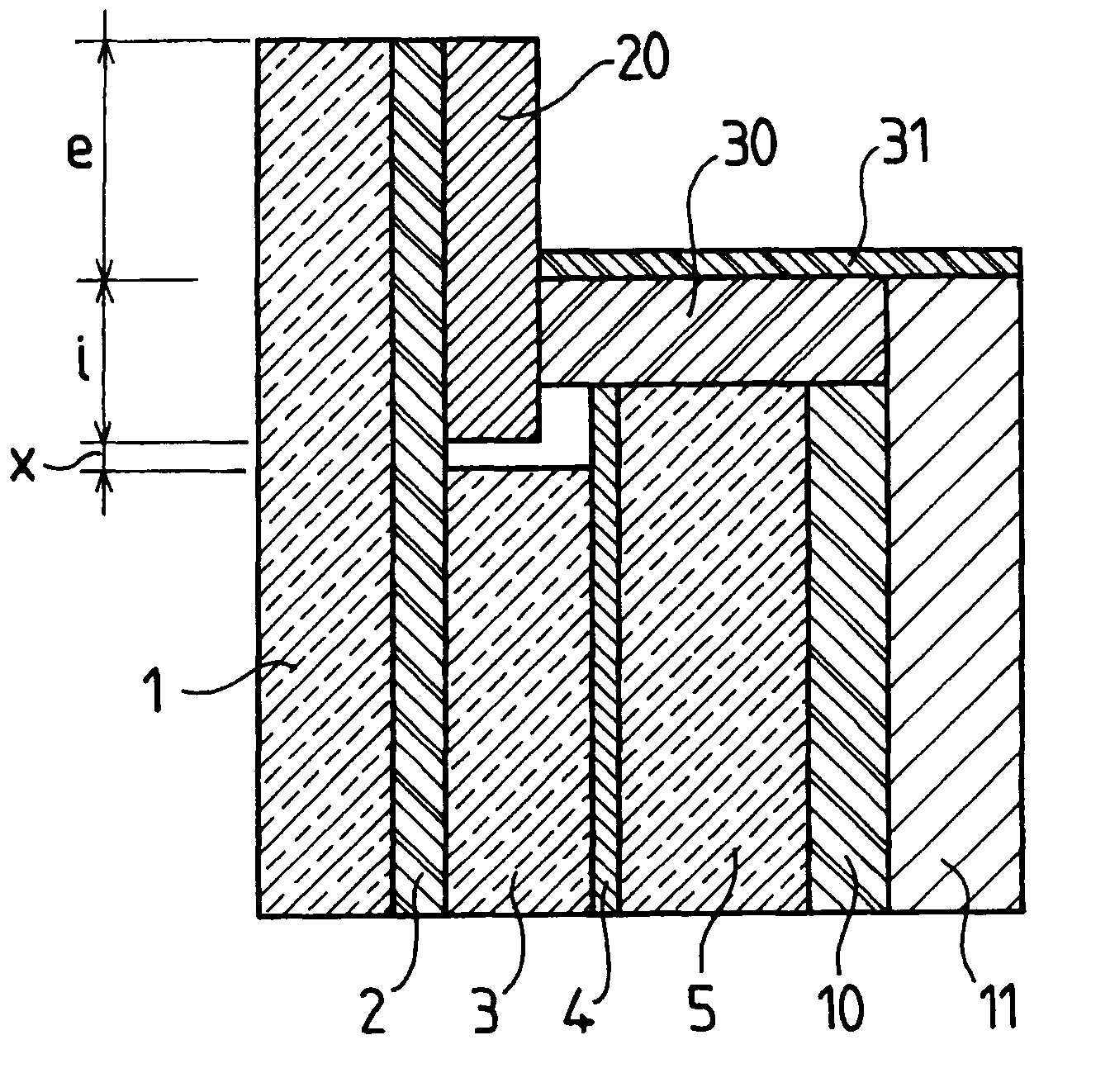
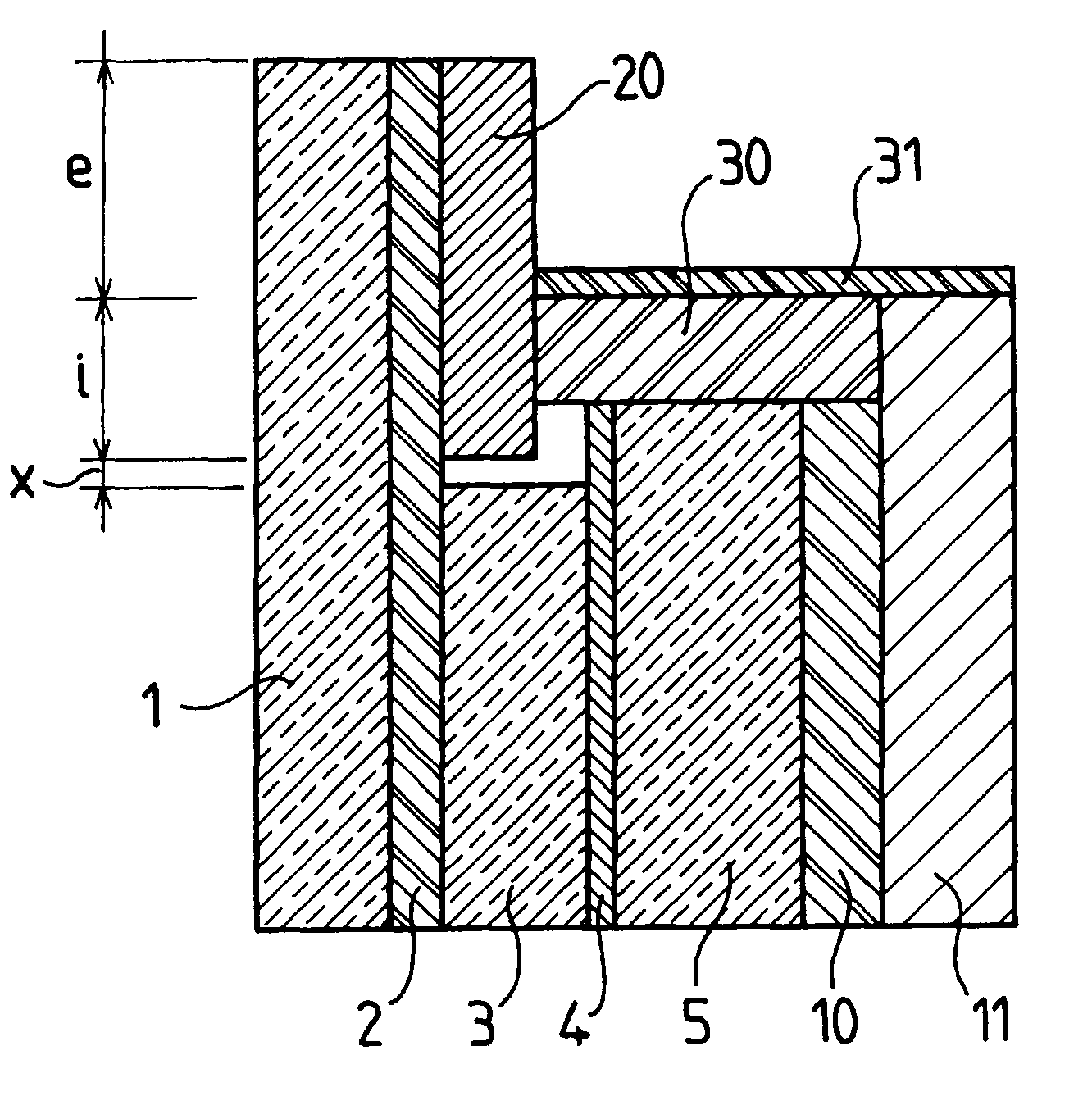
[0014]the encapsulation of the end face of part of the laminated structure comprising in particular the interface between the sheet for dampening the
impact of a
projectile and the
adhesive layer to which it is connected, lastingly preventing penetration of
moisture and therefore
delamination thereat.
[0016]The material capable of flowing and ensuring degassing during
assembly of the laminated structure and the encapsulation material are advantageously applied to the sheets before the baking of the laminated structure in the
autoclave. It is necessary, when these materials completely surround the periphery of the structure, to provide passages so that the gases released during
assembly can escape. According to an advantageous variant, the material capable of flowing and ensuring degassing is permeable to air and to
water vapor, thus allowing these gases to escape without impairing the quality of the
assembly. Optionally, accessory means may be used to make this degassing easier. This material is moreover compatible with the encapsulation material and the material constituting the sheet for dampening the
impact of a
projectile.
[0017]A bullet fired a
short distance from the lower edge of the armoring insert, toward the interior of the laminated structure—that is to say in the
daylight portion—with an
angle of incidence of about 45° C. and a rising direction, will not encounter the third
glass sheet but the material capable of absorbing the energy of the projectile. This material is firmly and durably held in place by the encapsulation material and the sheet for dampening the
impact of a projectile. This device is by nature capable of stopping the bullet. A glass splinter can no longer penetrate the side where the user is, either through the sheet for dampening the impact of the projectile or with
delamination of the edge of said sheet.
[0021]The encapsulation material has a
softening temperature above the temperature used during the baking in the
autoclave. It thus constitutes a stop without preventing any flow of the material capable of flowing and ensuring degassing. For standard use conditions, namely an
autoclave temperature between 100 and 140° C., the
softening temperature of the encapsulation material is, for example, between 145 and 190° C. Moreover, the encapsulation material has mechanical properties sufficient for both correcting and adapting to any alignment defects. It
Shore A
hardness is for example between 70 and 90. Preferably, it has for example an elongation at break of greater than 500% and its tensile strength is greater than 10 MPa, these values being measured according to the NF T 46-002 standard on H3-
dumbbell test specimens. Moreover, it has an elongation of greater than 200% and an initial Young's modulus of between 200 and 300 MPa, these values being measured have a temperature of −40° C. according to the NF T-46.002 standard. This property prevents the glazing from being damaged when subjected to low temperatures.
[0024]In a preferred embodiment of the invention, at least one of the first, second and third glass sheets, or additional glass sheets, is strengthened, especially chemically toughened. This measure improves the protection against piercing projectiles.
[0032]the armoring insert is made of steel or the like, with a thickness of between 1 and 4 mm, and penetrates into the laminated structure by a depth of between 3 and 20 mm from the edge of the sheet for dampening the impact of a projectile.


 Login to View More
  Login to View More