

Polymer having sulfonic acid group or sulfonic acid ester group and amide group, and toner for developing electrostatic latent image having the polymer
a technology of sulfonated styrene and ester group, which is applied in the field of novel polymers having sulfonated styrene or sulfonated styrene ester group and toner for developing electrostatic latent images. it can solve the problem that sulfonated styrene alone cannot meet sufficiently, and achieve the effect of improving and developing a novel polymer
- Summary
- Abstract
- Description
- Claims
- Application Information
AI Technical Summary
Benefits of technology
Problems solved by technology
Method used
Image

Examples
example a-0
[0243]Styrene and 4-vinylbenzoic acid were copolymerized with reference to Macromolecules, 24, 4310-4321 (1991) and Macromolecules, 26, 2791-2795 (1993). As a result, a copolymer which contains a unit shown by the following formula (A-0):
[0244]
in a content ratio (mol %) of (M):(F)=93:7 was obtained. The average molecular weight of the obtained polymer was number average molecular weight Mn=22,000, weight average molecular weight Mw=52,000.
example a-1
[0245]1.5023 g of the polymer obtained in Example A-0, 0.8492 g of 2-aminobenzenesulfonic acid are placed in a three-necked 200 ml flask, added with 56.5 ml of pyridine and stirred under nitrogen atmosphere. Then, 2.57 ml of triphenyl phosphite was added and heated at 120° C. for six hours.
[0246]After the reaction ended, pyridine was evaporated, and 150 ml of chloroform was added to dissolve the polymer. The solution was partitioned and washed with 600 ml of 2N hydrochloric acid and, after the solvent was evaporated and 1.2535 g of the polymer was collected. The polymer was dissolved in THF and purified with a permeable membrane using distilled water and isopropanol.
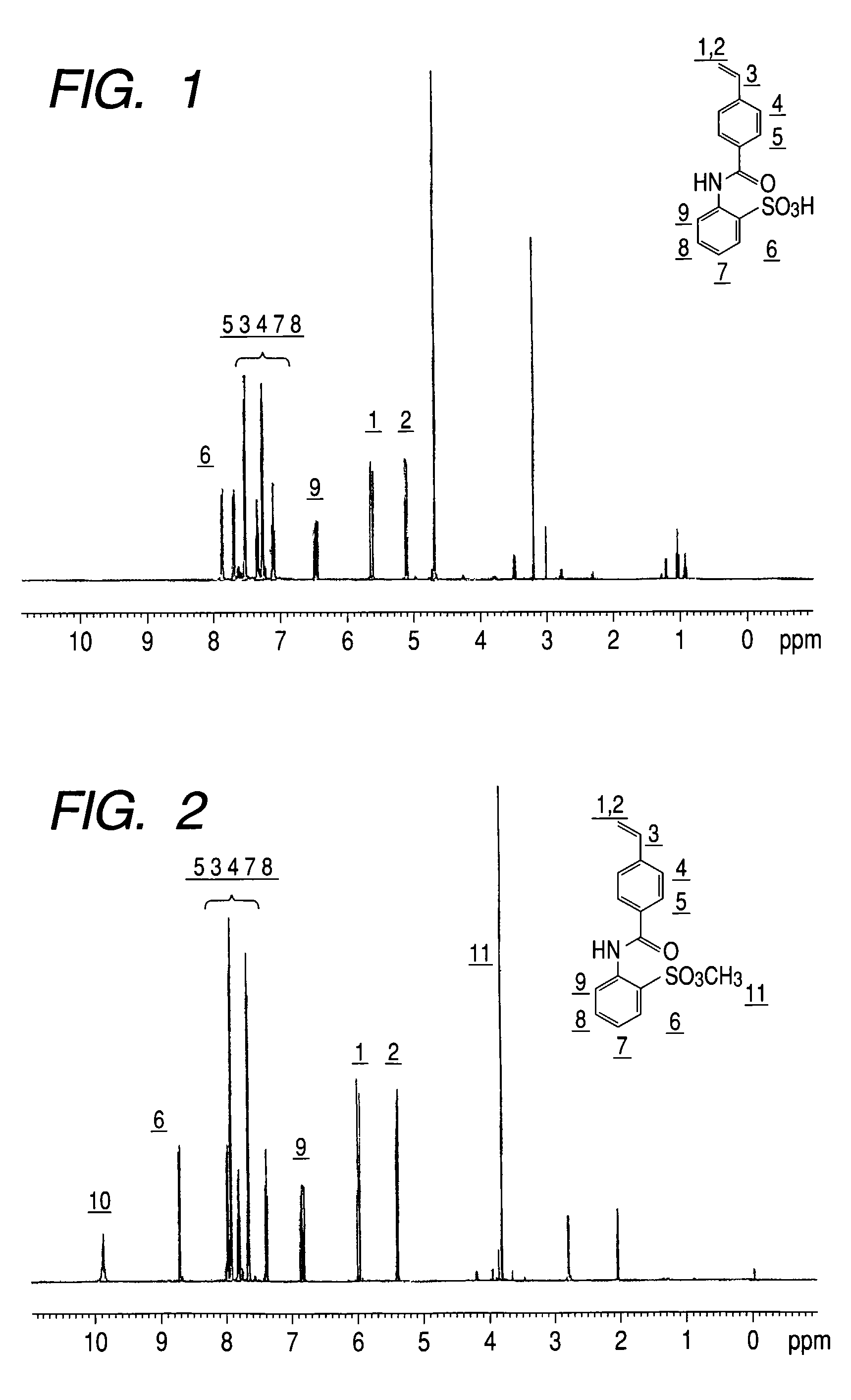
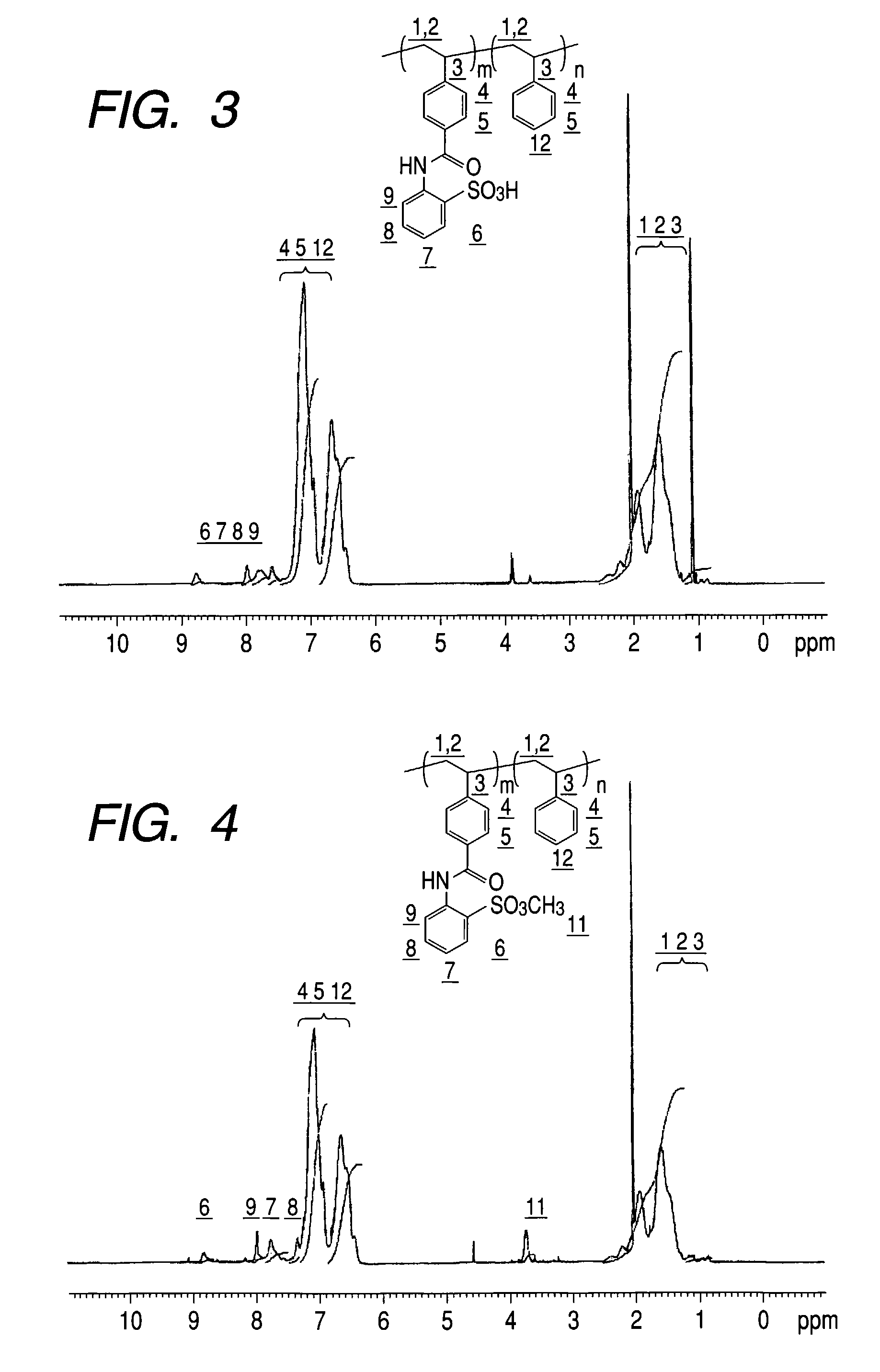
[0247]The peak that came from a phenyl group of 2-aminobenzenesulfonic acid was shifted in the result of 1H-NMR. As a result, it was confirmed that the obtained polymer was a copolymer which contains a unit shown by the following formula (A-1):
[0248]
in a content ratio of 6 mol %.
[0249]As for the obtained polymer, Mn=20,0...
example a-2
[0251]0.9777 g of the polymer obtained in Example A-1 was placed in a 300 mL flask, dissolved with 68.44 ml of chloroform and 17.11 ml of methanol and the mixture was cooled to 0° C. 3.00 ml of 2 mol / L trimethylsilyldiazomethane in hexane solution (product of Aldrich Company) was added as an esterifying agent and the solution was stirred for four hours. After the reaction ended, the solvent was evaporated by an evaporator, and the polymer was collected. Furthermore, 68.44 ml of chloroform and 17.11 ml of methanol were added to dissolve the polymer again and the solvent was evaporated by an evaporator. This operation of re-dissolution and evaporation of the solvent was repeated three times. 0.9552 g of the polymer was obtained by vacuum drying the polymer collected here. The peak of methyl proton as a result of 1H-NMR was observed in 3 to 4 ppm. From this, it was confirmed that the obtained polymer was a copolymer which contains a unit shown by the following formula (A-2):
[0252]
in a ...
PUM
| Property | Measurement | Unit |
|---|---|---|
| reaction time | aaaaa | aaaaa |
| boiling point | aaaaa | aaaaa |
| temperature | aaaaa | aaaaa |
Abstract
Description
Claims
Application Information
 Login to View More