Check patentability & draft patents in minutes with Patsnap Eureka AI!

Soot filter

a technology of honeycomb and filter, applied in the field of honeycomb ceramic filter, can solve the problems of excessive thermal stress and reduce the total effective filter area, and achieve the effects of increasing the back pressure, maximizing the effective filtration area, and excellent filtration

Inactive Publication Date: 2011-05-24
DOW GLOBAL TECH LLC
View PDF61 Cites 2 Cited by
  • Summary
  • Abstract
  • Description
  • Claims
  • Application Information

AI Technical Summary

Benefits of technology

The filter achieves improved soot combustion and reduced back pressure with enhanced thermal shock resistance and even soot distribution, maintaining filtration efficiency without significant increases in back pressure.

Problems solved by technology

Diesel engines, because of the way they operate, emit soot particles or very fine droplets of condensate or a conglomerate of the two (particulates) as well as typical harmful gasoline engine exhausts (i.e., HC and CO).
Each of these suffers from reducing the total effective filter area and excessive thermal stresses due to exaggerated different combustion along the length of the filter.

Method used

the structure of the environmentally friendly knitted fabric provided by the present invention; figure 2 Flow chart of the yarn wrapping machine for environmentally friendly knitted fabrics and storage devices; image 3 Is the parameter map of the yarn covering machine
View more

Image

Smart Image Click on the blue labels to locate them in the text.
Viewing Examples
Smart Image
  • Soot filter
  • Soot filter
  • Soot filter

Examples

Experimental program
Comparison scheme
Effect test

example 1

[0057]An approximately 40 mm×40 mm×130 mm piece of a bisque fired monolithic honeycomb prepared from 51 parts by weight of Todd Dark ball clay (Kentucky-Tennessee Clay Co., Mayfield, Ky.) and 49 parts by weight of kappa-alumina (Kappa Alumina ABA-6000-K, Selecto Scientific, Inc., Suwanee, Ga.) was placed end on into 10.5 mL of an aqueous solution containing 2.726 g of Ce(NO3)3.6H2O. When the solution had been absorbed by the part such that a ˜40 mm zone on the immersed end of the monolith was wet, the part was placed in a vacuum desiccator. The desiccator was evacuated and then backfilled to ˜300 torr with NH3 gas to precipitate the cerium ions (MAC) from solution. After 10 minutes, the NH3 was removed from the desiccator, which was backfilled with air. The part was removed, dried in a 120° C. oven, and then heated in air to 600° C. and held at that temperature for 1 hour. The part was then converted to acicular mullite by the catalytic reaction with SiF4 in the same manner as descr...

example 2

[0059]An approximately 18 mm×18 mm×100 mm piece of a bisque fired monolithic honeycomb prepared in the same manner as Example 1 was placed end on into 3.0 mL of an aqueous solution containing 0.354 g Sr(NO3)2. Following absorption of the liquid such that approximately 60 mm of the monolith was wet, the part was dried in an oven at 120° C., and then heated in air to 600° C. and held at that temperature for 1 hour. The part was then reacted with SiF4 as in Example 1.

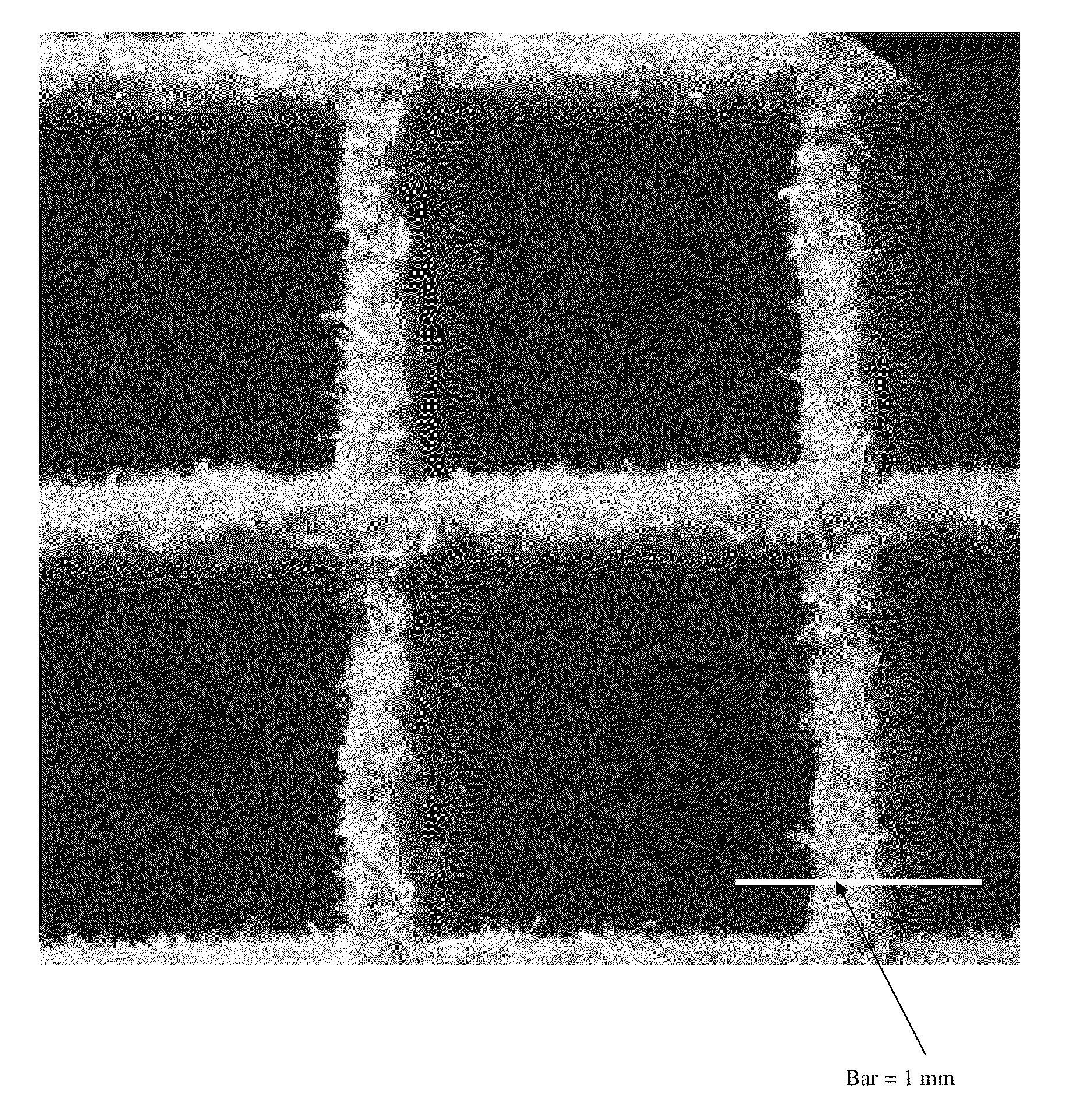
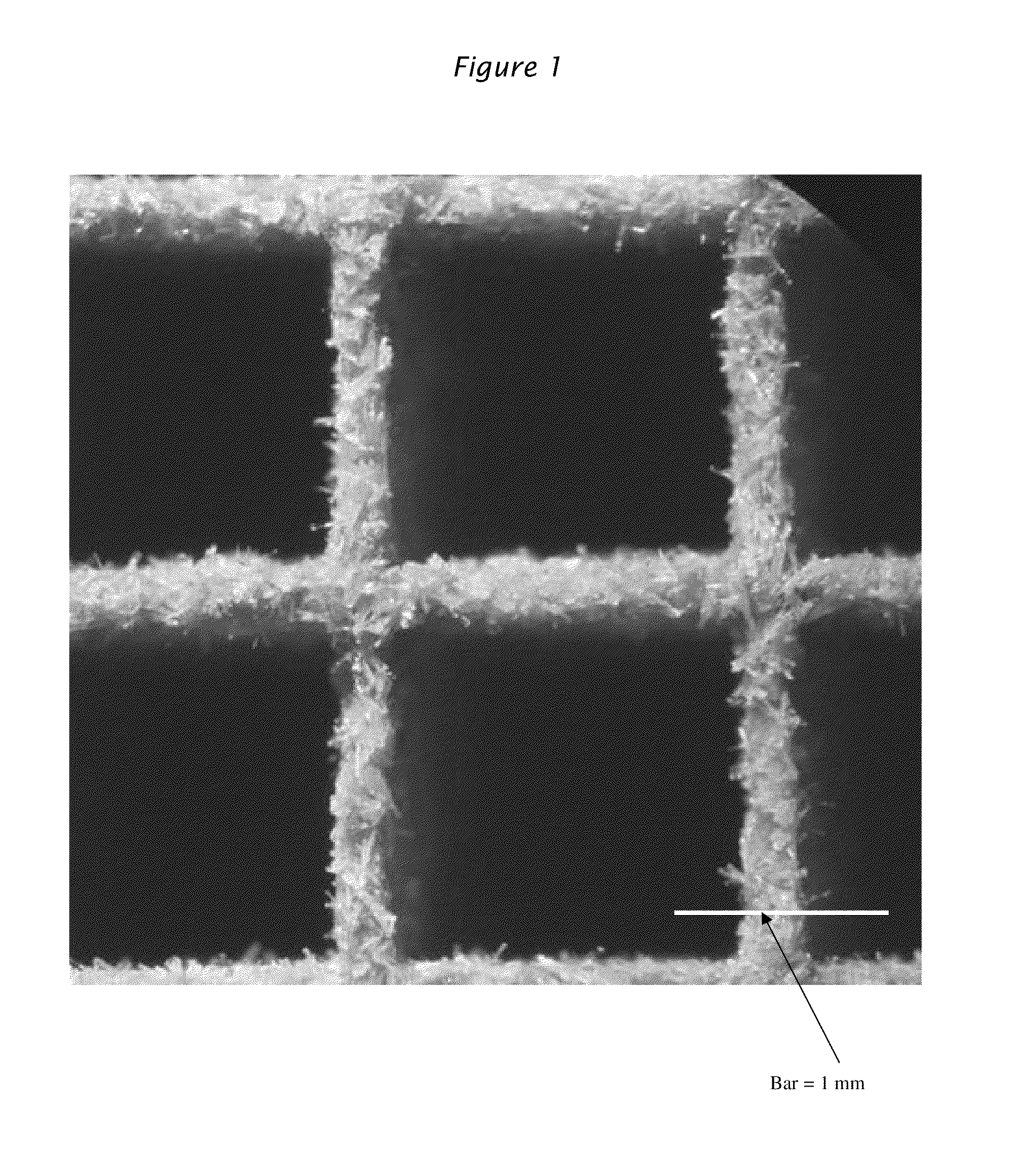
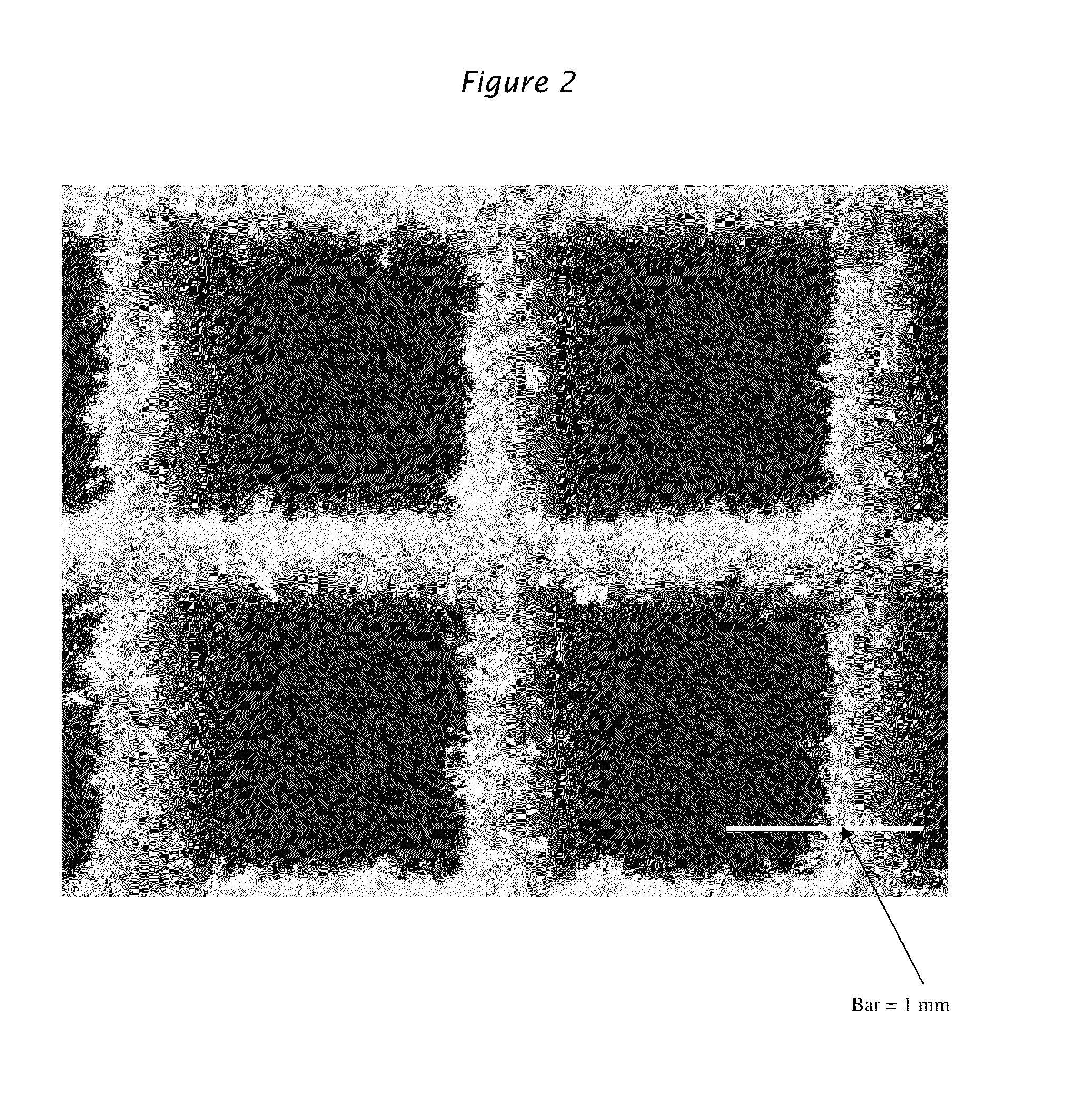
[0060]The piece after reaction was crack free. The section of the honeycomb piece that was treated with the MAC (strontium) developed a platy morphology (lower aspect ratio) than the untreated section which developed an acicular morphology, as shown by FIGS. 3 and 4 respectively. Because of the platy grains, the channels of the MAC treated section have a greater cross-sectional area than the channels of the end untreated with the MAC.

the structure of the environmentally friendly knitted fabric provided by the present invention; figure 2 Flow chart of the yarn wrapping machine for environmentally friendly knitted fabrics and storage devices; image 3 Is the parameter map of the yarn covering machine
Login to View More

PUM

PropertyMeasurementUnit
total porosityaaaaaaaaaa
porosityaaaaaaaaaa
porosityaaaaaaaaaa
Login to View More

Abstract

An improved ceramic honeycomb filter has at least one porous partition wall defining a channel that is (1) microstructurally different along the length of the channel, (2) microstructurally different than at least a portion of a partition wall defining another channel or (3) combination thereof. The improved filter may be used for filtering Diesel exhaust and may have reduced back pressure and equivalent soot capture efficiency compared to a filter without having said microstructural differences.

Description

CROSS-REFERENCE TO RELATED APPLICATION[0001]This application claims the benefit of U.S. Provisional Application Ser. No. 60,876,311, filed Dec. 21, 2006, which is hereby incorporated by reference.FIELD OF THE INVENTION[0002]The present invention relates to an improved ceramic honeycomb particulate filter. In particular, the invention relates to honeycomb ceramic filters that have at least one filtration wall that varies microstructurally.BACKGROUND OF THE INVENTION[0003]Diesel engines, because of the way they operate, emit soot particles or very fine droplets of condensate or a conglomerate of the two (particulates) as well as typical harmful gasoline engine exhausts (i.e., HC and CO). These “particulates” (herein Diesel soot), are rich in condensed, polynuclear hydrocarbons, some of which may be carcinogenic.[0004]As the awareness of the danger Diesel soot presents to health collides with the need for greater fuel efficiency that Diesel engines provide, regulations have been enacte...

Claims

the structure of the environmentally friendly knitted fabric provided by the present invention; figure 2 Flow chart of the yarn wrapping machine for environmentally friendly knitted fabrics and storage devices; image 3 Is the parameter map of the yarn covering machine
Login to View More

Application Information

Patent Timeline
no application Login to View More
Patent Type & Authority Patents(United States)
IPC IPC(8): B01D39/14B01D39/06B01D39/00B01D50/00
CPCB01D46/2429B01D46/2455B01J35/04C04B35/185C04B38/0009C04B38/0074F01N2330/06F01N3/0222B01D46/2466B01D46/2474B01D2046/2481B01D2046/2488B01D2046/2492B01D2046/2496B01D2275/30C04B2111/0081C04B2235/3213C04B2235/322C04B2235/3229C04B2235/349C04B2235/445C04B2235/78B01D46/2496B01D46/249B01D46/2486B01D46/2498B01D46/2476B01D46/2492B01J35/57C04B38/00B01D46/24B01J35/56
Inventor ZIEBARTH, ROBIN
Owner DOW GLOBAL TECH LLC
Features
  • R&D
  • Intellectual Property
  • Life Sciences
  • Materials
  • Tech Scout
Why Patsnap Eureka
  • Unparalleled Data Quality
  • Higher Quality Content
  • 60% Fewer Hallucinations
Social media
Patsnap Eureka Blog
Learn More