Microengineered multipole ion guide

US8507847B2Active Publication Date: 2013-08-13MICROSAIC SYST
38 Cites 14 Cited by

Patent Information

Authority / Receiving Office
US · United States
Patent Type
Patents(United States)
Current Assignee / Owner
Publication Date
2013-08-13

Smart Images

  • Figure 1
    Figure 1
  • Figure 2
    Figure 2
  • Figure 3
    Figure 3
Patent Text Reader

Abstract

A microengineered multipole ion guide for use in miniature mass spectrometer systems is described. Exemplary methods of mounting rods in hexapole, octupole, and other multipole geometries are described. The rods forming the ion guide are supported in etched silicon structures defined in at least first and second substrates.
Need to check novelty before this filing date? Find Prior Art

Description

CROSS-REFERENCE TO RELATED APPLICATIONS

[0001] This application claims the benefit of Great Britain Patent Application No. GB1005551.5 filed on Apr. 1, 2010.TECHNICAL FIELD OF THE INVENTION

[0002] The present application relates to ion guides. The invention more particularly relates to a multipole ion guide that is microengineered and used in mass spectrometer systems as a means of confining the trajectories of ions as they transit an intermediate vacuum stage. Such an intermediate vacuum stage may typically be provided between an atmospheric pressure ion source (e.g. an electrospray ion source) and a mass analyser in high vacuum.BACKGROUND OF THE INVENTION

[0003] Atmospheric pressure ionisation techniques such as electrospray and chemical ionisation are used to generate ions for analysis by mass spectrometers. Ions created at atmospheric pressure are generally transferred to high vacuum for mass analysis using one or more stages of differential pumping. These intermediate stages are used...

Examples

Embodiment Construction

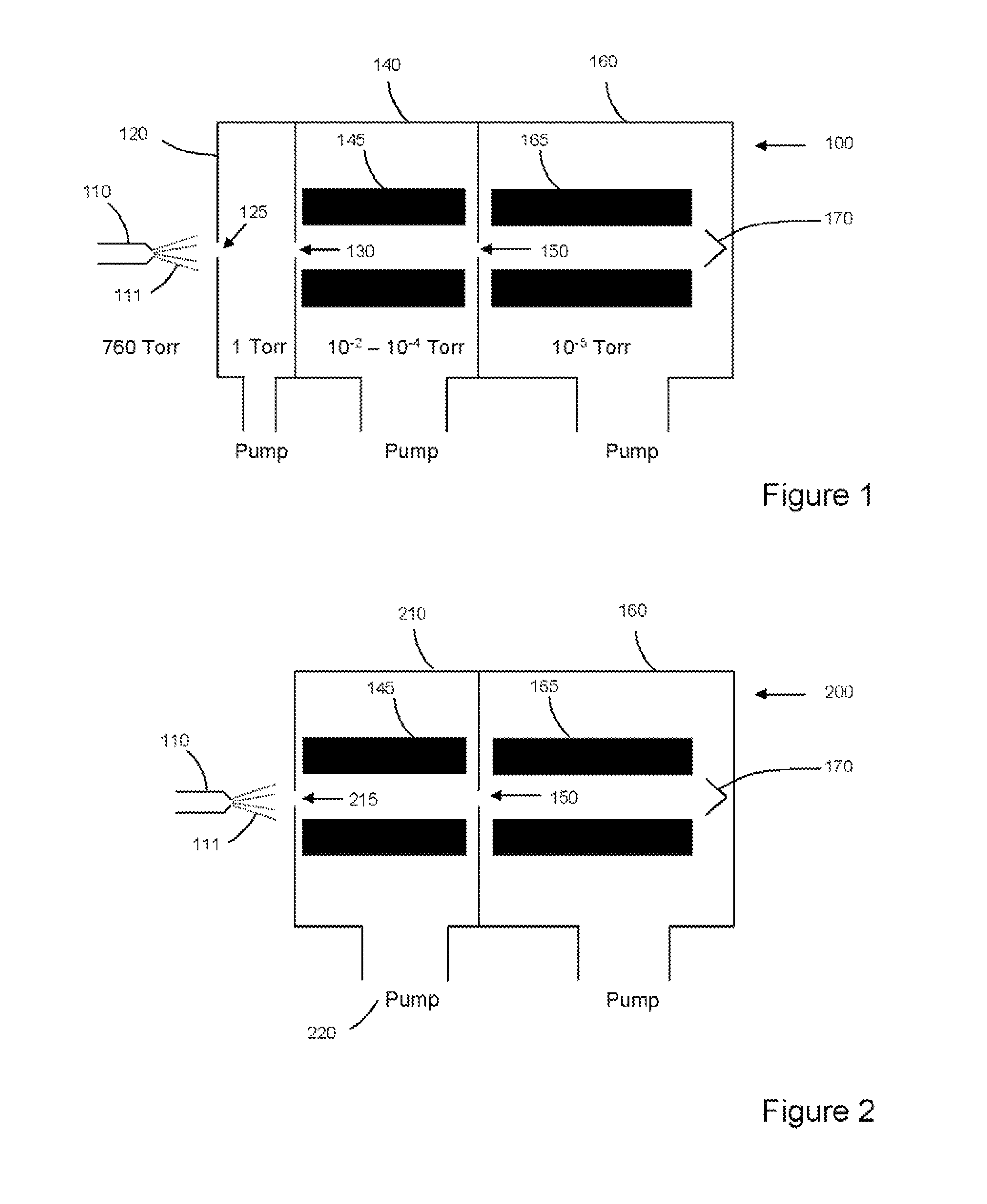
[0019]FIG. 1 shows in schematic form an example of a mass spectrometer system 100 in accordance with the present teaching. An ion source 110, such as an electrospray ion source, effects generation of ions 111 at atmospheric pressure. In this exemplary arrangement, the ions are directed into a first chamber 120 through a first orifice 125. The pressure in this first chamber is of the order of 1 Torr. A portion of the gas and entrained ions that passes into the first chamber 120 through orifice 125 is sampled by a second orifice 130 and passes into a second chamber 140, which is typically operated at a pressure of 10−4 to 10−2 Torr. The second orifice 130 may be presented as an aperture in a flat plate or a cone. Alternatively, a skimmer may be provided proximal to or integrated with the entrance to the second chamber so as to intercept the initial free jet expansion. The second chamber, or ion guide chamber, 140 is coupled via a third orifice 150 to an analysis chamber 160, where the...