
Electro-optical device and driving circuit
a technology of optical devices and driving circuits, applied in the field of optical devices, can solve the problems of power consumption, power may vary, and the voltage of the capacitance line may not reach the desired voltage level quickly, so as to prevent the deterioration of display quality and reduce the noise
- Summary
- Abstract
- Description
- Claims
- Application Information
AI Technical Summary
Benefits of technology
Problems solved by technology
Method used
Image


Examples
first embodiment
[0023
[0024]Above all, a first embodiment of the invention will be described. FIG. 1 is a block diagram showing a configuration of an electro-optical device according to the first embodiment.
[0025]As shown in FIG. 1, an electro-optical device 10 is peripheral-circuit-containing panel including a display area 100, and around the display area 100, a scanning-line-driving circuit 140, a capacitance-line-driving circuits 150L and 150R, and a data-line-driving circuit 190. Further, a display-control circuit 20 is connected to the peripheral-circuit-containing panel by, for example, a flexible printed circuit (FPC) board.
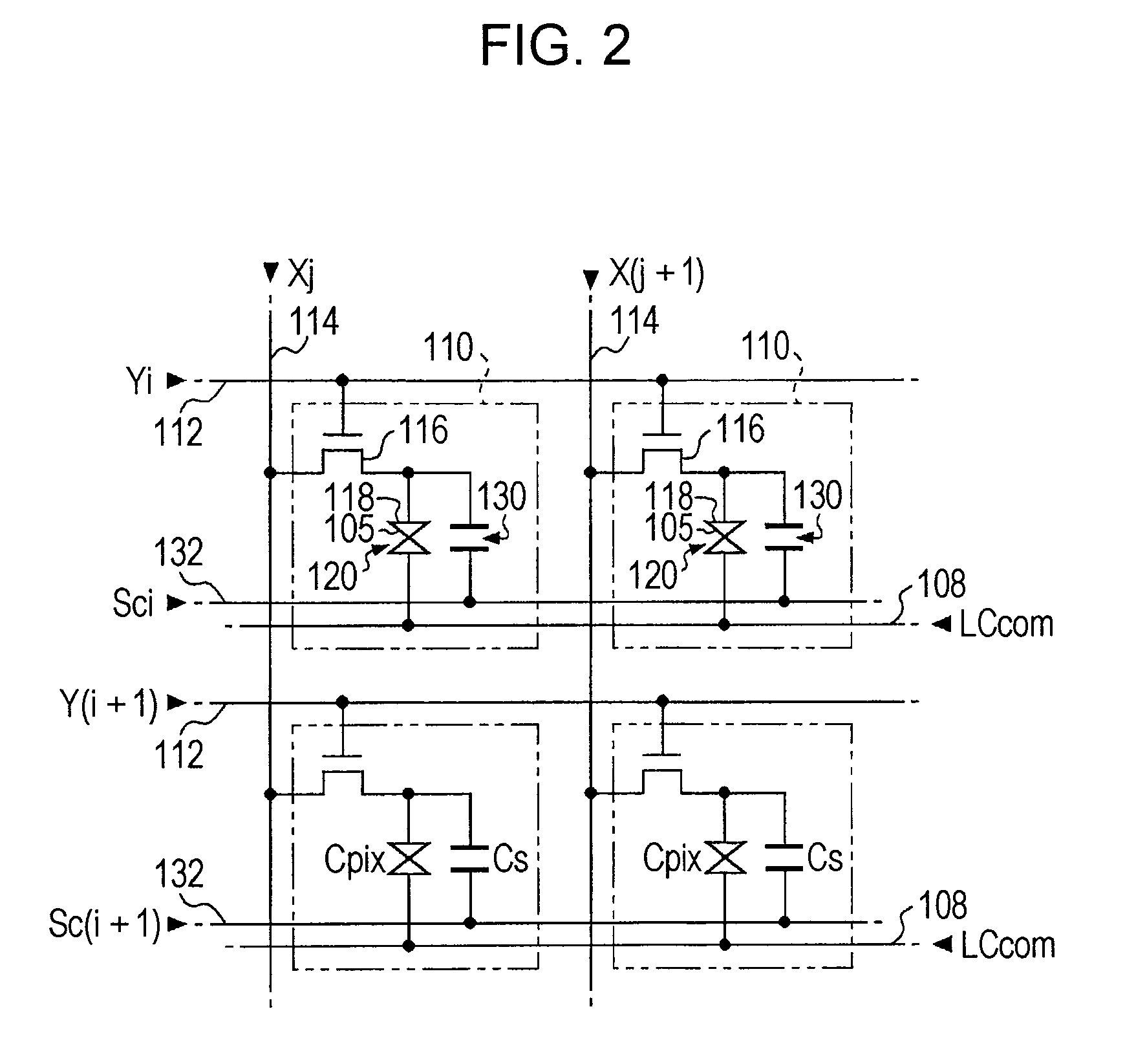
[0026]The display area 100 is an area in which pixels 110 are arranged, and in the embodiment, while scanning lines 112 of total 322 rows from row 0 to row 321 extends in the row direction in the figure, data lines 114 of 240 columns extends in the column direction.
[0027]In FIG. 1, respective pixels 110 are arranged corresponding to the intersections between the data lines...
second embodiment
[0056
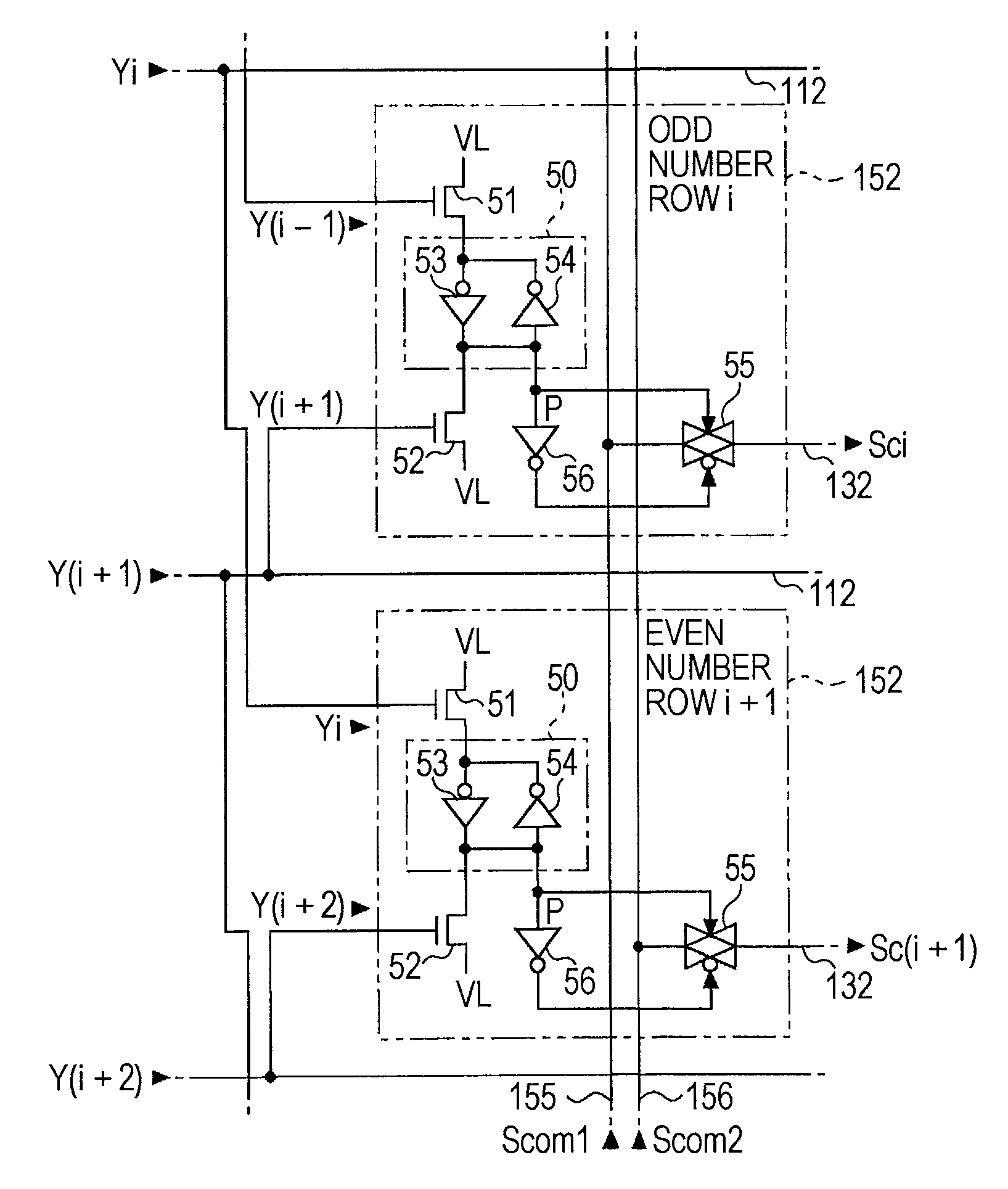
[0057]Next, an electro-optical device according to a second embodiment will be described. FIG. 7 is a block diagram showing a configuration of the electro-optical device according to the second embodiment. In the first embodiment shown in FIG. 1, while a writing polarity is inverted by one row at a time, in the second embodiment, the writing polarity is inverted by two rows at a time. Therefore, the second embodiment is different from the first embodiment in terms of two points: one is that the capacitance signal of the second embodiment includes a first capacitance signal Scom1 and a second capacitance signal Scom2 (a first difference), and the other is that in the capacitance-line-driving circuits 150L and 150R the connection relation of the unit control circuits 152 in odd-numbered rows is different from that in even-numbered rows (a second difference). Since the second embodiment has similar configurations to the first embodiment other than the above differences, the follow...
third embodiment
[0065
[0066]In the first and the second embodiment described above, for example as for a row i, the terminal P in the unit control circuit 152 is maintained at L level except two horizontal-scanning periods including horizontal-effective-scanning periods in which the row i and row i−1 are selected. On this account, except the two horizontal-scanning periods, the transmission gate 55 becomes an off-state, and therefore the capacitance line 132 is not connected to any signal line 153 (155 and 156) (high impedance state), and the voltage of the capacitance line 132 is maintained only by the parasitic capacitance or the like. Under such high impedance state, if noise or the like are superposed on the capacitance line 132, voltage of the capacitance line 132 is varied from the voltages VSH and VSL. The voltage variation of the capacitance line 132 effects on the sustaining voltage of the pixel capacitances 120 of one row which share the capacitance line 132, causing deterioration of the d...
PUM
 Login to View More
 Abstract
Description
Claims
Application Information
 Login to View More