Unlock instant, AI-driven research and patent intelligence for your innovation.

Method for detecting target materials using nuclear quadrupole resonance

a target material and nuclear quadrupole resonance technology, applied in the field of detection of target materials, can solve the problems of large amount of power required for rf pulses, process about, problems and issues may still arise, etc., and achieve the effect of effectively measuring the nqr emission and optimizing power consumption

Inactive Publication Date: 2016-11-22
BAE SYST INFORMATION & ELECTRONICS SYST INTERGRATION INC
View PDF15 Cites 0 Cited by
  • Summary
  • Abstract
  • Description
  • Claims
  • Application Information

AI Technical Summary

Benefits of technology

The invention is a system and method for detecting explosive materials using a safe level of RF power. The system optimizes power consumption through continuous wave irradiation signals at targeted frequencies, allowing for effective scanning of humans potentially carrying explosive or target molecules with up to 1 W of power. The method also includes steps to avoid false alarms or positives by conducting multiple detection tests within a frequency range and increasing the dwell time by lengthening the time a sample material is exposed to the radiation excitation frequency. Additionally, the invention monitors the total power output from multiple signal generators so that the safety level of the total power output across all signal generators does not exceed a predetermined level of about 1 watt.

Problems solved by technology

The combined forces of these fields cause the quadrupole to experience a torque, which causes it to precess about the electric field gradient.
Problems and issues may still arise with the '898 patent, namely, with respect to the detection of explosives or other contraband.
One problem is that certain non-explosive materials also contain nitrogen bonds having energy levels substantially equal or in a similar frequency range as an explosive or contraband material.
An additional problem results from the RF pulses.
The RF pulses require a large amount of power.
This system would be unsafe for direct human use.
Further, an issue arises where the RF pulses would require a relaxation time (the time between the broadcasted pulse signals and a receiver being able to locate a return frequency signal) in the range of about 3 to 8 seconds for detecting trinitrotoluene (TNT).
This relaxation time is too long for any real world application requiring scanning of moving people.
Or, this problem would also arise when the pulsed system would be transmitting signals while simultaneously trying to measure or listen for the return frequency.
Another issue with pulsed NQR detection systems is there is a large dynamic range in decibels (db, the ratio between two values of a physical quantity, power and intensity [amplitude]).
This is an extremely low level of return signal strength, making it difficult to positively identify the nitrate.
The '884 application is remarkable in that problems may arise with respect to searching for target material.
The '884 application may still have relaxation times in the range of 3-8 seconds for target materials, such as TNT, because the '884 application does not disclose any way of suppressing the transmitted excitation signal from overdriving or jamming the receiver detection circuit.
Further, it may be unsafe for human use depending on the total power irradiating the sample material.

Method used

the structure of the environmentally friendly knitted fabric provided by the present invention; figure 2 Flow chart of the yarn wrapping machine for environmentally friendly knitted fabrics and storage devices; image 3 Is the parameter map of the yarn covering machine
View more

Image

Smart Image Click on the blue labels to locate them in the text.
Viewing Examples
Smart Image
  • Method for detecting target materials using nuclear quadrupole resonance
  • Method for detecting target materials using nuclear quadrupole resonance
  • Method for detecting target materials using nuclear quadrupole resonance

Examples

Experimental program
Comparison scheme
Effect test

second embodiment

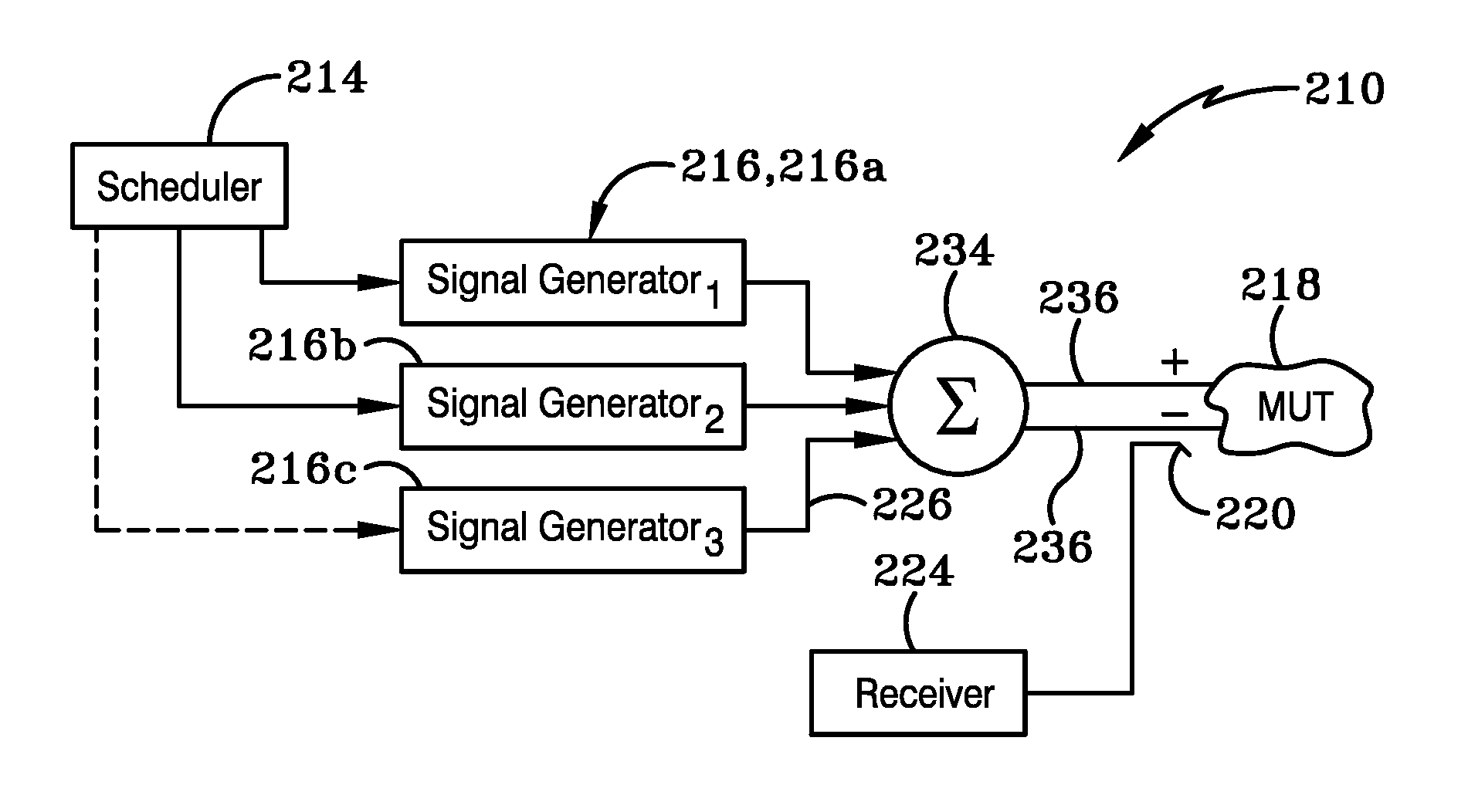
[0060]As shown in FIG. 3, a second embodiment system 210 may include a scan schedule 214, a signal generator 216, sample material 218, a directional coupler 220, a receiver 224, transmission lines 226, a mixer or diplexor 234, and twin lead lines 236. Scheduler 214 is in communication with generator 216. As shown in FIG. 3, generator 216 can be furcated into multiple generators, shown as 216a, 216b, and 216c, respectively, each able to broadcast a continuous wave irradiation signal at a given frequency. These three signals are carried via transmission lines 226 to mixer 234 and broadcasted to material 218 via twin lead lines 236. Return frequencies are transmitted through the directional coupler 220 to a receiver 224. Receiver 224 is preferably a twenty-bit receiver having a dynamic range receiving capacity between about 0 to about 90 db. In this system, the multiple excitation frequencies are directly coupled to a single probe within the measurement chamber. NQR emissions from the ...

third embodiment

[0062]As shown in FIG. 4, a third embodiment system 310 to detect explosives using NQR includes a random scan scheduler 314, a pulsed signal generator 316, sample material 318, a directional coupler, an amplifier 322 and a receiver 324. Signals are transmitted through transmission lines 326 through amplifier 322 and broadcasted into sample material 318. Return frequencies are transmitted through the directional coupler 220 to a receiver 224. The scheduler that controls the frequencies and pulses transmitted by the signal generator selects the frequencies rather randomly to prevent an independent observer that might be monitoring the test frequencies and their sequence of transmission pulses from being recorded for later application of countermeasures to prevent the system from detecting the targeted material in the MUT or simply by selecting a material that is not being checked for on that particular day for expediency purposes.

[0063]Rather than providing a continuous wave irradiati...

fourth embodiment

[0066]With primary reference to FIG. 5, a fourth embodiment system 410 includes a library 412, a power control 414, a signal generator 416, sample material 418, a directional coupler 420, an amplifier 422, a correlator 424, transmission lines 426, a mixer or diplexer 434 for transmitting signals via twin leads 436 to sample material 418. As shown in FIG. 5, power control may be separated into individual control units 414a, 414b, and 414c connected to first signal generator 416a, second signal generator 416b, and third signal generator 416c, respectively. Generators 416a-c transmit signals to mixer 434 for transmitting signals via twin leads 436 to sample material 418. Directional coupler 420 permits return signals from sample material 418 to be sent through amplifier 422 to correlator 424 via transmission lines 426. Library 412 is operatively connected to correlator 424.

[0067]In accordance with another aspect of the invention as herein described above, the system 410 provides a syst...

the structure of the environmentally friendly knitted fabric provided by the present invention; figure 2 Flow chart of the yarn wrapping machine for environmentally friendly knitted fabrics and storage devices; image 3 Is the parameter map of the yarn covering machine
Login to View More

PUM

PropertyMeasurementUnit
relaxation timeaaaaaaaaaa
relaxation timesaaaaaaaaaa
Login to View More

Abstract

A method for detecting target material or explosives using Nuclear Quadrupole Resonance, comprises the steps of providing a sample material to test for a target material. The sample material is then irradiated with a first frequency from a continuous wave signal generator to create at least one sample material return frequency. A return frequency is then measured and it is determined whether the sample material contains the target material by comparing the return frequency to a known target material frequency in a library. The method allows for simultaneous irradiation of sample material and measuring the return frequency of the sample material. The method utilizes NQR to detect explosive material using a power safe for human scanning and testing.

Description

CROSS REFERENCE TO RELATED APPLICATIONS[0001]This application claims the earliest benefit of U.S. Provisional Application Ser. No. 61 / 692,840 filed on Aug. 24, 2012; Ser. No. 61 / 692,842 filed on Aug. 24, 2012; Ser. No. 61 / 692,846 filed on Aug. 24, 2012; Ser. No. 61 / 692,850 filed on Aug. 24, 2012, the disclosures of which are incorporated herein by reference.BACKGROUND OF THE INVENTION[0002]Technical Field[0003]The present invention relates generally to the detection of a target material contained within a sample material. More particularly, the present invention relates the detection of explosives contained in a sample material. Specifically, the present invention utilizes Nuclear Quadrupole Resonance to locate the target material so it may be evaluated and determined whether it is an explosive.[0004]Background Information[0005]Since the earliest days of explosive and contraband detection, people have been trying to gain advantages over their opponents. These advantages have become ...

Claims

the structure of the environmentally friendly knitted fabric provided by the present invention; figure 2 Flow chart of the yarn wrapping machine for environmentally friendly knitted fabrics and storage devices; image 3 Is the parameter map of the yarn covering machine
Login to View More

Application Information

Patent Timeline
no application Login to View More
Patent Type & Authority Patents(United States)
IPC IPC(8): G01N24/08G01R33/44
CPCG01N24/084G01R33/441
Inventor ZANK, PAUL A.
Owner BAE SYST INFORMATION & ELECTRONICS SYST INTERGRATION INC