Latex solution for producing lignin nonwoven cloth for cigarette

A technology of latex and non-woven fabrics, applied in the fields of application, tobacco, and non-woven fabrics, can solve the problems of high moisture regain, low wet strength, and poor compression resilience, and achieve low moisture regain, high wet strength, and compression Good resilience effect

CN101402773AActive Publication Date: 2009-04-08JIANGSU DAYA CIGARETTE FILTER MATERIAL CO LTD
3 Cites 4 Cited by

Patent Information

Authority / Receiving Office
CN · China
Current Assignee / Owner
Publication Date
2009-04-08

Smart Images

  • Figure 1
    Figure 1
  • Figure 2
    Figure 2
  • Figure 3
    Figure 3
Patent Text Reader

Abstract

The invention discloses latex used for the production of tobacco used wood pulp non-woven, which consists of an adhesive, a cross-linking agent, water and a curing agent and a stabilizer; the adhesive is any one of the following substances: vinyl acetate, vinyl acetate copolymer, acrylic ester and acrylic copolymer or the mixture of vinyl acetate and vinyl acetate copolymer or the mixture of acrylic ester and acrylic copolymer; the cross-linking agent is any of the following substances: HMMM, polyfunctional aziridine, bifunctional end aziridine or closed isocyanate; the curing agent is ammonium chloride; and the stabilizer is ammonia water. Compared with the prior art, the tobacco used wood pulp non-woven produced with the latex has the advantages of higher humidity and strength, lower moisture regain, good compression elasticity, as well as good stiffness and filtering performance when being used as cigarette holder so that the cigarette is not apt to occur hot collapse or generate foreign odor when being smoked.
Need to check novelty before this filing date? Find Prior Art

Description

technical field

[0001] The invention relates to a latex for producing wood pulp non-woven fabrics, and in particular to a latex for producing wood pulp non-woven fabrics for cigarette filters. Background technique

[0002] Traditional non-woven fabrics are mainly produced by methods such as spinning, melt blown, spunlace, needle punching, thermal bonding and chemical bonding. The web-forming technology mainly adopts dry-laid (including mechanical-laid and air-laid), wet-laid and polymer extrusion-laid. The reinforcement process of the fiber web includes mechanical reinforcement, chemical bonding and thermal bonding.

[0003] Typically, air-laid, dry-laid, card-laid, and wet-laid nonwovens are different from traditional textiles that rely on yarn interweaving to create cohesion, and have little strength without treatment. In practice, they require physical, chemical or thermal consolidation to provide sufficient strength, stiffness and resilience, etc.

[0004] When non-wo...

Examples

Embodiment 1

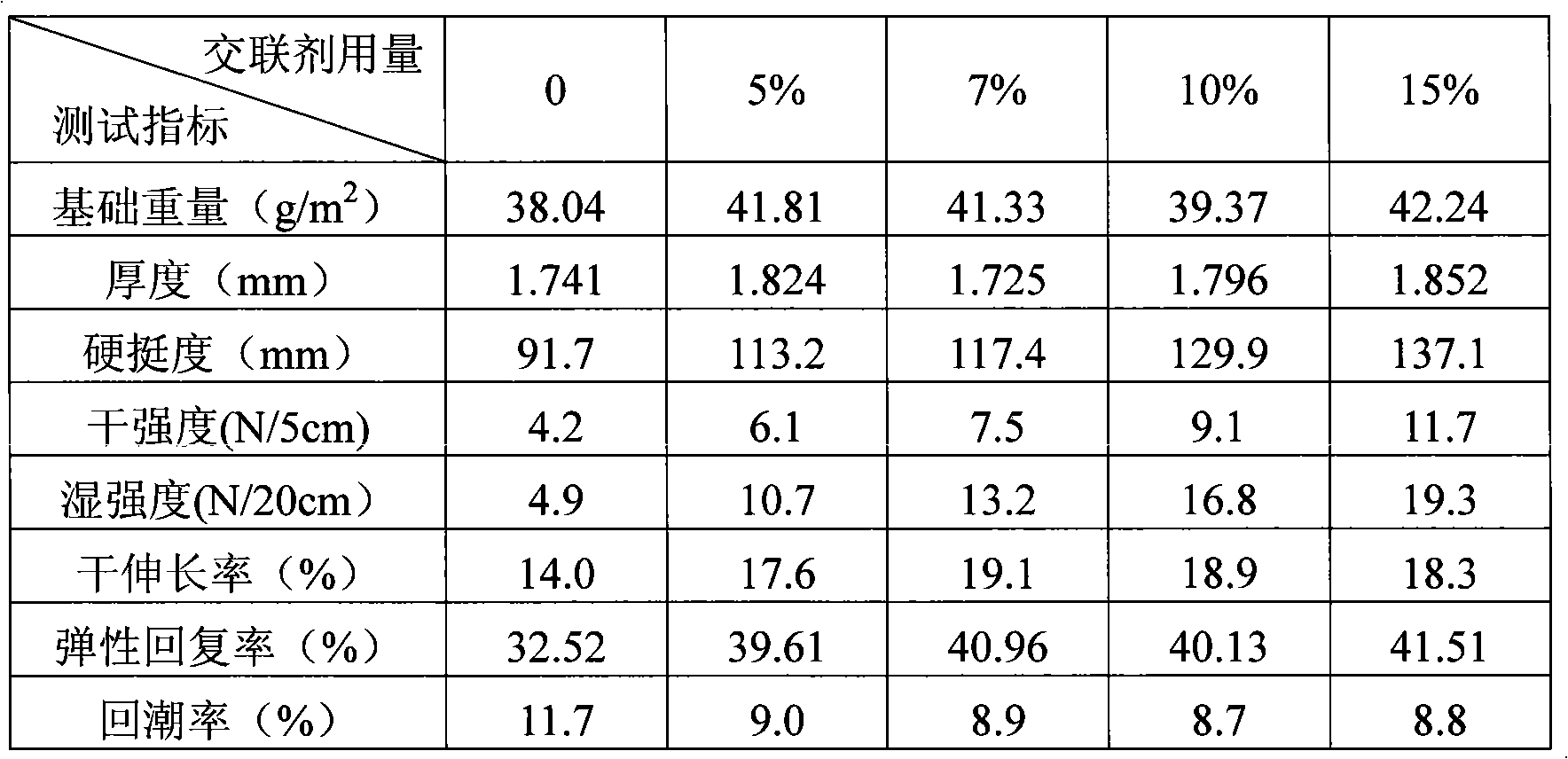
[0016] In the latex, mix vinyl acetate copolymer and vinyl acetate binder in a mass ratio of 5:5, apply HMMM cross-linking agent, and add stabilizer ammonia water, adjust the pH value of the latex within the range of 7.5 to 9.0, wherein The solid content of the vinyl acetate copolymer and the vinyl acetate adhesive is 55%, the crosslinking agent CPS4000~6000, and the solid content of the latex emulsion is 8%. The obtained latex emulsion was used to produce non-woven fabrics, and the test indexes of the non-woven fabrics are listed in Table 1.

[0017] Table 1. The non-woven fabric index under the formula of embodiment 1

[0018]

Embodiment 2

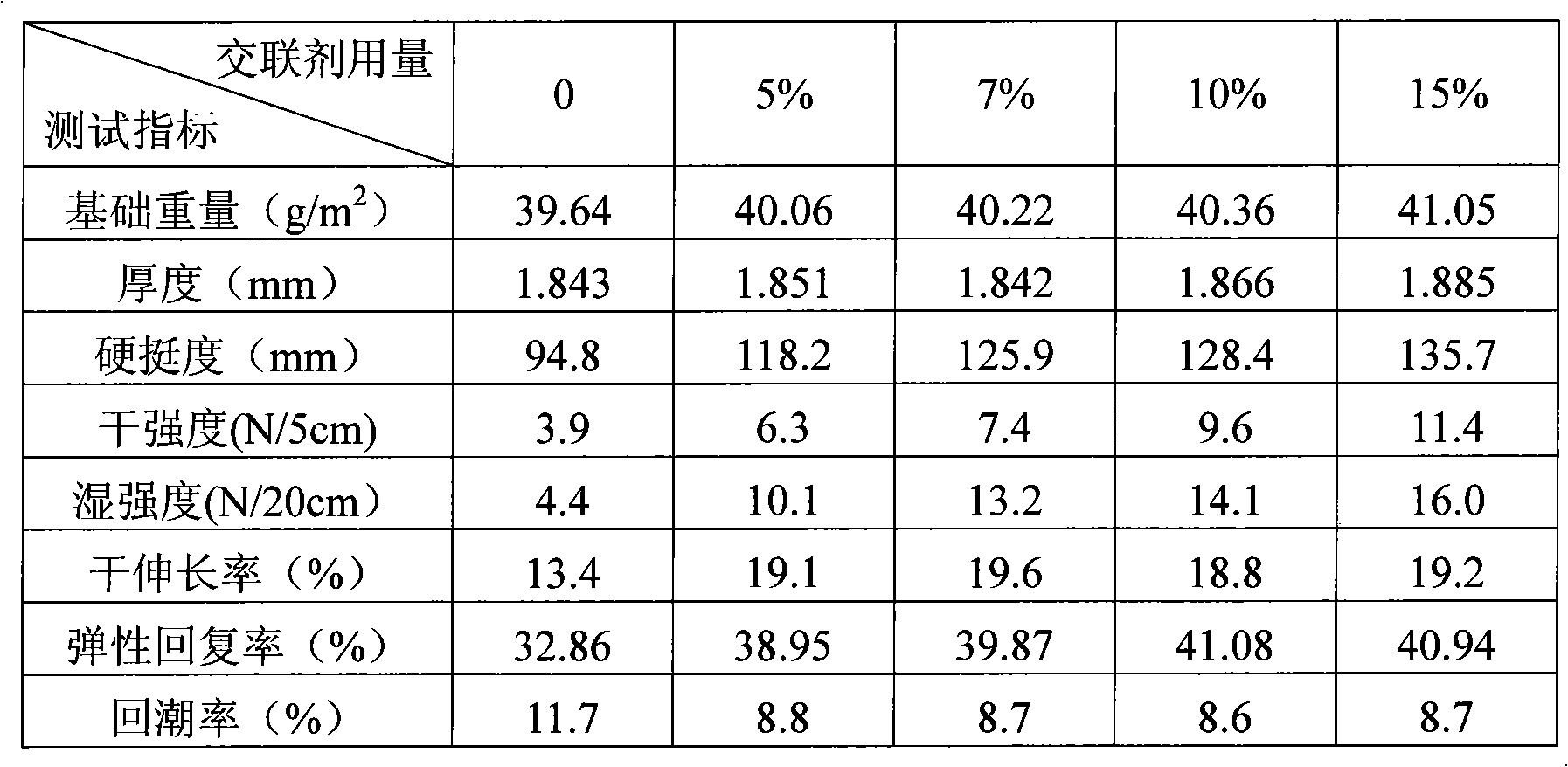
[0020] Vinyl acetate in embodiment 1 and the mass ratio of vinyl acetate copolymer adhesive are changed into 3: 7, and the non-woven fabric index produced under the latex emulsion formula formed under other conditions unchanged is listed in table 2 .

[0021] Table 2. The non-woven fabric index under the formula of embodiment 2

[0022]

Embodiment 3

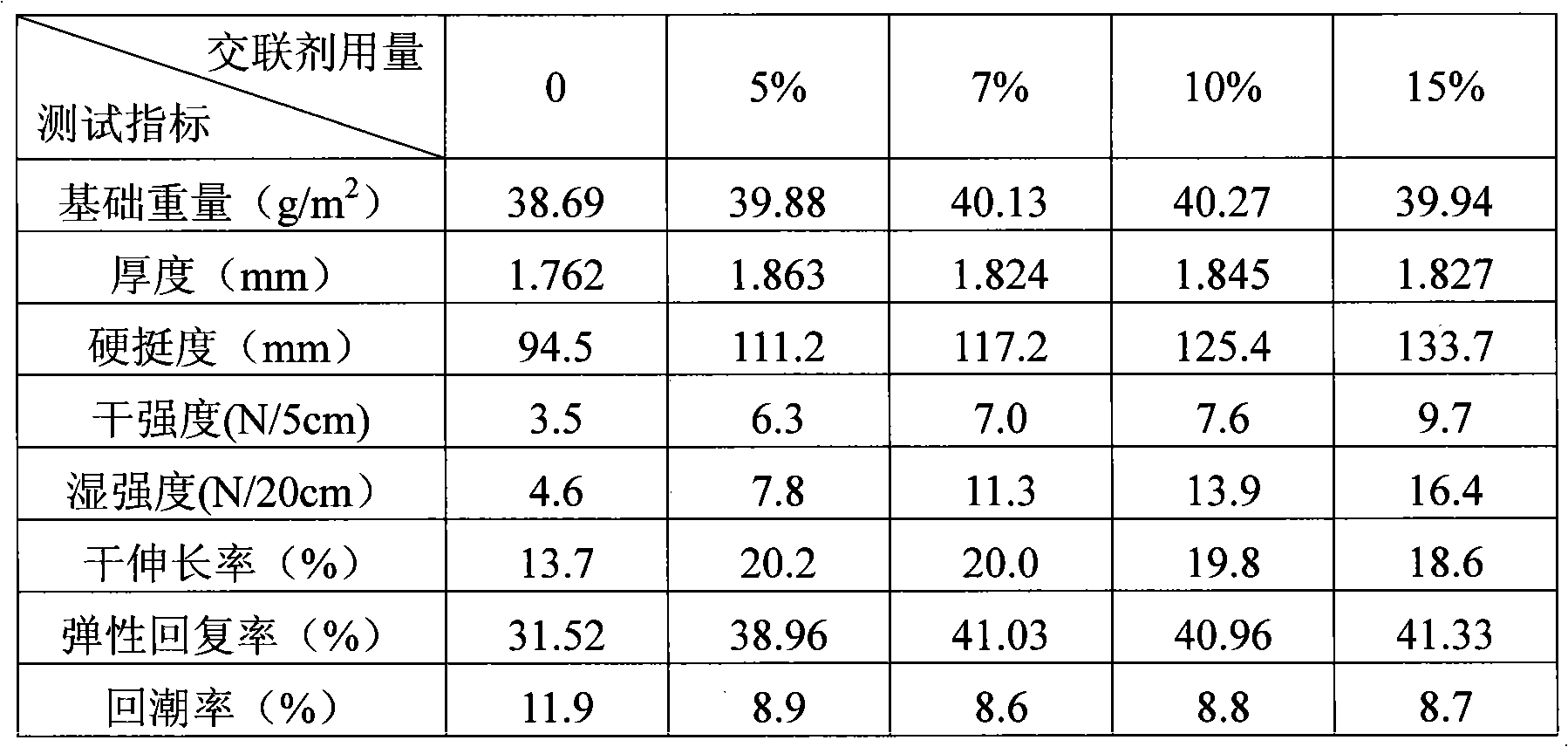
[0024] In the latex emulsion of Example 1, the mass ratio of vinyl acetate and vinyl acetate copolymer was changed to 7: 3, and the indicators of the non-woven fabric produced under the latex emulsion formula formed under other conditions were listed in Table 3.

[0025] Table 3. The non-woven fabric index under the formula of embodiment 3

[0026]