Check patentability & draft patents in minutes with Patsnap Eureka AI!

Method for preparing polylactic acid with sulfamic acid compound as catalyst

A technology of sulfamic acid and compounds, which is applied in the field of direct polycondensation of lactic acid under the action of a composite catalyst to prepare high-molecular-weight polylactic acid, can solve the problems of poor thermal stability of polymers, large dosage, and low melting point of polylactic acid, etc., and achieve simple process , low-cost effect

Active Publication Date: 2009-04-15
萘琪沃克有限责任公司
View PDF0 Cites 2 Cited by
  • Summary
  • Abstract
  • Description
  • Claims
  • Application Information

AI Technical Summary

Problems solved by technology

[0035] However, so far, the melting point of polylactic acid prepared by direct melting and solid state polymerization is not high.
In addition, due to the large amount of tin catalyst used in the direct method, the thermal stability of the polymer obtained is far inferior to that of polylactic acid obtained by ring-opening polymerization.

Method used

the structure of the environmentally friendly knitted fabric provided by the present invention; figure 2 Flow chart of the yarn wrapping machine for environmentally friendly knitted fabrics and storage devices; image 3 Is the parameter map of the yarn covering machine
View more

Image

Smart Image Click on the blue labels to locate them in the text.
Viewing Examples
Smart Image
  • Method for preparing polylactic acid with sulfamic acid compound as catalyst
  • Method for preparing polylactic acid with sulfamic acid compound as catalyst
  • Method for preparing polylactic acid with sulfamic acid compound as catalyst

Examples

Experimental program
Comparison scheme
Effect test

Embodiment A1

[0056] After injecting 500g of L-lactic acid solution (90wt%) into a 1000ml three-necked bottle, the three-necked bottle was put into an oil bath. After installing mechanical stirring, connecting the vacuum / nitrogen system, and inserting the thermocouple thermometer, replace nitrogen twice under stirring conditions. At normal pressure, the temperature was raised to 130°C in 20 minutes. Under the premise of not bumping, the pressure is gradually reduced to 50kPa, 20kPa, 10kPa, 5kPa in stages and kept at each pressure stage for 30 minutes (including decompression time), that is, a total of 2 hours of dehydration under reduced pressure to obtain 430g Lactic acid polymer A1, the degree of polymerization is 3 (determined by end group analysis, the same below)

Embodiment A2

[0058] After injecting 500g of L-lactic acid solution (90wt%) into a 1000ml three-necked bottle, the three-necked bottle was put into an oil bath. After installing mechanical stirring, connecting the vacuum / nitrogen system, and inserting the thermocouple thermometer, replace nitrogen twice under stirring conditions. At normal pressure, the temperature was raised to 100°C in 15 minutes. Under the premise of not bumping, the pressure is gradually reduced to 40kPa, 20kPa, 10kPa, 5kPa in stages and kept at each pressure stage for 120 minutes (including decompression time), that is, a total of 8 hours of dehydration under reduced pressure to obtain 410g Lactic acid polymer A2, the degree of polymerization is 4.

Embodiment A3

[0060] After injecting 500g of L-lactic acid solution (90wt%) into a 1000ml three-necked bottle, the three-necked bottle was put into an oil bath. After installing mechanical stirring, connecting the vacuum / nitrogen system, and inserting the thermocouple thermometer, replace nitrogen twice under stirring conditions. Under normal pressure, the temperature was raised to 80°C in 10 minutes. On the premise of not bumping, adjust the pressure and temperature to 50kPa and 80°C, 40kPa and 100°C, 30kPa and 120°C, 20kPa and 140°C, 10kPa and 160°C, 5kPa and 180°C in stages Hold for 30 minutes (including temperature and pressure adjustment time), that is, dehydration under reduced pressure for a total of 2.5 hours, to obtain 418 g of lactic acid polymer A3 with a degree of polymerization of 5.

[0061] Preparation of lactic acid prepolymer

the structure of the environmentally friendly knitted fabric provided by the present invention; figure 2 Flow chart of the yarn wrapping machine for environmentally friendly knitted fabrics and storage devices; image 3 Is the parameter map of the yarn covering machine
Login to View More

PUM

PropertyMeasurementUnit
melting pointaaaaaaaaaa
Login to View More

Abstract

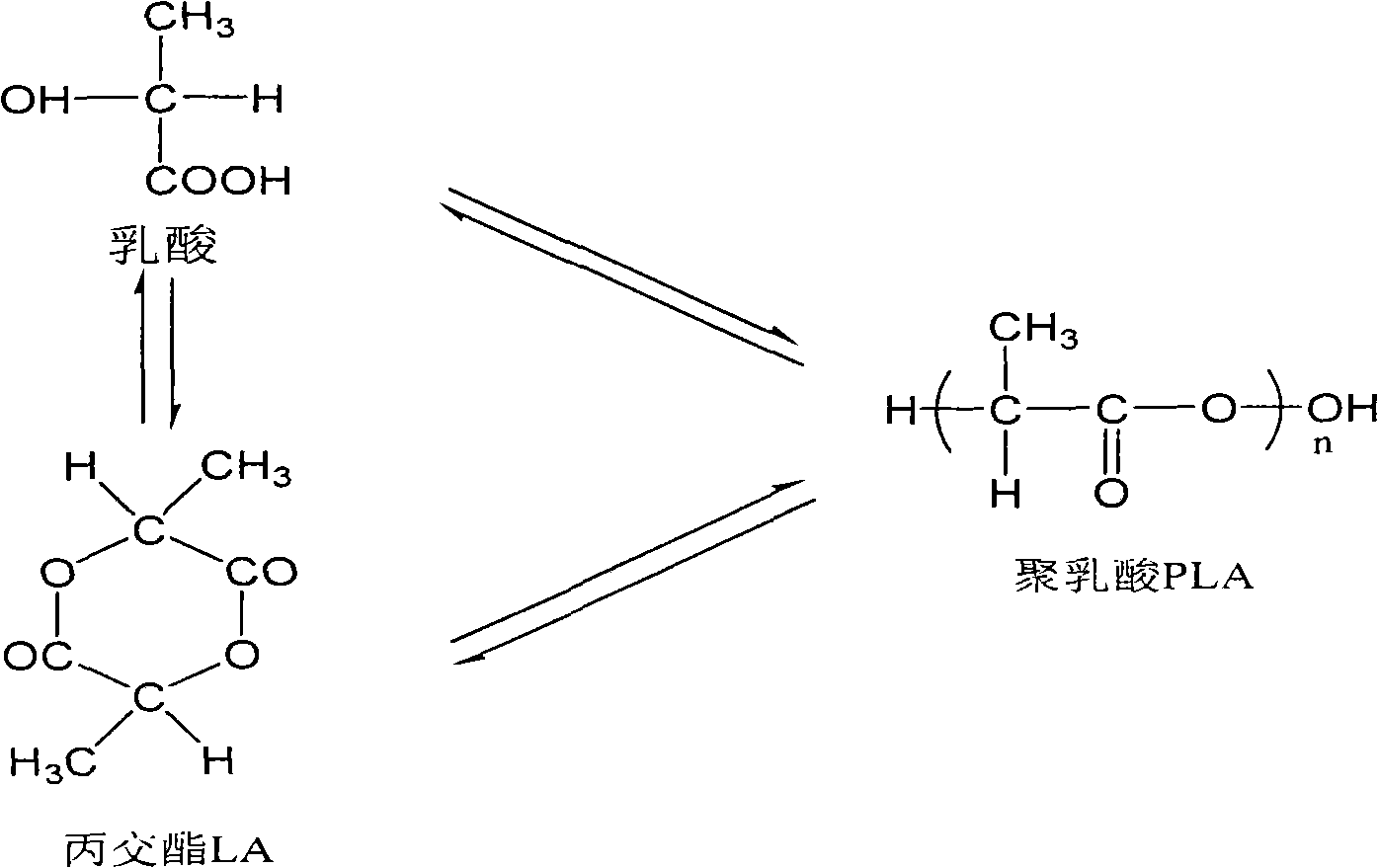
The invention discloses a method for preparing polylactic acid, which adopts an amidosulphuric acid compound as catalyst and lactic acid as raw materials. First, lactic acid polymer is obtained after one to eight hours of decompression and dehydration with the temperature of 80 to 180 DEG C; the catalyst, the amidosulphuric acid compound or composite catalyst, the amidosulphuric acid compounds and a tin compound are added into the lactic acid polymer and then after three to twenty four hours of decompression and fusion polymerization with the temperature of 120 to 200 DEG C, preformed polymer is obtained; and the preformed polymer is sent into decompressed or inert atmosphere with the temperature of 140 to 180 DEG C for solid phase polymerization for eight to one hundred and twenty hours and at last polylactic acid is obtained. The method of the invention overcomes shortcomings of a direct method for preparing polylactic acid through fusion polymerization and solid phase polymerization; and the polylactic acid obtained from the direct method is characterized by the low melting point and the bad thermal stability. However the polylactic acid obtained from the method of the invention is characterized by the high molecular weight, the high melting point and the high thermal stability. The method of the invention is also characterized in that the producing process is comparatively simple and the cost is comparatively low.

Description

technical field [0001] The invention belongs to the field of polymer materials, and in particular relates to a method for preparing high-molecular-weight polylactic acid through direct polycondensation of lactic acid under the action of a composite catalyst. Background technique [0002] With the development of science and society, people pay more and more attention to environmental and resource issues and become global issues. Petroleum-based plastic materials are widely used, and such materials are difficult to recycle after use, resulting in a relatively serious "white pollution" problem; moreover, resources such as petroleum are non-renewable resources, and a large number of unreasonable uses have brought human There is a serious shortage of resources. The emergence of degradable materials, especially the recyclability of raw materials for degradable materials, provides an effective means to solve this problem. [0003] Polylactic acid (PLA) is a degradable material th...

Claims

the structure of the environmentally friendly knitted fabric provided by the present invention; figure 2 Flow chart of the yarn wrapping machine for environmentally friendly knitted fabrics and storage devices; image 3 Is the parameter map of the yarn covering machine
Login to View More

Application Information

Patent Timeline
no application Login to View More
Patent Type & Authority Applications(China)
IPC IPC(8): C08G63/08C08G63/87
Inventor 郭晓左璞晶朱可新于波王枫何勇
Owner 萘琪沃克有限责任公司
Features
  • R&D
  • Intellectual Property
  • Life Sciences
  • Materials
  • Tech Scout
Why Patsnap Eureka
  • Unparalleled Data Quality
  • Higher Quality Content
  • 60% Fewer Hallucinations
Social media
Patsnap Eureka Blog
Learn More