
Fruit anti-staling agent
A preservative and fruit technology, applied in the field of biochemistry, can solve the problems of limited fresh-keeping effect, lack of effective control measures for pathogenic microorganisms, few natural green substances to prepare preservatives, etc., and achieve good fresh-keeping effect
- Summary
- Abstract
- Description
- Claims
- Application Information
AI Technical Summary
Problems solved by technology
Method used
Image

Examples
Embodiment 1
[0046] Embodiment 1: fresh-keeping test of navel orange
[0047] Citrus penicillium italium and green mold (Penicillium digitaum) are the main storage diseases of citrus after harvest. According to statistics, penicillium and green mold are the most important losses of citrus fruit due to rotten fruit during storage and transportation, accounting for more than 90%.
[0048] The composition of navel orange preservative is as follows:
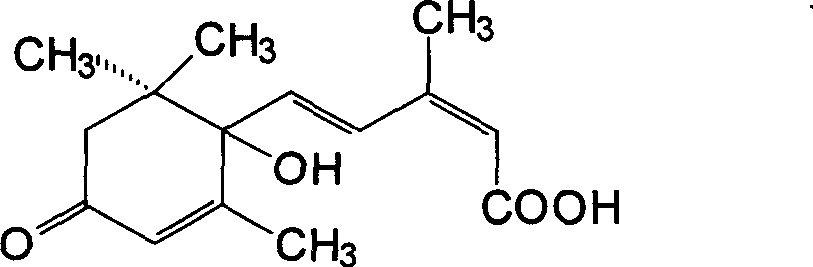
[0049] Natural Abscisic Acid 35.0 mg
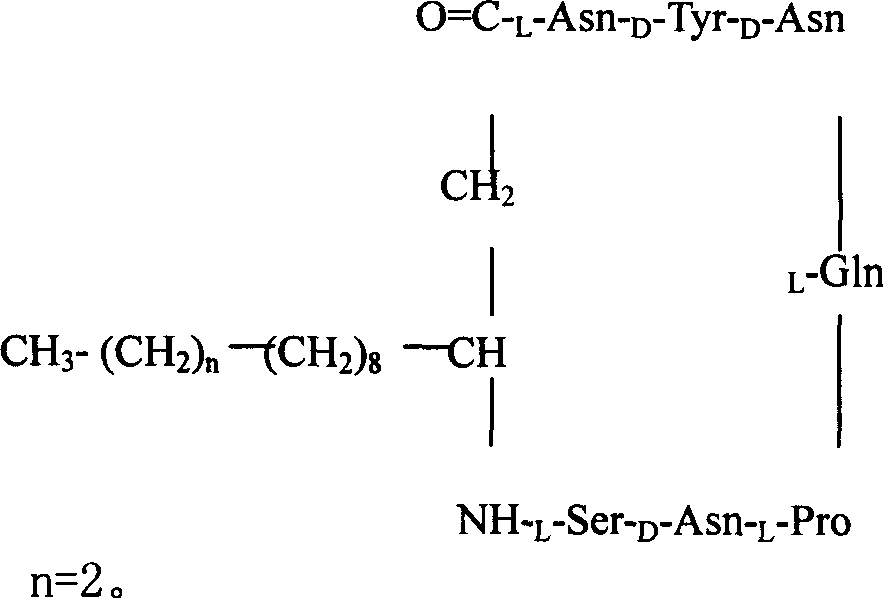
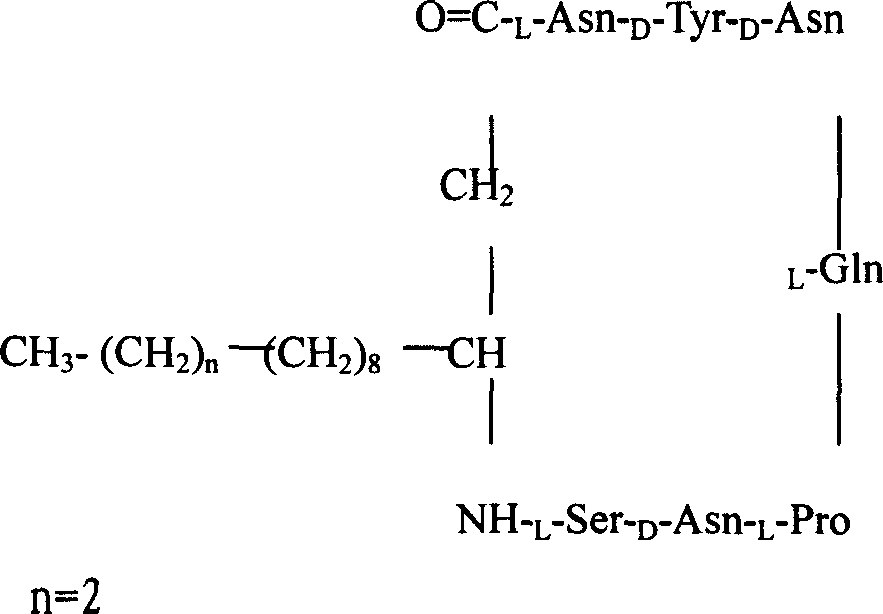
[0050] Iturin 20.0g
[0051] γ-polyglutamic acid 1L (with 10g dry matter)
[0052] Dissolve the above-mentioned natural abscisic acid and iturin in a small amount of sterile water, add to the sterile aqueous solution containing γ-polyglutamic acid (containing 10 g of dry matter), add sterile water to a volume of 1 L, and fully Stir evenly, spray evenly on the surface of the fruit with a sprayer, or dip the fruit in the liquid for 2-10 seconds, dry it and place it away from light and air.
[0053] Invest...
Embodiment 2
[0055] Embodiment 2: litchi preservation test
[0056] Sour rot of litchi [Geotrichum candidum Link] and Peronophthora litchi Chen ex Ko et al. are the main storage diseases of litchi after harvest, and the preservation and storage of litchi is also a big problem.
[0057] The composition of preservatives used in litchi preservation is as follows:
[0058] Natural Abscisic Acid 50.0mg
[0059] Iturin 30.0g
[0060] Gamma-polyglutamic acid 1L (contains 15g dry matter)
[0061] Dissolve the above-mentioned natural abscisic acid and iturin in a small amount of sterile water, add to the sterile aqueous solution containing γ-polyglutamic acid (containing 15 grams of dry matter), add sterile water to a volume of 1 L, and fully Stir evenly, immerse the lychee in the liquid for 2-10 seconds, dry it and place it away from light and air.
[0062] Investigation on Result of Litchi Preservation Test
[0063]
[0064]
Embodiment 3
[0065] Embodiment 3: Apple preservative
[0066] Apple ring spot fungus (Botryosphaeria berengeriana) is the main storage disease of apples after harvest. In the long-term storage of apples, the main problems are dehydration shrinkage and mildew.
[0067] The composition of apple preservative is as follows:
[0068] Natural Abscisic Acid 25.0 mg
[0069] Iturin 40.0g
[0070] Sodium Carboxymethyl Cellulose 1L (Contains 12g dry matter)
[0071] Dissolve the above-mentioned natural abscisic acid and iturin with a small amount of sterile water, add it to the sterile aqueous solution containing sodium carboxymethylcellulose (containing 9 grams of dry matter), add sterile water to a volume of 1 L, and fully Stir evenly, spray evenly on the surface of the fruit with a sprayer, or dip the fruit in the liquid for 2-10 seconds, dry it and place it away from light and air.
[0072] Investigation on the Result of Apple Fresh-keeping Test
[0073]
PUM
 Login to View More
 Abstract
Description
Claims
Application Information
 Login to View More