
Benzimidazole derivative containing alkoxy substituted pyridine
An ethoxyl and methoxyl technology, which is applied in the field of medicine, can solve the problems of large individual differences in pharmacokinetics, reducing surgical operation rates, affecting drug efficacy and pharmacokinetic parameters, etc.
- Summary
- Abstract
- Description
- Claims
- Application Information
AI Technical Summary
Problems solved by technology
Method used
Image

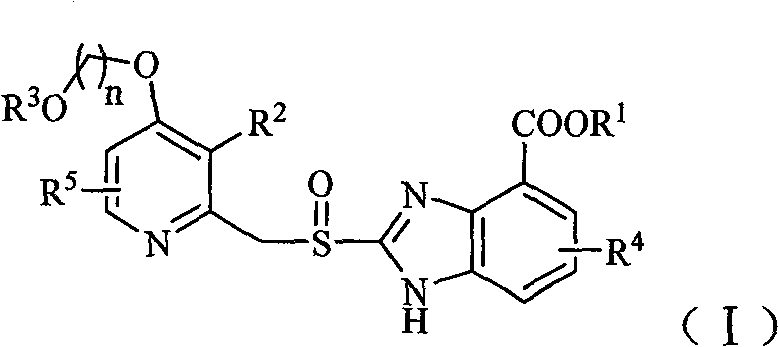
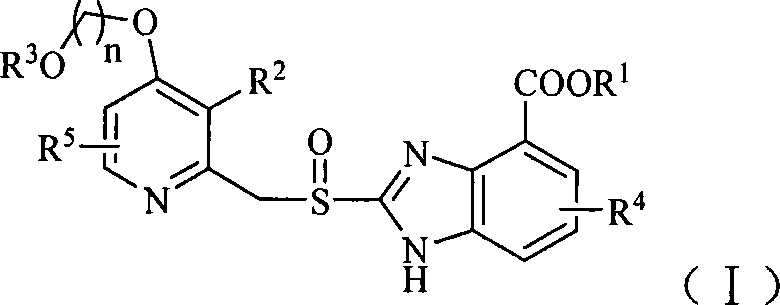
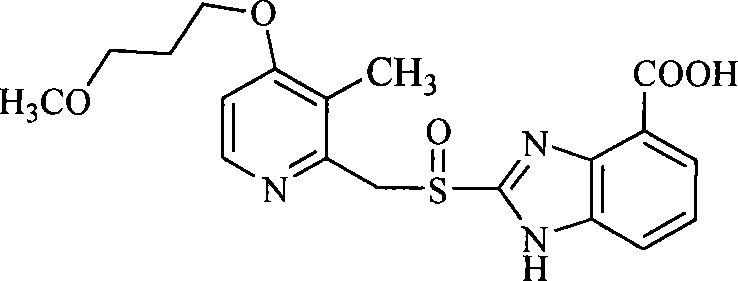
Examples
Embodiment 1
[0102] Example 1 Preparation of 2-mercapto-4-methoxycarbonyl-benzimidazole
[0103] Put 10g (60mmol) of 2,3-diamino-benzoic acid methyl ester into the reaction flask, add 200ml of ethyl acetate, then add 12.8g (80mmol) of potassium ethoxysulfonate, and heat to reflux at 80°C for 4h. After the reaction was completed, cool to room temperature, pour the reaction solution into 200ml of ice water, stir evenly, adjust the pH to 3-4 with 4N hydrochloric acid, precipitate a solid, filter, wash with water until neutral, and vacuum-dry the filter cake to obtain 9.1g of the product. Rate: 73.2%.
Embodiment 2
[0104] Example 2 Preparation of 4-(3-methoxypropoxy)-2,3-dimethyl-N-pyridine oxide
[0105] Add 16.8g (100mmol) of 4-(3-methoxypropoxy)-2,3-dimethyl-N-pyridine oxide, 100ml of 1,3-propylene glycol monomethyl ether, powder Potassium carbonate 20g, heated and stirred under reflux for 12h, stopped the reaction, cooled to room temperature, filtered, the filtrate was concentrated under reduced pressure to recover excess 1,3-propanediol monomethyl ether, and the oily substance 4-(3-methoxypropoxy) - 11.2 g of 2,3-dimethyl-N-pyridine oxide, yield: 53.2%, directly put into the next step for reaction.
Embodiment 3
[0106] Example 3 Preparation of 4-(3-methoxypropoxy)-2-hydroxymethyl-3-methyl-pyridine
[0107] Add 21.1g (100mol) of 4-(3-methoxypropoxy)-2,3-dimethyl-N-pyridine oxide and 200ml acetic anhydride to a dry reaction flask, heat up to 60°C and stir for reaction 1 After 2 hours, the acetic anhydride was distilled off under reduced pressure, 150ml of 2N sodium hydroxide solution was added to the residue, stirred and reacted at 40°C for 4 hours, extracted with chloroform (100ml×3), dried and concentrated to obtain 14.8g of oil, yield 70.2%.
PUM
 Login to View More
 Abstract
Description
Claims
Application Information
 Login to View More