
Preparation method of activated carbon material for electrochemical capacitor
A technology of activated carbon and capacitors, which is applied in the field of preparation of activated carbon materials for electrochemical capacitors, can solve the problems of long time consumption and high energy consumption, and achieve the effects of reducing production costs, saving grinding costs, and accelerating the activation reaction speed
- Summary
- Abstract
- Description
- Claims
- Application Information
AI Technical Summary
Problems solved by technology
Method used
Image

Examples
Embodiment 1
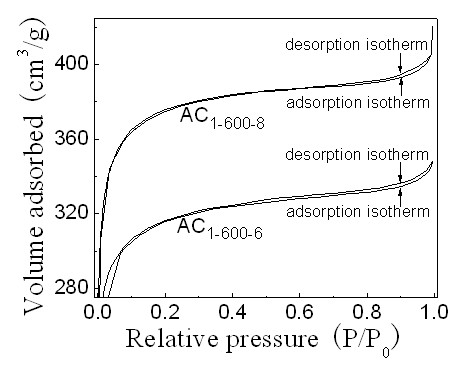
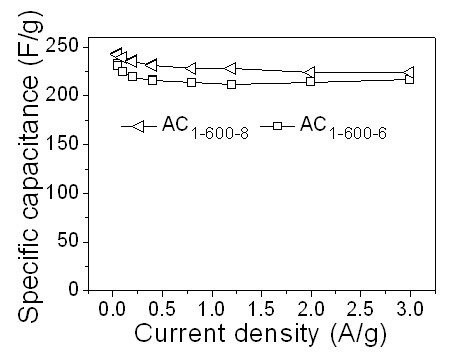
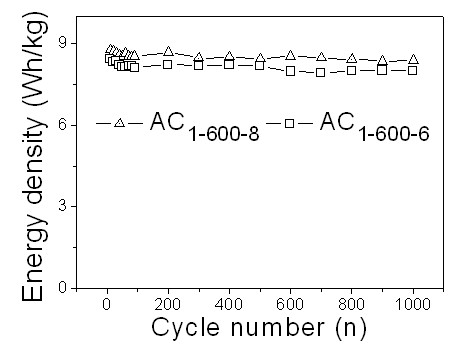
[0020] Embodiment 1: activated carbon AC 1-600-6 Concrete preparation process is as follows:
[0021] (1) Pretreatment of peanut shells: After cleaning and drying the peanut shells cut into small pieces with ordinary water, weigh 27g of peanut shells and place them in a beaker, add 200mL of 0.5M KOH solution, and place the beaker on a magnetic heating stirrer Heating for 2 hours, cooling to room temperature, washing peanut shells with distilled water at 70-80°C until the pH of the filtrate is 7, putting the washed peanut shells into a drying oven and drying at a constant temperature of 110°C for 12 hours to obtain pretreated peanut shells .
[0022] (2) Measure 60mL of distilled water in a beaker, weigh 9g of potassium hydroxide and dissolve in the distilled water in the beaker, stir quickly until the potassium hydroxide lye is obtained at room temperature; weigh 9g of the pretreated peanut shells obtained in step (1) , add to the lye obtained in step (2), stir with a glass ...
Embodiment 2
[0025] Example 2: Activated carbon AC 1-600-8 Concrete preparation process is as follows:
[0026] (1) Pretreatment of peanut shells: implemented in the same manner as step (1) in Example 1.
[0027] (2) Carry out the same method as step (2) in Example 1.
[0028] (3) Carry out the same method as step (3) in Example 1, except that the activation time is 8 minutes.
[0029] (4) Carry out the same method as step (4) in Example 1. The difference is that the resulting activated carbon material is labeled as AC 1-600-8 .
Embodiment 3
[0030] Example 3: AC 1-600-10 Concrete preparation process is as follows:
[0031] (1) Pretreatment of peanut shells: implemented in the same manner as step (1) in Example 1.
[0032] (2) Carry out the same method as step (2) in Example 1.
[0033] (3) Carry out the same method as step (3) in Example 1, except that the activation time is 10 minutes.
[0034] (4) Carry out the same method as step (4) in Example 1. The difference is that the resulting activated carbon material is labeled as AC 1-600-10 .
PUM
| Property | Measurement | Unit |
|---|---|---|
| specific surface area | aaaaa | aaaaa |
| specific surface area | aaaaa | aaaaa |
| volatile matter | aaaaa | aaaaa |
Abstract
Description
Claims
Application Information
 Login to View More