

Spiral urethral stent and production method thereof
A production method and spiral technology, applied in the field of medical devices, can solve the problems of low elasticity of scaffold materials, blockage, and inability to fundamentally solve the problem of urethra, and achieve good tissue compatibility, good dispersion, fragmentation and connection, and foreign matter small effect
- Summary
- Abstract
- Description
- Claims
- Application Information
AI Technical Summary
Problems solved by technology
Method used
Image

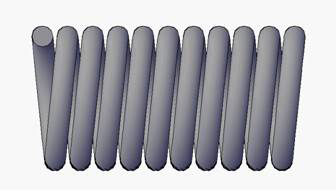
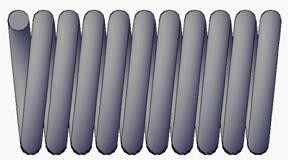
Examples
Embodiment 1
[0021] Example 1 : Composite scaffold material: polyurethane / polylactide (200,000), production steps:
[0022] 1. Mix granular polyurethane and polylactide (200,000) with a particle size of 1mm-10mm evenly in a ratio of 1:2 to make a mixture;
[0023] 2. Put the mixture in step 1 into the extruder and extrude it into a wire with a diameter of 0.5mm at 180-200°C;
[0024] 3. Wind the wire in step 2 into a spiral shape on the mold, and set it at 50° C. for 24 hours to make a spiral urethral stent.
Embodiment 2
[0025] Example 2 : Composite scaffold material: polyethylene / polybutylene succinate (200,000), production steps:
[0026] 1. Mix granular polyethylene and polybutylene succinate (200,000) with a particle size of 1mm-10mm uniformly in a ratio of 1:4 to make a mixture;
[0027] 2. Add the mixture in step 1 into the extruder, and extrude it into a wire with a diameter of 0.3mm at 170-210°C;
[0028] 3. Wind the wire in step 2 into a spiral shape on the mold, and set it at 70° C. for 12 hours to make a spiral urethral stent.
Embodiment 3
[0029] Example 3 : Composite scaffold material: polyamide / polyglycolide (150,000), production steps:
[0030] 1. The flake polyglycolide (150,000) with a diameter of 1mm-5mm and the granular polyamide with a particle size of 1mm-5mm are evenly mixed together in a ratio of 1:1 to make a mixture;
[0031] 2. Put the mixture in step 1 into the extruder and extrude it into a wire with a diameter of 0.5mm at 230-270°C;
[0032] 3. Wind the wire in step 2 into a spiral shape on the mold, and set it at 75° C. for 24 hours to make a spiral urethral stent.
PUM
| Property | Measurement | Unit |
|---|---|---|
| Length | aaaaa | aaaaa |
| Diameter | aaaaa | aaaaa |
| Diameter | aaaaa | aaaaa |
Abstract
Description
Claims
Application Information
 Login to View More