Olefin selective membrane comprising an ionic liquid and a complexing agent
An ionic liquid, olefin technology, applied in membrane technology, separation method, gas treatment, etc., can solve the problems of harmful diaphragm performance, reducing olefin/paraffin selectivity, etc.
- Summary
- Abstract
- Description
- Claims
- Application Information
AI Technical Summary
Problems solved by technology
Method used
Image

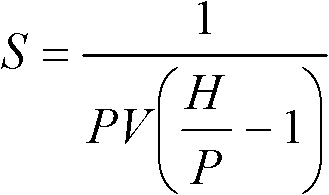
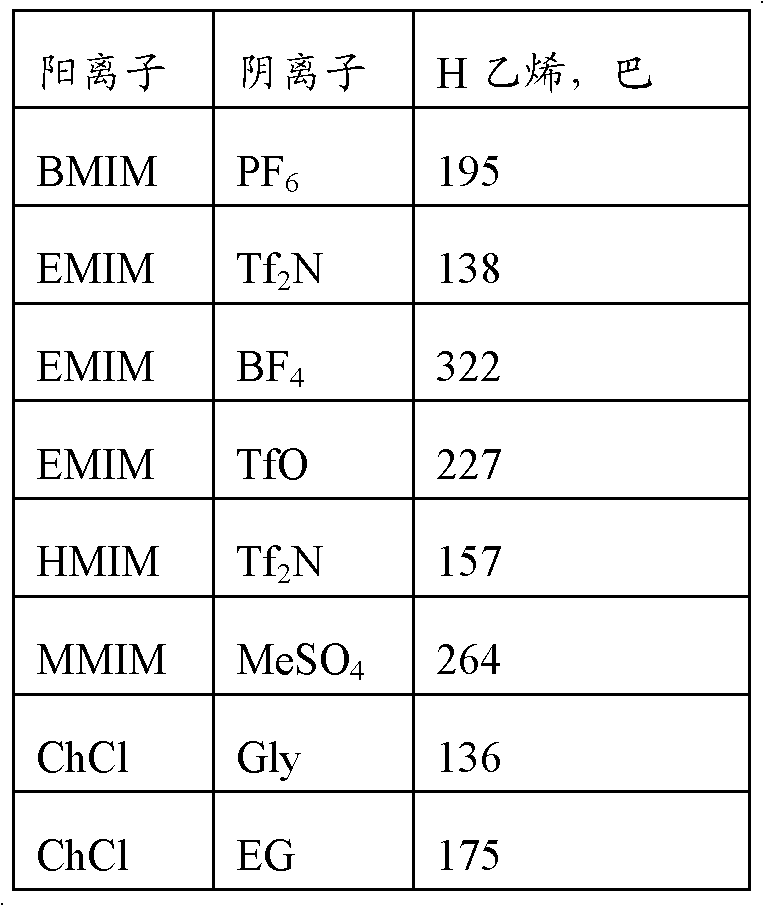

Examples
Embodiment 1 and comparative example 1
[0044] Synthetic choline chloride-urea ionic liquid (embodiment 1)
[0045] A certain amount of pure (99 wt%) choline chloride was added to the flask. An amount of pure (99 wt%) urea was also added to the flask such that the molar ratio of choline chloride to urea was 1:2. The mixture was stirred at 250-500 revolutions per minute (rpm) at 80°C until a homogeneous liquid formed (this was after about 1 hour). A quantity of silver chloride (AgCl) is added and dissolved to the ionic liquid until a point of saturation is approached or reached. This composition is hereinafter referred to as ChCl:U2AgCl.
[0046] Synthesis of 1-butyl-3-methylimidazole Two (trifluoromethane) sulfonamide ionic liquid (comparative example 1)
[0047] A certain amount of ionic liquid 1-butyl-3-methylimidazole Chloride (more than 95 wt%) was added to a 1-neck round bottom flask on a stir plate. Deionized water was added to the ionic liquid (5:1 weight / weight (w / w)) to dissolve the ionic liquid the...
preparation Embodiment 1 and comparative example 1
[0049] Prepare the diaphragm of Example 1 and Comparative Example 1
[0050] 0.5 to 2 g of Example 1 ionic liquid (comprising silver chloride as metal salt favoring olefins) was placed on a glass fiber sample supported by wax paper, and a similar amount of Comparative Example 1 ionic liquid was placed on another Fiberglass samples supported on waxed paper. Each sample was loaded into a permeation cell, and each permeation cell was secured into a pure gas permeation system. Osmotic systems are constant volume / variable pressure systems routinely used in the art. Both samples were exposed to vacuum at 70°C for at least 16 hours prior to testing.
[0051] Test matrix olefin adsorption properties
[0052] Samples of each septum matrix (5 ml each) were placed in vials in a parallel pressure reactor (PPR). The samples were exposed to 200 psi (1379 kPa) ethylene at 30°C. The pressure of ethylene was maintained at 200 psi (1379 kPa) by the PPR for the duration of each test. The a...
Embodiment 2-3 and comparative example 2-7
[0058] Using the methods of Example 1 and Comparative Example 1 respectively, two additional example compositions (Example 2-3) and six comparative compositions (Comparative Examples 2-7) were used to prepare separators, the composition of which is shown in Table 2.
[0059] Table 2
[0060]
[0061] Key: ChCl is Choline Chloride
[0062] U is urea
[0063] Gly is glycerin
[0064] EG is ethylene glycol
[0065] * 2 represents stoichiometry, ie, 2 moles of urea, glycerol, or EG per mole of choline chloride.
[0066] BMIM[AOT] is 1-butyl-3-methylimidazole Dioctyl sulfosuccinate
[0067] BMIM[Tf2N] is 1-butyl-3-methylimidazole Bis(trifluoromethane)sulfonimide
[0068] BMIM[BF4] is 1-butyl-3-methylimidazole Tetrafluoroborate
[0069] It should be noted that although Comparative Examples 2-4 meet the adsorption requirements for the ionic liquids of the present invention operating at 30 °C membrane, they do not contain metal salts that can contribute to olefins, whe...
PUM
 Login to View More
 Abstract
Description
Claims
Application Information
 Login to View More
 - R&D
- Intellectual Property
- Life Sciences
- Materials
- Tech Scout
- Unparalleled Data Quality
- Higher Quality Content
- 60% Fewer Hallucinations
Browse by: Latest US Patents, China's latest patents, Technical Efficacy Thesaurus, Application Domain, Technology Topic, Popular Technical Reports.
© 2025 PatSnap. All rights reserved.Legal|Privacy policy|Modern Slavery Act Transparency Statement|Sitemap|About US| Contact US: help@patsnap.com