Check patentability & draft patents in minutes with Patsnap Eureka AI!

A method and equipment for recycling fluoride in the production of zirconium-containing compounds

A zirconium compound and fluoride technology, applied in zirconia and other directions, can solve the problems of polluting the environment, reducing the utilization rate of fluorine-containing compounds, etc., and achieving the effect of repeated recycling and reducing

Active Publication Date: 2016-05-04
贵州万方铝化科技开发有限公司
View PDF5 Cites 0 Cited by
  • Summary
  • Abstract
  • Description
  • Claims
  • Application Information

AI Technical Summary

Problems solved by technology

Now fluoride will produce a variety of wastes during the use of fluoride, such as ammonium fluoride and ammonium bifluoride as the etchant waste residue ammonium fluorozirconate and fluorine-containing carbon residue produced by the electrolytic zirconium production process; another example is the electrolytic process. A large amount of gas such as hydrofluoric acid and zirconium tetrafluoride and dust such as zirconium fluoride and calcium fluoride; fluorite (CaF 2 ) as a flux, so the dust contains a large amount of harmful substances such as calcium fluoride and hydrogen fluoride; magnesium and zirconium also produce hydrogen fluoride and zirconium tetrafluoride in casting; these fluorine-containing compounds are stored for a long time or directly discharged. Not only will it pollute the environment, Moreover, the utilization rate of these fluorine-containing compounds is reduced

Method used

the structure of the environmentally friendly knitted fabric provided by the present invention; figure 2 Flow chart of the yarn wrapping machine for environmentally friendly knitted fabrics and storage devices; image 3 Is the parameter map of the yarn covering machine
View more

Image

Smart Image Click on the blue labels to locate them in the text.
Viewing Examples
Smart Image
  • A method and equipment for recycling fluoride in the production of zirconium-containing compounds
  • A method and equipment for recycling fluoride in the production of zirconium-containing compounds
  • A method and equipment for recycling fluoride in the production of zirconium-containing compounds

Examples

Experimental program
Comparison scheme
Effect test

Embodiment 1

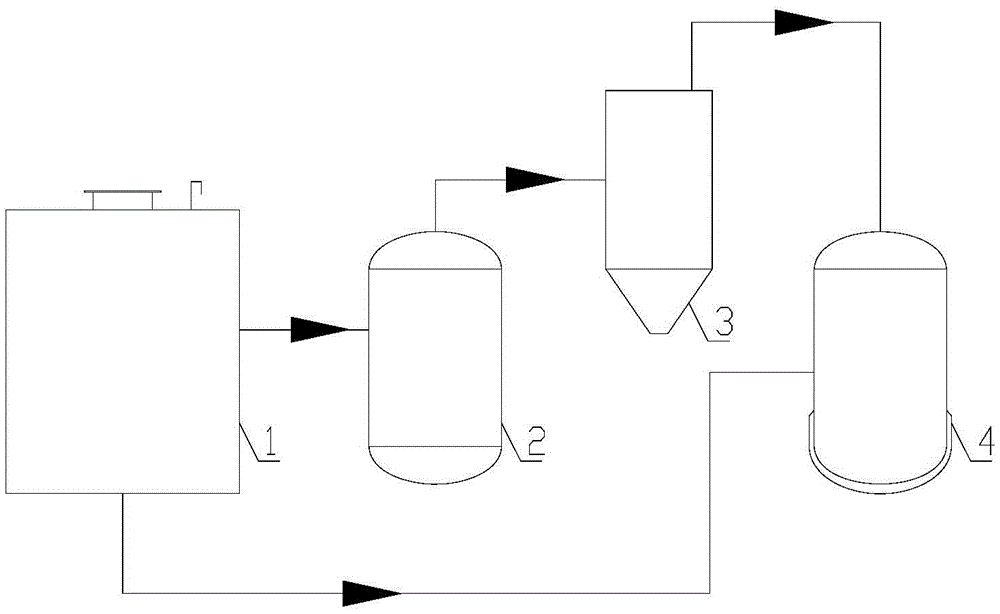
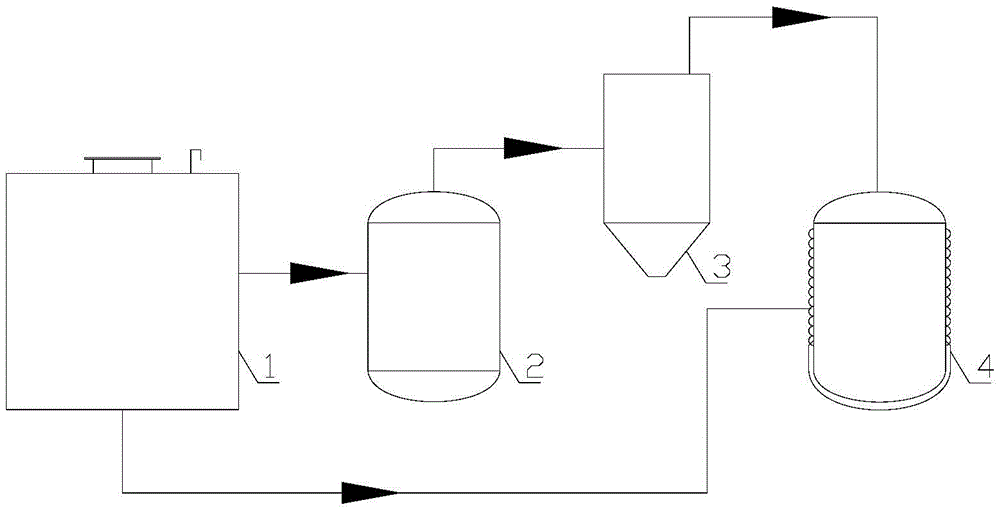
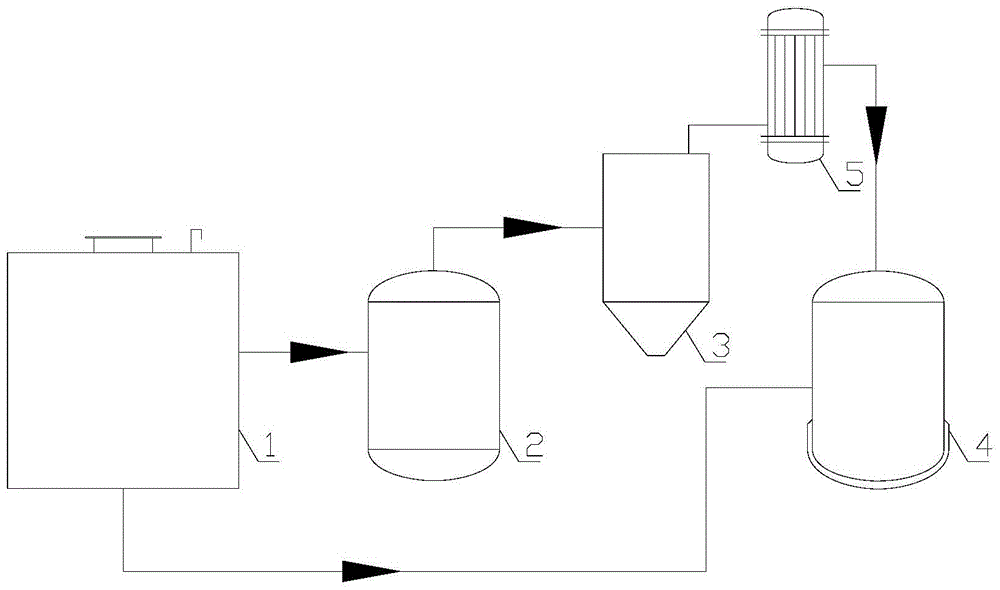
[0065] will contain ZrO 2 waste with CaF 2 Mix well to get a mixture, ZrO 2 with CaF 2 The particle size is below 3mm, the CaF in the resulting mixture 2 The mass percentage is 80%. Calcinate the mixture in the first reactor at 1150°C for 1 hour to generate CaO and ZrF 4 , ZrF 4 It is gaseous at high temperature and escapes from solid reactants. ZrF that will escape 4 Introduced into the second reactor and hydrolyzed at 900°C to generate ZrO 2 and HF gas. The HF gas produced by hydrolysis is transported to the third reactor with a polytetrafluoroethylene pipeline, and reacted with the reaction product CaO at 600°C for 2.5 hours to obtain CaF again. 2 , thus realizing CaF 2 of recycling. The reaction equation is as follows:

[0066] ZrO 2 +2CaF 2 →2CaO+ZrF 4 (4)

[0067] ZrF 4 +2H 2 O→ZrO 2 +4HF (5)

[0068] CaO+2HF→CaF 2 +H 2 O(6)

Embodiment 2

[0070] The baddeleyite (ZrO 2  mSiO 2 ) with AlF 3 Mix well to get a mixture, baddeleyite and AlF 3 The particle size is below 5mm, and the AlF in the resulting mixture 3 The mass percentage is 60%. The mixture was calcined at 1300°C for 3 hours in the first reactor to generate Al 2 o 3 and gaseous ZrF 4 and gaseous SiF 4 , the gaseous SiF 4 After being separated at low temperature, it is hydrolyzed to produce silicon dioxide and hydrogen fluoride. ZrF 4 Escape from the solid reactant by sublimation. ZrF that will escape 4 Introduced into the second reactor and hydrolyzed at 1000°C to generate ZrO 2 and HF gas. The HF gas produced by hydrolysis is transported to the third reactor with polytetrafluoroethylene pipeline, and the reaction product Al 2 o 3 After reacting at 100°C for 5 hours, AlF was recovered 3 , thus achieving AlF 3 of recycling. The reaction equation is as follows:

[0071] 3ZrO 2 +4AlF 3 →2Al 2 o 3 +3ZrF 4 (7)

[0072] 3SiO 2 +4AlF 3 ...

Embodiment 3

[0076] ZrO 2 Coarse particles and NH 4 HF 2 Mix well, ZrO 2 with NH 4 HF 2 The particle size is below 7mm, and the NH in the resulting mixture 4 HF 2 The mass percentage is 40%. The mixture was calcined at 600°C for 5 hours in the first reactor to generate NH 3 、H 2 O and ZrF 4 , ZrF 4 escaped from the solid. ZrF that will escape 4 Introduced into the second reactor and hydrolyzed at 500°C to generate ZrO 2 and HF gas. The HF gas produced by hydrolysis is transported to the third reactor with polytetrafluoroethylene pipeline, and the reaction product NH 3 and H 2 O was reacted at 150°C for 4.5 hours to regain NH 4 HF 2 , thus achieving NH 4 HF 2 of recycling. The reaction equation is as follows:

[0077] ZrO 2 +2NH 4 HF 2 →ZrF 4 +2NH 3 +2H 2 O(11)

[0078] ZrF 4 +2H 2 O→ZrO 2 +4HF (12)

[0079] NH 3 ·H 2 O+2HF→NH 4 HF 2 +H 2 O(13)

the structure of the environmentally friendly knitted fabric provided by the present invention; figure 2 Flow chart of the yarn wrapping machine for environmentally friendly knitted fabrics and storage devices; image 3 Is the parameter map of the yarn covering machine
Login to View More

PUM

PropertyMeasurementUnit
particle diameteraaaaaaaaaa
quality scoreaaaaaaaaaa
Login to View More

Abstract

The invention relates to the field of recycling fluorides and particularly relates to a method and equipment for recycling fluoride in the zirconium-containing compound production. The method comprises the following steps: mixing a raw material of a zirconium-containing oxide with a solid fluoride to form a mixture; calcining the mixture, wherein Zr<4+> in the zirconium-containing oxide and F<-> generate a first product ZrF4 gas, and O<2->in the zirconium-containing oxide and cations in the fluoride generate a second product; introducing the first product to water vapor to react to form a gas-solid mixture containing solid ZrO2 and gaseous HF; separating the gas-solid mixture to obtain a first gas phase containing unreacted water vapor and gaseous HF, and solid ZrO2; and enabling the first gas phase to react with the second product to obtain solid fluoride again. According to the method disclosed by the invention, the cost is reduced by repeated recycling of the fluoride, and the pollution of the fluoride to the environment is also avoided.

Description

technical field [0001] The invention relates to the field of fluoride recycling, in particular to a method and equipment for fluoride recycling in the production of zirconium-containing compounds. Background technique [0002] The fluorine in fluorine chemical products mainly comes from fluorspar, which is a non-renewable resource and a strategic resource at the same time. Efficient utilization of existing fluorine resources and conservation of existing fluorspar resources have become an important direction for the sustainable development of the fluorine chemical industry. Now fluoride will produce a variety of wastes during the use of fluoride, such as ammonium fluoride and ammonium bifluoride as the etchant waste residue ammonium fluorozirconate and fluorine-containing carbon residue produced by the electrolytic zirconium production process; another example is the electrolytic process. A large amount of gas such as hydrofluoric acid and zirconium tetrafluoride and dust su...

Claims

the structure of the environmentally friendly knitted fabric provided by the present invention; figure 2 Flow chart of the yarn wrapping machine for environmentally friendly knitted fabrics and storage devices; image 3 Is the parameter map of the yarn covering machine
Login to View More

Application Information

Patent Timeline
no application Login to View More
Patent Type & Authority Patents(China)
IPC IPC(8): C01G25/02
Inventor 刘瑞章林史春华龚龙江
Owner 贵州万方铝化科技开发有限公司
Features
  • R&D
  • Intellectual Property
  • Life Sciences
  • Materials
  • Tech Scout
Why Patsnap Eureka
  • Unparalleled Data Quality
  • Higher Quality Content
  • 60% Fewer Hallucinations
Social media
Patsnap Eureka Blog
Learn More