
Method for producing hyaluronic acids with different molecular weights through reasonable regulation
A technology of hyaluronic acid and hyaluronic acid synthase, applied in the field of bioengineering, can solve problems such as large differences in molecular weight, and achieve the effect of large application advantages
- Summary
- Abstract
- Description
- Claims
- Application Information
AI Technical Summary
Problems solved by technology
Method used
Image

Examples
Embodiment 1
[0034] Example 1 Construction of integrated recombinant plasmid pAX01-hasA
[0035] The hyaluronic acid synthase hasA gene used in the present invention is derived from Streptococcus zooepidemicus ATCC 35246. The Streptococcus zooepidemicus is inoculated in 5ml M17 liquid medium and cultured at 37° C. and 200 rpm for 16 hours. The bacteria were collected, and the genomic DNA of Streptococcus zooepidemicus was extracted using a bacterial genome extraction kit.
[0036] According to the published genome information sequence, the primers hasA-F / hasA-R were respectively designed, and the extracted genomic DNA was used as a template to amplify and obtain the hasA gene using a standard PCR amplification system and program.
[0037] Primer sequence information: 5'-3' direction
[0038] hasA-F: CGCGGATCCATGAGAACATTAAAAAACCTCATAAC
[0039] hasA-R: TGCATGCATTTATAATAATTTTTACGTGTTCC
[0040] BamHI and SacII restriction enzyme sites were introduced at both ends of the upstream and downs...
Embodiment 2
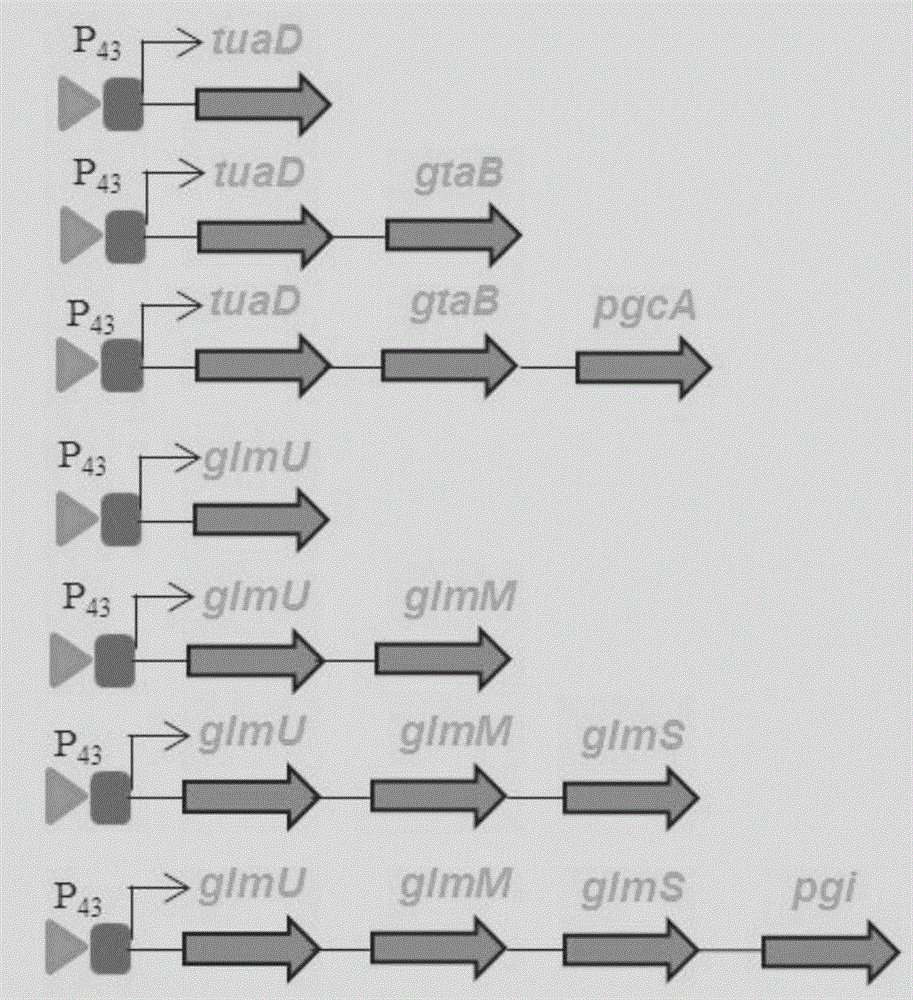
[0041] Example 2 Construction of recombinant plasmids pP43NMK / tuaD, pP43NMK / tuaD-gtaB, pP43NMK / tuaD-gtaB-pgcA
[0042] Bacillus subtilis 168 strain was inoculated in 5ml LB medium, cultured at 37°C, 200rpm for 16h. The bacteria were collected, and the genomic DNA of Streptococcus zooepidemicus was extracted using a bacterial genome extraction kit. According to the published genome information sequence of Bacillus subtilis168, primers tuaD-F / tuaD-R, gtaB-F / gtaB-R and pgcA-F / pgcA-R were designed respectively. Introduce KpnI restriction enzyme site and P43 RBS sequence (AAGAGAGGAATGTACAC) at the 5 end of upstream primer tuaD-F, introduce XhoI and SacI restriction enzyme site at the 5 end of downstream primer tuaD-R; The SacI restriction site and P43 RBS sequence were introduced into the 5 end of F, the XhoI and XbaI restriction site were introduced into the 5 end of the downstream primer gtaB-R; the SpeI (XbaI) was introduced into the 5 end of the upstream primer pgcA-F The sam...
Embodiment 3
[0054] Example 3 Construction of recombinant plasmids pP43NMK / glmU, pP43NMK / glmU-glmM, pP43NMK / glmU-glmM-glmS, pP43NMK / glmU-glmM-glmS-pgi
[0055] According to the published genome information sequence of Bacillus subtilis 168, primers glmU-F / glmU-R, glmM-F / glmM-R, glmS-F / glmS-R and pgi-F / pgi-R were designed respectively. A KpnI restriction enzyme site and P43 RBS sequence were introduced at the 5-end of the upstream primer glmU-F, and XhoI and XbaI restriction enzyme sites were introduced at the 5-end of the downstream primer glmU-R. The XbaI homologous enzyme was connected; the SpeI restriction enzyme site and the P43 RBS sequence were introduced at the 5 end of the upstream primer glmM-F, and the XhoI and XbaI restriction enzyme site were introduced at the 5 end of the downstream primer glmM-R; A SpeI restriction site and P43 RBS sequence were introduced into the 5-end of the upstream primer glmS-F, and XhoI and XbaI restriction sites were introduced into the 5-terminus of ...
PUM
 Login to View More
 Abstract
Description
Claims
Application Information
 Login to View More