
Amphiphilic polymer/ Ag nano composite microsphere preparation method
A nano-composite and polymer technology, which is applied in the preparation of organic-inorganic nano-composite materials and the preparation of nano-composite microspheres, can solve the problems of large specific surface area of nano-silver particles, particle oxidation and agglomeration, and high specific surface energy, and achieve good parents sexual effect
- Summary
- Abstract
- Description
- Claims
- Application Information
AI Technical Summary
Problems solved by technology
Method used
Image

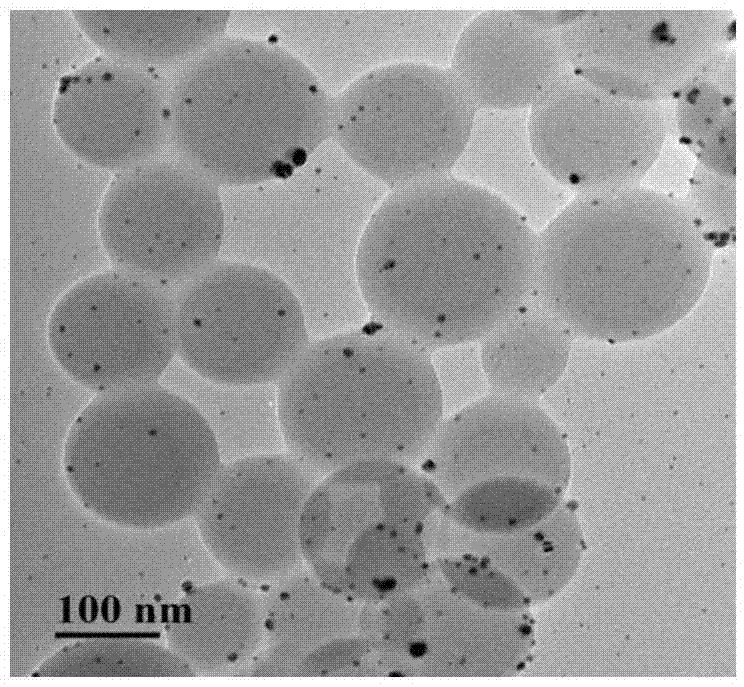
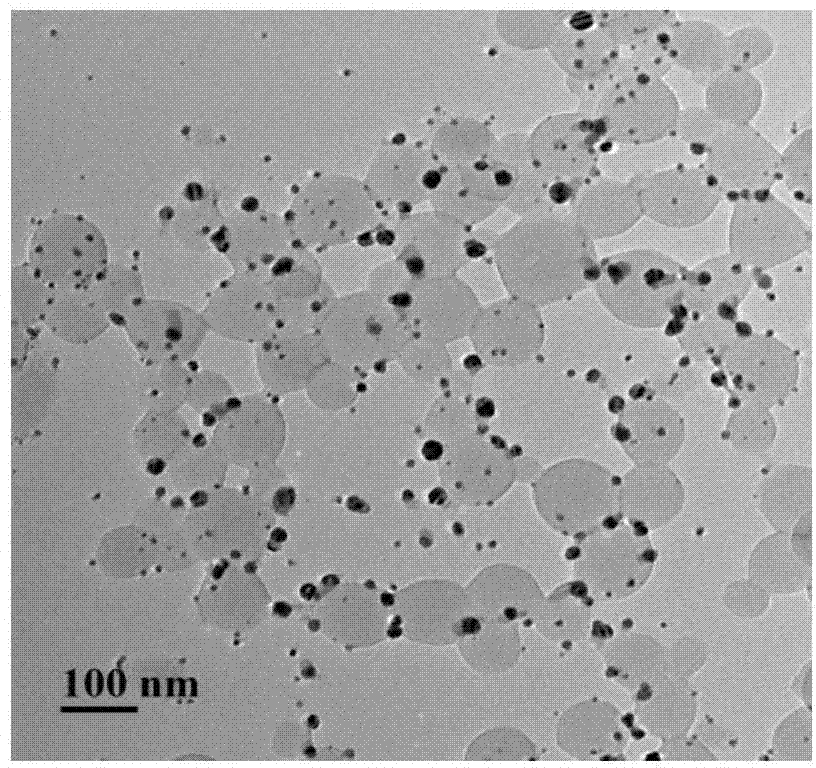
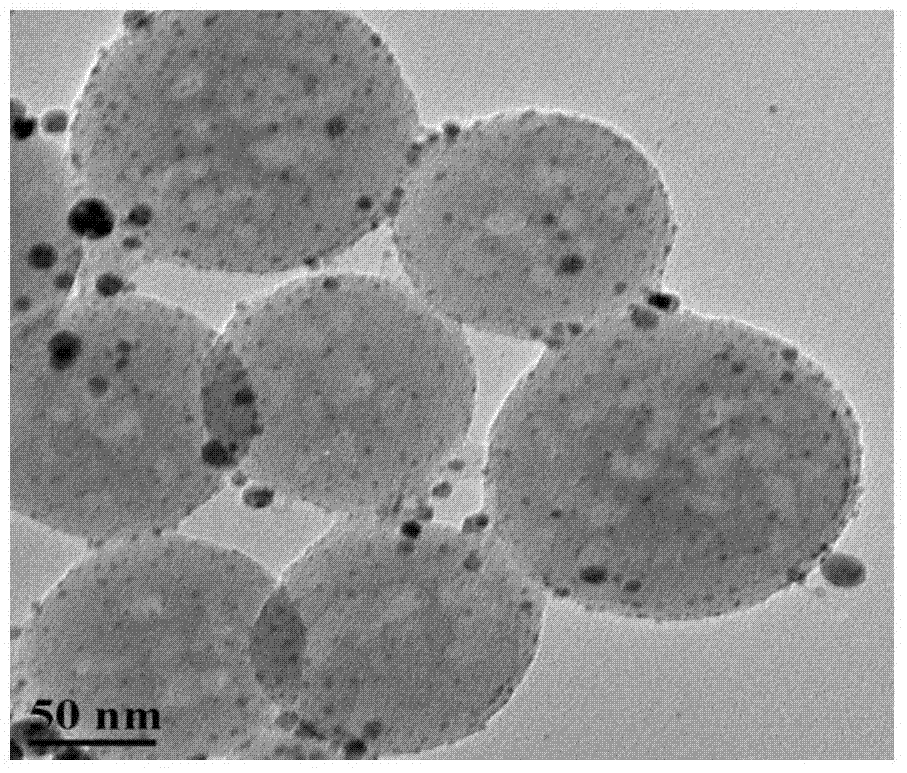
Examples
Embodiment 1
[0029] Weigh 0.25g SDS, 0.15g sodium bicarbonate, 0.15g sodium dihydrogen phosphate, dilute with 100g deionized water, and transfer to a 250ml four-necked bottle equipped with a stirring device, a thermometer and a reflux condensing device (component A); Take 10.0g of styrene (St) monomer, 0.5g of HD, 0.1g of AIBN (component B), stir well and transfer to the dropping funnel. Slowly add component B to component A dropwise at room temperature, and continue to stir for 0.5h to emulsify after the addition. Take out the above mixed components and ultrasonically fine emulsify for 10min. Continue to transfer to a 250ml four-necked flask equipped with a stirring device, a thermometer and a reflux condensing device, slowly raise the temperature to 70°C, polymerize for 5 hours, and prepare blank polystyrene microspheres.
[0030] Take out 5g of the above-mentioned styrene emulsion, dilute it with 50g deionized water, and transfer it to a 250ml four-necked bottle equipped with a stirrin...
Embodiment 2
[0032] Weigh 0.25g SDS, 0.15g sodium bicarbonate (NaHCO3), 0.1g sodium dihydrogen phosphate (NaHCO 2 PO4), diluted with 100g of deionized water, transferred to a 250ml four-neck flask equipped with a stirring device, a thermometer and a reflux condensing device (component A); weigh 10.0g of 3-methacryloxypropyltrimethoxysilane (MEMO), 0.5gHD, 0.1g AIBN (component B), stir well and transfer to the dropping funnel. Slowly add component B to component A dropwise at room temperature, and continue to stir for 0.5h to emulsify after the addition. Take out the above mixed components and ultrasonically fine emulsify for 10min. Continue to transfer to a 250ml four-neck flask equipped with a stirring device, a thermometer and a reflux condensing device, slowly raise the temperature to 70°C, polymerize for 5h, and prepare PS-MEMO microspheres with reductive surface silylation.
[0033] Take out 5g of the above-mentioned copolymerized emulsion, dilute it with 50g deionized water, transf...
Embodiment 3
[0035] Weigh 0.25g SDS, 0.15g sodium bicarbonate (NaHCO3), 0.1g sodium dihydrogen phosphate (NaHCO 2 PO4), diluted with 100g of deionized water, transferred to a 250ml four-neck flask equipped with a stirring device, a thermometer and a reflux condensing device (component A); weigh 10.0g of 3-methacryloxypropyltrimethoxy Silane (MEMO), 0.5g HD, 0.1g AIBN (component B), stir well and transfer to the dropping funnel. Slowly add component B to component A dropwise at room temperature, and continue to stir for 0.5h to emulsify after the addition. Take out the above mixed components and ultrasonically fine emulsify for 10min. Continue to transfer to a 250ml four-neck flask equipped with a stirring device, a thermometer and a reflux condensing device, slowly raise the temperature to 70°C, polymerize for 5h, and prepare PS-MEMO microspheres with reductive surface silylation.
[0036] Take out 5g of the above-mentioned copolymerized emulsion, dilute it with 50g deionized water, tran...
PUM
 Login to View More
 Abstract
Description
Claims
Application Information
 Login to View More