
Textile printing and dyeing waste water treatment process
A sewage treatment and sewage technology, applied in the field of printing and dyeing textile sewage treatment process, can solve the problems of high energy consumption, high operating cost and single method of electrolysis, and achieve the effect of large amount of sewage treatment, high treatment effect and short time
- Summary
- Abstract
- Description
- Claims
- Application Information
AI Technical Summary
Problems solved by technology
Method used
Image

Examples
Embodiment Construction
[0028] In order to make the purpose, technical solutions and advantages of the embodiments of the present invention clearer, the technical solutions in the embodiments of the present invention will be clearly and completely described below in conjunction with the drawings in the embodiments of the present invention. Obviously, the described embodiments It is a part of embodiments of the present invention, but not all embodiments. Based on the embodiments of the present invention, all other embodiments obtained by persons of ordinary skill in the art without creative efforts fall within the protection scope of the present invention.
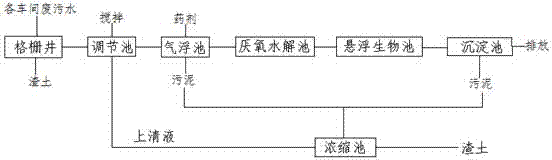
[0029] In this example, if figure 1 As shown, 1) Printing and dyeing textile sewage flows into the grid well through the pipelines of each workshop for filtration. After filtration, the dregs that do not pass through the grid well are separated, and the sewage after the separation of dregs is passed into the regulating tank;
[0030] 2) Stir the...
PUM
 Login to View More
 Abstract
Description
Claims
Application Information
 Login to View More