
A kind of double quaternary ammonium salt compound and its application in solid phase chemical cleaning agent
A solid-phase chemistry, biquaternary ammonium salt technology, applied in the field of oil drilling, can solve the problems of not effectively inhibiting the hydration expansion and dispersion of drilling cuttings, destroying the colloidal stability of drilling fluid, reducing the efficiency of solid-phase removal, etc. High phase removal efficiency, high shale rolling recovery rate, and good inhibition ability
- Summary
- Abstract
- Description
- Claims
- Application Information
AI Technical Summary
Problems solved by technology
Method used
Image

Examples
Embodiment 1
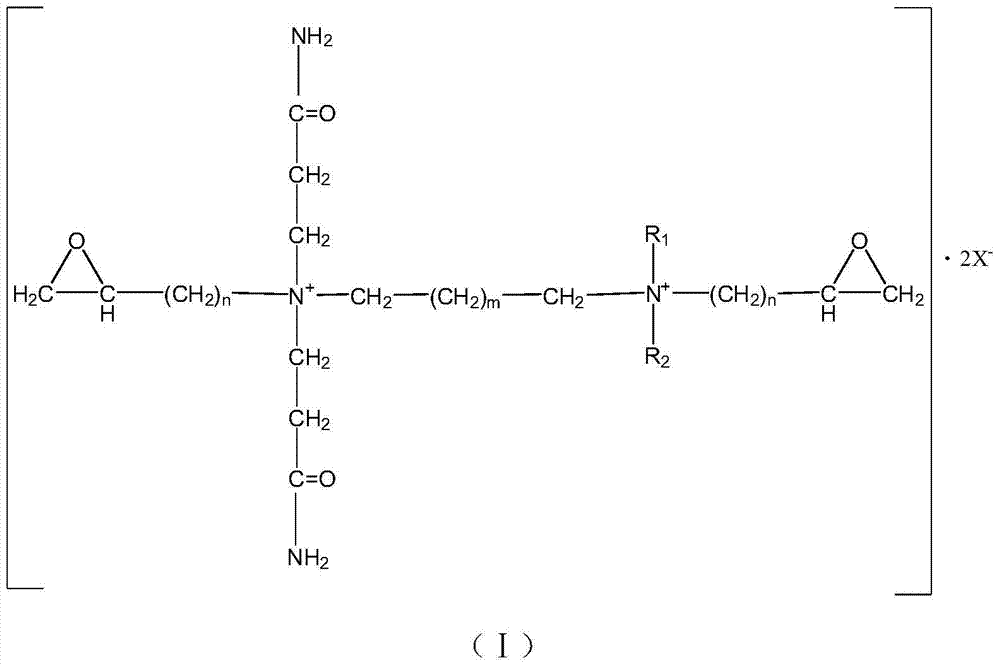
[0051] Add 517 grams of water and 144 grams (2 moles) of acrylamide into the reaction kettle, stir until the acrylamide is completely dissolved, then add 102.2 grams (1 mole) of dimethylaminopropylamine, stir for 5 to 10 minutes, and React at 20°C for 16 hours; after the reaction time is up, heat up to 30°C, add 0.431 grams of catalyst benzyltriethylammonium chloride, and then slowly add 185 grams (2 moles) of epichlorohydrin to the reaction kettle dropwise , keep the temperature of the reaction system within 35°C during the dropwise addition; after adding epichlorohydrin, the temperature is raised to 70°C, and the reaction is continued for 1 hour. After the reaction time is up, the reaction product is dried and pulverized to obtain the structural formula: The diquaternary ammonium salt compound shown in (II).
[0052]
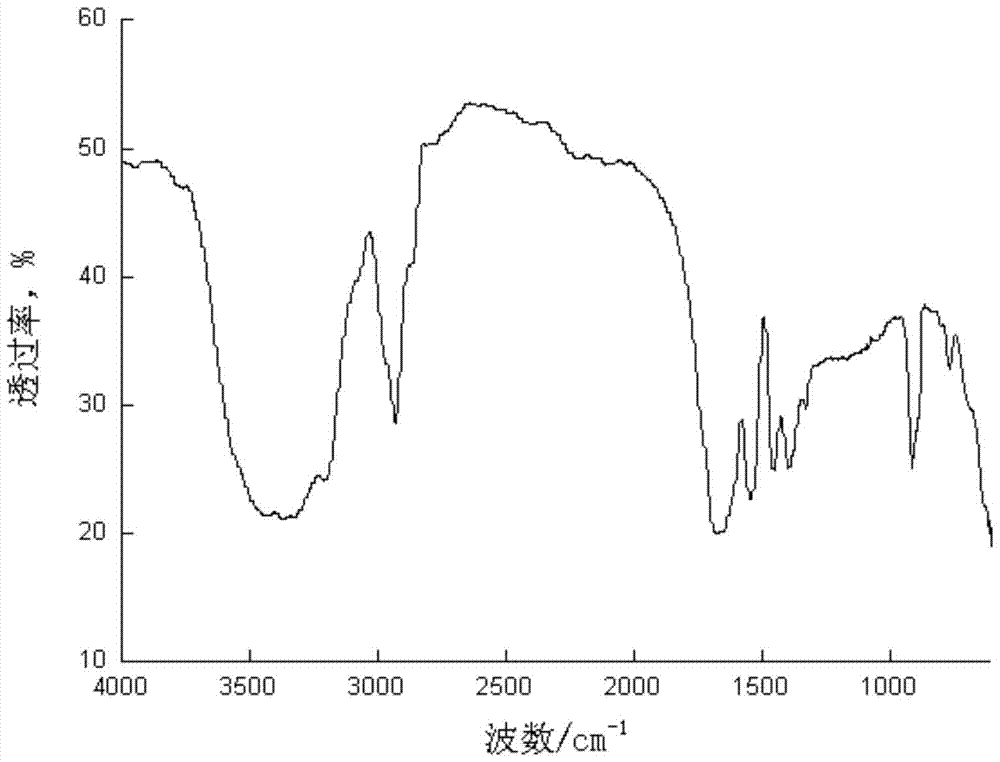
[0053] The appearance of the compound obtained in this example is white or slightly yellow crystal, which is very easy to absorb moisture, and its aqueous ...
Embodiment 2
[0056] Add 668 grams of water and 144 grams (2 moles) of acrylamide into the reaction kettle, stir until the acrylamide is completely dissolved, then add 107.3 grams (1.05 moles) of dimethylaminopropylamine, stir for 5 to 10 minutes, and set the temperature at 0 to 20°C Reacted for 32 hours; after the reaction time reached, the temperature was raised to 30°C, 4.31g of catalyst tetrabutylammonium bromide was added, and then 194.25 grams (2.1 moles) of epichlorohydrin was slowly added dropwise to the reactor, and the dropwise addition process kept The temperature of the reaction system is within 35°C; after the addition of epichlorohydrin, the temperature is raised to 60°C, and the reaction is continued for 3 hours. After the reaction time is up, the reaction product is dried and pulverized to obtain a diquaternary ammonium compound.
Embodiment 3
[0058] Add 517 grams of water and 144 grams (2 moles) of acrylamide into the reaction kettle, stir until the acrylamide is completely dissolved, then add 102.2 grams (1 mole) of dimethylaminopropylamine, stir for 5 to 10 minutes, and store at 0 to 20°C React for 24 hours; after the reaction time reaches 30°C, add 2.2 grams of catalyst tetrabutylammonium chloride, and then slowly add 185 grams (2 moles) of epichlorohydrin to the reactor. Keep the temperature of the reaction system within 35°C; raise the temperature to 65°C after adding the epichlorohydrin, and continue the reaction for 5 hours. After the reaction time is up, dry and pulverize the reaction product to obtain the bis-quaternary ammonium compound.
PUM
 Login to View More
 Abstract
Description
Claims
Application Information
 Login to View More