Unlock instant, AI-driven research and patent intelligence for your innovation.
Conveyer belt reproduction polymer compounded rubber material
What is Al technical title?
Al technical title is built by PatSnap Al team. It summarizes the technical point description of the patent document.
A technology of compounding rubber and polymer, applied in the field of polymer materials, can solve problems such as waste and reuse, and achieve the effect of improving service life, prolonging service life and enhancing wear resistance.
Inactive Publication Date: 2016-12-21
山西佰得拓普工贸有限公司
View PDF9 Cites 6 Cited by
Summary
Abstract
Description
Claims
Application Information
AI Technical Summary
This helps you quickly interpret patents by identifying the three key elements:
Problems solved by technology
Method used
Benefits of technology
Problems solved by technology
[0003] At present, generally speaking, after the conveyor belt is damaged, it is discarded and cannot be rebuilt and reused, resulting in waste
The prior art and inventions all focus on how to enhance the wear resistance and service life of new conveyor belts. So far, they have never involved composite materials suitable for remanufacturing conveyor belts. The present invention focuses on the recycling of conveyor belts and has enhanced Aiming at the wear resistance and service life of remanufactured conveyor belts, a polymer composite material suitable for remanufacturing conveyor belts and its preparation method have been developed and designed
Method used
the structure of the environmentally friendly knitted fabric provided by the present invention; figure 2 Flow chart of the yarn wrapping machine for environmentally friendly knitted fabrics and storage devices; image 3 Is the parameter map of the yarn covering machine
View more
Image
Smart Image Click on the blue labels to locate them in the text.
Viewing Examples
Smart Image
Click on the blue label to locate the original text in one second.
Reading with bidirectional positioning of images and text.
Smart Image
Examples
Experimental program
Comparison scheme
Effect test
Embodiment 1
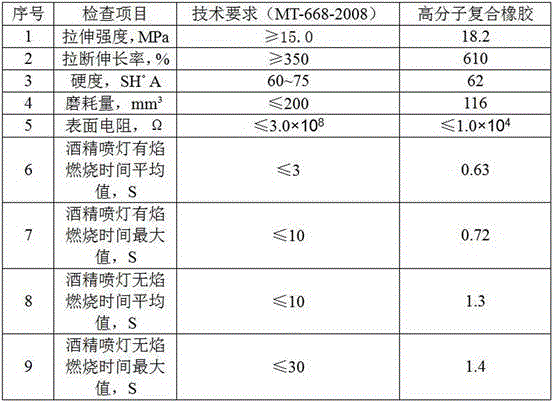
[0027] A polymer composite rubber material for conveyor belt recycling, comprising the following components by weight:
[0028] 2 parts of methyl vinyl silicone rubber, 5 parts of natural rubber, 3 parts of butadiene rubber, 1.5 parts of styrene-butadiene rubber, 3 parts of carbon fiber reinforced material, 2 parts of zincoxide, 0.5 parts of stearic acid, 5 parts of carbon black, Guma Long 0.2 parts, accelerator 1 part, anti-aging agent 2.5 parts, sulfur 0.8 parts.
[0029] After uniform mixing, it can be vulcanized and formed by conventional vulcanization process.
Embodiment 2
[0031] A polymer composite rubber material for conveyor belt recycling, comprising the following components by weight:
[0032] 4 parts of methyl vinyl silicone rubber, 6 parts of natural rubber, 1 part of butadiene rubber, 2 parts of styrene-butadiene rubber, 1 part of carbon fiber reinforced material, 1 part of zincoxide, 0.6 parts of stearic acid, 3 parts of carbon black, Guma Long 0.8 parts, accelerator 2 parts, anti-aging agent 3 parts, sulfur 0.1 part.
[0033] After uniform mixing, it can be vulcanized and formed by conventional vulcanization process.
Embodiment 3
[0035] A polymer composite rubber material for conveyor belt recycling, comprising the following components by weight:
[0036] 1 part of methyl vinyl silicone rubber, 1 part of natural rubber, 6 parts of butadiene rubber, 2.5 parts of styrene-butadiene rubber, 1.5 parts of carbon fiber reinforced material, 2 parts of zinc oxide, 1 part of stearic acid, 4 parts of carbon black, Guma 1 part of Long, 1 part of Accelerator, 1.5 parts of Antiaging Agent, 1 part of Sulfur.
[0037] After uniform mixing, it can be vulcanized and formed by conventional vulcanization process.
the structure of the environmentally friendly knitted fabric provided by the present invention; figure 2 Flow chart of the yarn wrapping machine for environmentally friendly knitted fabrics and storage devices; image 3 Is the parameter map of the yarn covering machine
Login to View More
PUM
Login to View More
Abstract
The invention relates to the technique of preparation of a conveyer belt rubber material, particularly to a conveyer belt reproductionpolymer compounded rubber material. The conveyer belt reproductionpolymer compounded rubber material comprises the following components in parts by weight: 1-10 parts of methyl vinyl silicone rubber, 1-8 parts of natural rubber, 1-6 parts of butadiene rubber, 1-3 parts of butadiene styrene rubber, 1-3 parts of carbon fiber reinforced plastic, 1-2 parts of zincoxide, 0.1-1 part of stearic acid, 1-5 parts of carbon black, 0.1-1 part of coumarone, 1-2 parts of an accelerant, 1-3 parts of an antiager and 0.1-1 part of sulphur. The conveyer belt reproductionpolymer compounded rubber material is used for reproducing a conveyer belt, is synthesized from the methyl vinyl silicone rubber and part of polymer rubbers, has the excellent performance of high abrasion resistance, high strength and shock resistance, and accords with the industry requirement.
Description
technical field [0001] The invention belongs to the technical field of polymer materials, and in particular relates to a polymer composite rubber material for remanufacturing the upper and lower rubber of a conveyor belt and a preparation method thereof. Background technique [0002] The conveyor belt, also known as the conveyor belt, is used in the belt conveyor belt to carry and transport materials. It is a composite product of rubber and fiber, metal, or a composite product of plastic and fabric. Conveyor belts are widely used in cement, coking, metallurgy, chemical, steel and other industries where the conveying distance is short and the conveying volume is small. [0003] At present, generally speaking, after the conveyor belt is damaged, it is discarded and cannot be rebuilt and reused, resulting in waste. The prior art and inventions all focus on how to enhance the wear resistance and service life of new conveyor belts. So far, they have never involved composite mate...
Claims
the structure of the environmentally friendly knitted fabric provided by the present invention; figure 2 Flow chart of the yarn wrapping machine for environmentally friendly knitted fabrics and storage devices; image 3 Is the parameter map of the yarn covering machine
Login to View More
Application Information
Patent Timeline
Application Date:The date an application was filed.
Publication Date:The date a patent or application was officially published.
First Publication Date:The earliest publication date of a patent with the same application number.
Issue Date:Publication date of the patent grant document.
PCT Entry Date:The Entry date of PCT National Phase.
Estimated Expiry Date:The statutory expiry date of a patent right according to the Patent Law, and it is the longest term of protection that the patent right can achieve without the termination of the patent right due to other reasons(Term extension factor has been taken into account ).
Invalid Date:Actual expiry date is based on effective date or publication date of legal transaction data of invalid patent.



 Login to View More
  Login to View More