
A method of generating porous spherical iron system alloyed powder by a reduction reaction, and its powder and sintered compact
A technology of iron-based alloy and mixed powder, which is applied in transportation and packaging, metal processing equipment, etc., can solve the problem of high cost of powder metallurgy iron-based alloy workpieces
- Summary
- Abstract
- Description
- Claims
- Application Information
AI Technical Summary
Problems solved by technology
Method used
Image

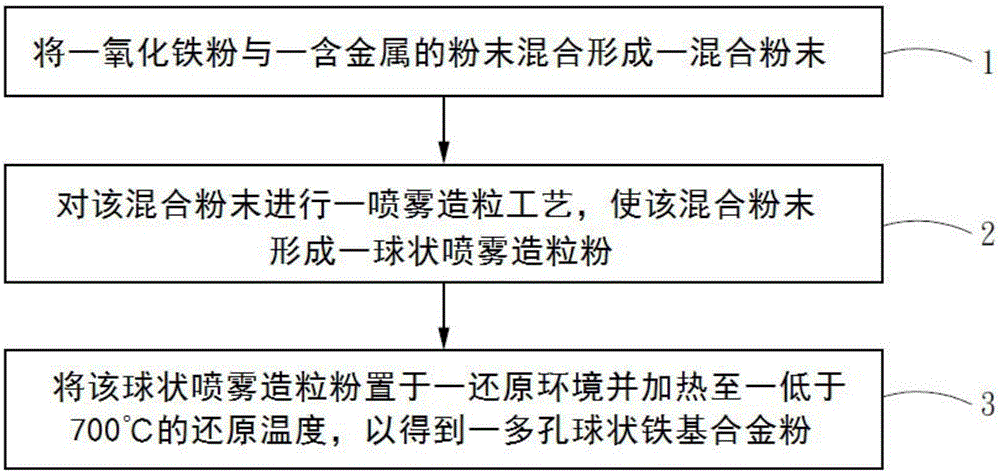
Examples
Embodiment 1
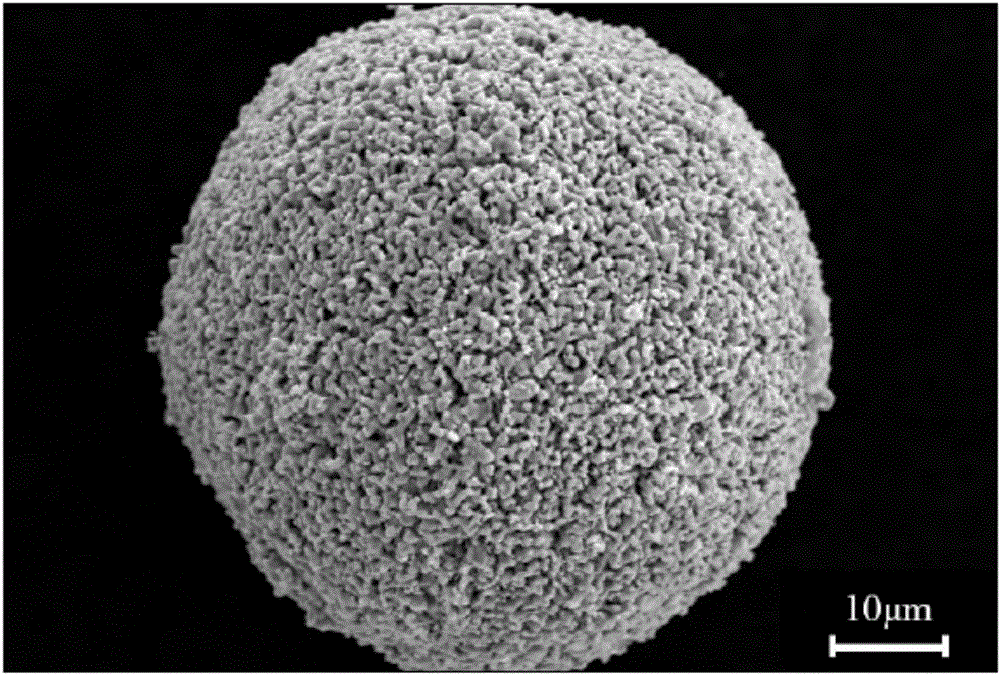
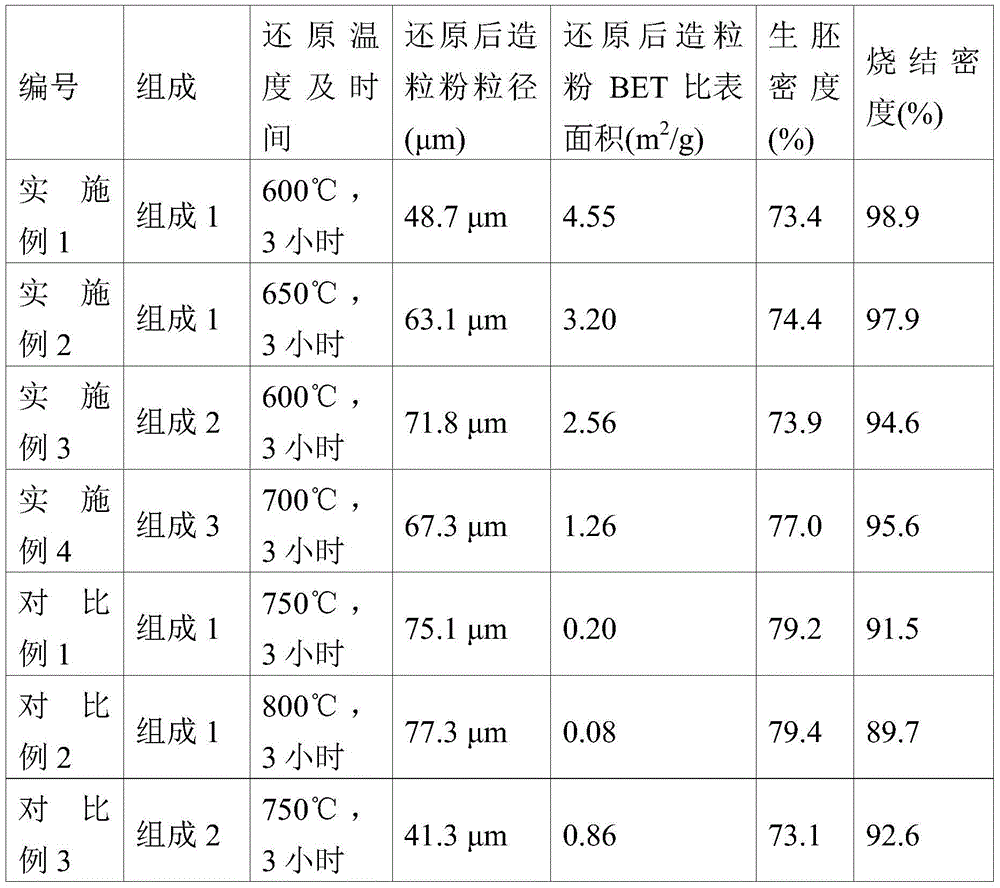
[0036] Embodiment 1~2: be to adopt the mixed powder of composition 1, wherein the average particle diameter of ferric oxide powder is 0.3 μm, 316L stainless steel powder contains the chromium of 17wt%, the nickel of 10.4wt%, the molybdenum of 2.2wt%, 1.6 Wt% manganese, 0.6wt% silicon, and its average particle size is 8 μm, and the average particle size of molybdenum powder is 3 μm. After adding binder, plasticizer and water to this mixed powder, it is obtained after the spray granulation process Spherical spray granulation powder, no hollow large holes through section inspection. The spray granulated powder was reduced for 3 hours at the reduction temperature of 600°C and 650°C respectively, and the obtained porous spherical iron-based alloy powder had a specific surface area of 4.55m 2 / g and 3.20m 2 / g, the green density is above 70%, and the compressibility is good, while the sintered density reaches 98.9% and 97.9% respectively. figure 2 It is an electron microscope p...
Embodiment 3
[0037] Example 3: using the mixed powder of composition 2, at a reduction temperature of 600°C, after 3 hours of reduction, the obtained porous spherical iron-based alloy powder has a specific surface area of 2.56m 2 / g, the green density is above 70%, the compressibility is good, and the sintered density reaches 94.6%. It can be clearly seen from a high-magnification electron microscope that the porous spherical iron-based alloy powder is in a good spherical shape and has a large number of holes.
Embodiment 4
[0038] Example 4: The mixed powder of composition 3 is used, and the reduction is carried out for 3 hours at a reduction temperature of 700 ° C. The obtained porous spherical iron-based alloy powder has a specific surface area of 1.26m 2 / g, while the sintered density reaches 95.6%. The porous spherical iron-based alloy powder is in a good spherical shape and has a large number of holes.
[0039] Comparative examples 1 and 2: the iron-based alloy powder obtained by using the mixed powder of composition 1 and reducing it at the reduction temperature of 750°C and 800°C for 3 hours, the specific surface area is only 0.20m 2 / g and 0.08m 2 / g, the green density is 79.2% and 79.4%, respectively, higher than the examples, but the sintered density is only 91.5% and 89.7%. Although the iron-based alloy powder is slightly spherical, it has almost no holes, so the specific surface area is small and the sintering driving force is low.
PUM
| Property | Measurement | Unit |
|---|---|---|
| The average particle size | aaaaa | aaaaa |
| Specific surface area | aaaaa | aaaaa |
| Specific surface area | aaaaa | aaaaa |
Abstract
Description
Claims
Application Information
 Login to View More