Unlock instant, AI-driven research and patent intelligence for your innovation.

Detection method for sialic acid in proteinic drug

A technology of sialic acid and protein, applied in the direction of measuring devices, instruments, scientific instruments, etc., can solve problems such as poor reproducibility, shortened column life, and long time

Inactive Publication Date: 2017-06-30
INNOVENT BIOLOGICS (SUZHOU) CO LTD
View PDF3 Cites 6 Cited by
  • Summary
  • Abstract
  • Description
  • Claims
  • Application Information

AI Technical Summary

Problems solved by technology

However, this method is not only costly, but also has the following disadvantages: 1) The processed samples contain interfering substances (such as proteins that cannot be completely removed), which will significantly shorten the life of the chromatographic column; (2) Even centrifugation cannot fully remove proteins , and the use of solvent treatment will produce solvent effects during chromatographic separation; (3) a long period of chromatographic column flushing is required after each sample analysis; (4) labeling reagents and impurity peaks may affect the separation and identification of sialic acid, The retention time of the standard will drift, the reproducibility is not good, and the tolerance of the method is poor
[0007] In summary, there is still a lack of satisfactory high-accuracy and high-sensitivity methods for the detection of sialic acid in protein drugs in this field

Method used

the structure of the environmentally friendly knitted fabric provided by the present invention; figure 2 Flow chart of the yarn wrapping machine for environmentally friendly knitted fabrics and storage devices; image 3 Is the parameter map of the yarn covering machine
View more

Image

Smart Image Click on the blue labels to locate them in the text.
Viewing Examples
Smart Image
  • Detection method for sialic acid in proteinic drug
  • Detection method for sialic acid in proteinic drug
  • Detection method for sialic acid in proteinic drug

Examples

Experimental program
Comparison scheme
Effect test

Embodiment 1

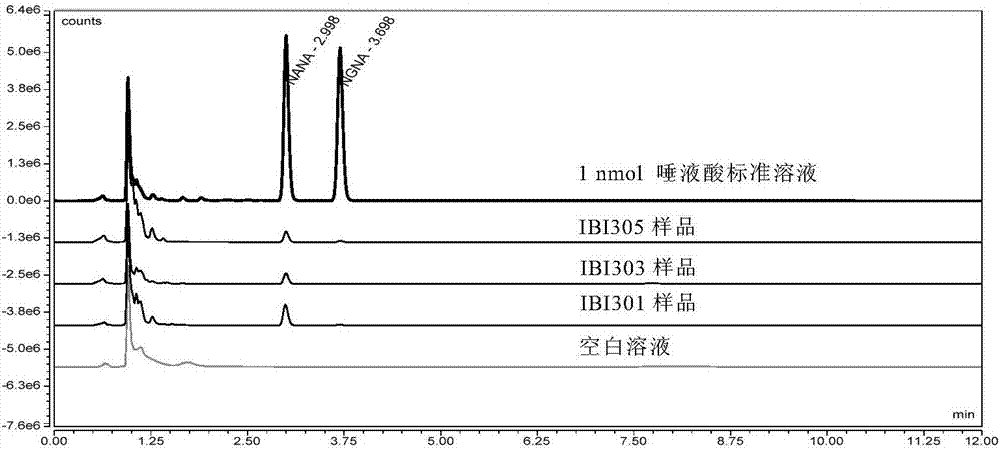
[0149] Embodiment 1 The effect and specificity investigation of hydrophilic chromatographic column separation

[0150] Take 500 μg of protein sample, add water to 25 μl, then add 25 μl of 4M acetic acid and mix well, react at 80°C for 2 hours, then add 50 μl of labeling reagent that has been aliquoted, and react for 2 hours at 50°C in the dark, after the reaction, add 400 μl of acetonitrile, mix well After centrifugation at 13000r / min for 5 minutes, the supernatant was taken for chromatographic analysis.

[0151] The chromatographic parameters are: chromatographic column Waters Glycan BEH Amide; flow rate 0.4ml / min; detection wavelength ex=373nm, em=448nm; running time 12 minutes; injection volume 5μl. The sample tray temperature was set at 4°C. The eluent was a gradient of acetonitrile / water (85 / 15). The elution gradient of chromatographic analysis is shown in Table 6.

[0152] Table 6 The elution gradient of BEH amide

[0153] time flow rate ACN(%) h 2 O...

Embodiment 2

[0156] Example 2 Sample injection precision experiment

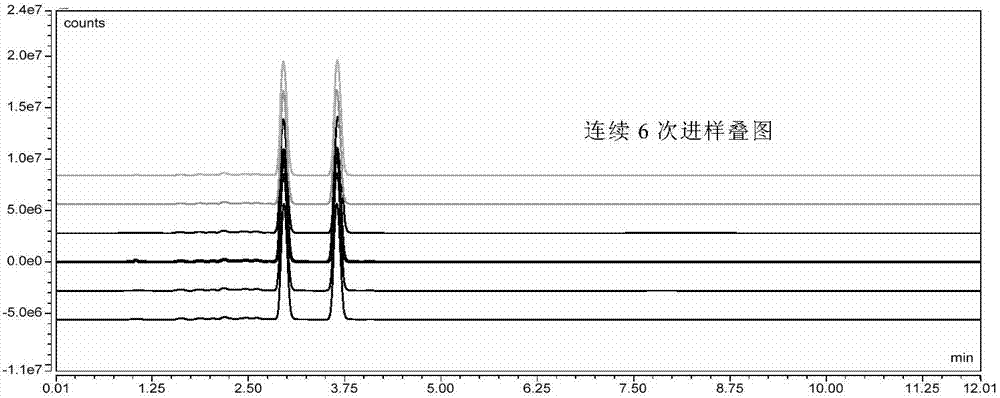
[0157] Repeat Example 1 to prepare 1 nmol of sialic acid standard substance, inject 6 times continuously, and investigate the stability of peak area and retention time.

[0158] The experimental results show that the retention time of six consecutive experiments is basically the same.

[0159] The results of the injection precision experiment are shown in Table 7.

[0160] Table 7 Injection precision results

[0161] frequency Nana RT Nana area NGNA RT NGNA area 1 3.00 396213 3.70 410972 2 3.00 390613 3.70 407435 3 3.00 393292 3.71 410560 4 3.00 391216 3.70 406978 5 3.00 386582 3.70 402065 6 3.00 389568 3.70 404223 average value 3.00 391247 3.70 407039 RSD(%) 0.0 0.8 0.1 0.9

[0162] The experimental results show that the peak areas and relative retention times of NANA and NGNA injected six times in a row are very stable (RSDs are n...

Embodiment 3

[0164] Embodiment 3 sialic acid standard substance linear inspection

[0165] Sialic acid standard handling

[0166] Take 1 μmol NANA and NGNA that have been aliquoted, take 10 μl each in the same centrifuge tube, add 980 μl ultrapure water and mix to obtain a 1 μmol / ml mixed standard sample as standard stock 1, take 100 μl stock 1 and add 900 μmol ultrapure water to obtain 0.1 μmol The mixed standard sample of NANA and NGNA / ml is used as standard stock 2, take 100 μl of stock 2 and add 900 μl ultrapure water to obtain 0.01 µmol / ml of NANA and NGNA mixed standard sample as standard stock 3, prepare different moles according to Table 8 Amount of standard solution, acid hydrolyzed at 80°C for 2 hours, after the reaction, add 50 μl of labeled reagent that has been dispensed, and react in the dark at 50°C for 2 hours, then add 400 μl of acetonitrile to terminate the reaction, centrifuge at 13000r / min for 5 minutes to take the supernatant chromatogram analyze.

[0167] Table 8 St...

the structure of the environmentally friendly knitted fabric provided by the present invention; figure 2 Flow chart of the yarn wrapping machine for environmentally friendly knitted fabrics and storage devices; image 3 Is the parameter map of the yarn covering machine
Login to View More

PUM

No PUM Login to View More

Abstract

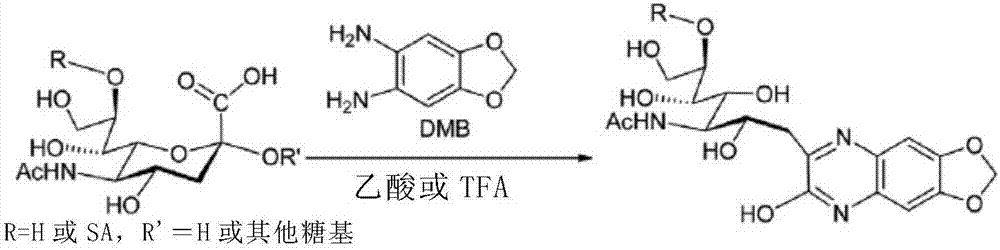
The invention provides a detection method for sialic acid in a proteinic drug. Particularly, the invention provides a method for detecting the content of the sialic acid in protein. The method comprises the following steps: (1) providing a sample to be analyzed, wherein the sample contains the protein to be analyzed; (2) performing acid hydrolysis on the sample in the step (1), thus obtaining an acid hydrolysis product; (3) labeling the acid hydrolysis product obtained in the step (2) with a labeling reagent, thus obtaining a labeled mixture; (4) performing chromatographic pretreatment on the labeled mixture through an organic solvent, thus obtaining a pretreated mixture; (5) loading the pretreated mixture to a hydrophilic interaction chromatographic column for chromatographic separation, thus obtaining labeled sialic acid-containing eluent; (6) detecting the eluent, thus obtaining a measurement result of the content of the sialic acid in the protein.

Description

technical field [0001] The invention relates to the field of quality control detection, in particular to a detection method for sialic acid in protein drugs. Background technique [0002] Sialic acid (SA) is a derivative of neuraminic acid, an acidic amino sugar containing 9 carbon atoms and a pyranose structure, named 5-amino-3,5 dideoxy-D-glycerol-D -Galacnonylose. [0003] Different sialic acid derivatives are formed according to different linking groups on the 5th carbon. The two most important sialic acids are 5-acetylamino-3,5-dideoxy-D-galactonulose (NANA, Neu5Ac, N-acetylneuraminic acid) and 3-deoxy-D-glycerol-D- Galactononyl sugar (KDN), the rest of the sialic acid are derived from these two. N-glycolylneuraminic acid (NGNA) is obtained by hydroxylation at the acetyl position of NANA. NGNA and NANA usually exist in the form of oligosaccharides, glycolipids or glycoproteins. [0004] Sialic acid modification is closely related to the safety and effectiveness of ...

Claims

the structure of the environmentally friendly knitted fabric provided by the present invention; figure 2 Flow chart of the yarn wrapping machine for environmentally friendly knitted fabrics and storage devices; image 3 Is the parameter map of the yarn covering machine
Login to View More

Application Information

Patent Timeline
no application Login to View More
IPC IPC(8): G01N30/02
CPCG01N30/02
Inventor 邢伟博
Owner INNOVENT BIOLOGICS (SUZHOU) CO LTD