

Dry film developing solution for printed circuit board and preparation method of dry film developing solution
A technology for printed circuit boards and developer, which is applied in the chemical industry, can solve the problems of large developer waste water treatment, easy generation of a large number of bubbles, and increased production costs, so as to reduce residual image phenomenon, reduce decomposition rate and corrosiveness, The effect of promoting clearance
- Summary
- Abstract
- Description
- Claims
- Application Information
AI Technical Summary
Problems solved by technology
Method used
Image

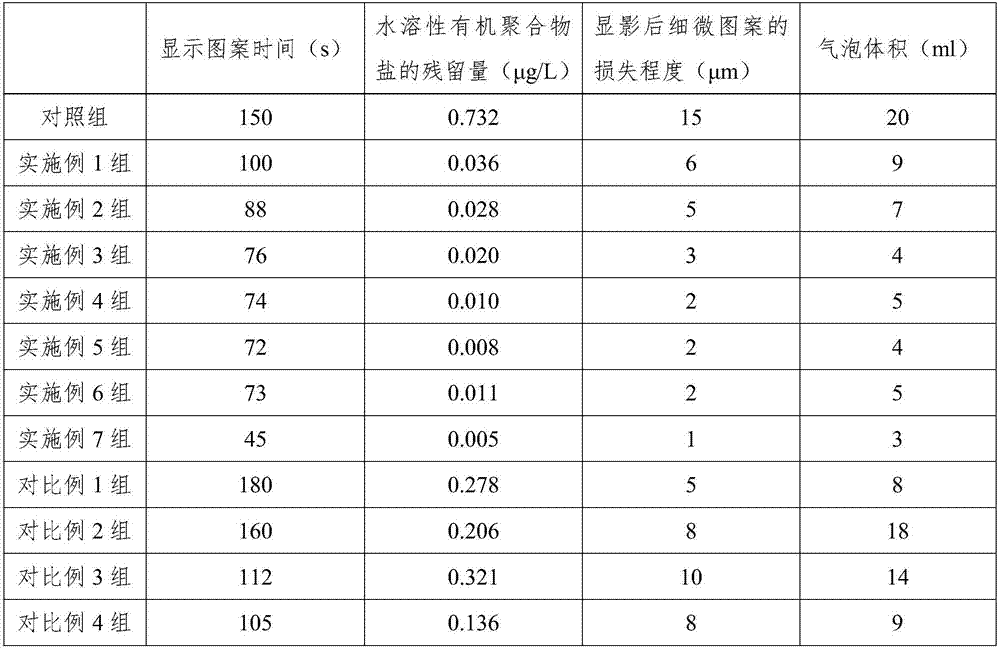
Examples
Embodiment 1
[0030] Embodiment 1, a kind of dry film developer for printed circuit board
[0031] The dry film developer for printed circuit boards is composed of the following components and content:
[0032] Potassium carbonate 0.2kg, sodium carbonate 0.8kg, sodium hypochlorite 0.08kg and water 95kg.
[0033] Preparation:
[0034] S1 Add potassium carbonate and sodium carbonate to water, stir until completely dissolved to obtain a mixed solution;
[0035] S2 Add sodium hypochlorite to the mixed solution obtained in step S1 and stir evenly to obtain final product.
Embodiment 2
[0036] Embodiment 2, a kind of dry film developing solution for printed circuit board
[0037] The dry film developer for printed circuit boards is composed of the following components and content:
[0038] Potassium carbonate 0.4kg, sodium carbonate 0.5kg, sodium hypochlorite 0.1kg and water 99kg.
[0039] The preparation method is similar to Example 1.
Embodiment 3
[0040] Embodiment 3, a kind of dry film developer for printed circuit board
[0041] The dry film developer for printed circuit boards is composed of the following components and content:
[0042] Potassium carbonate 0.4kg, sodium carbonate 0.5kg, sodium hypochlorite 0.1kg, sodium alginate 4kg and water 99kg.
[0043] Preparation:
[0044] S1 Add potassium carbonate and sodium carbonate to water, stir until completely dissolved to obtain a mixed solution;
[0045] S2 Add sodium hypochlorite and sodium alginate to the mixed solution obtained in step S1 and stir evenly to obtain.
PUM
 Login to View More
 Abstract
Description
Claims
Application Information
 Login to View More