
Solvent and method suitable for liquid-phase intercalation stripping of lamellar graphite material
A graphite material, lamellar technology, applied in the field of nano-powder material manufacturing, can solve the problems of limited production capacity, difficult to control the safety of the production process, harsh process conditions, etc., to improve osmotic pressure and diffusion performance, increase energy The transfer efficiency and the effect of alleviating the large solvent loss
- Summary
- Abstract
- Description
- Claims
- Application Information
AI Technical Summary
Problems solved by technology
Method used
Image

Examples
Embodiment 1
[0045] Raw materials: natural flake graphite with a particle size of 0.1-0.5 mm
[0046] Intercalation solvent Ⅰ: Tetrafluorochloroethane (R-124a), solvent parameters:
[0047]
[0048] Auxiliary working fluid: nitrogen (N 2 )
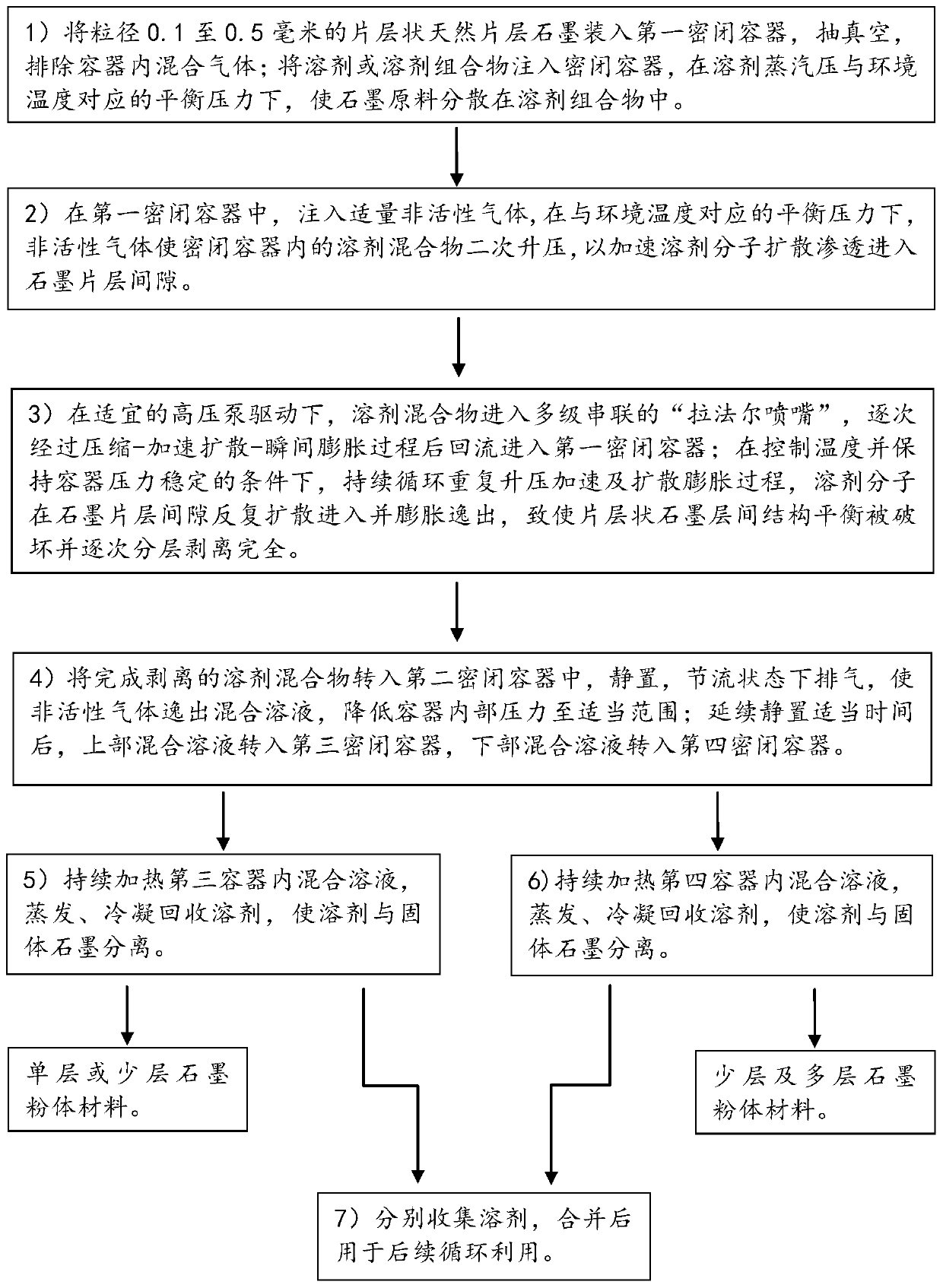
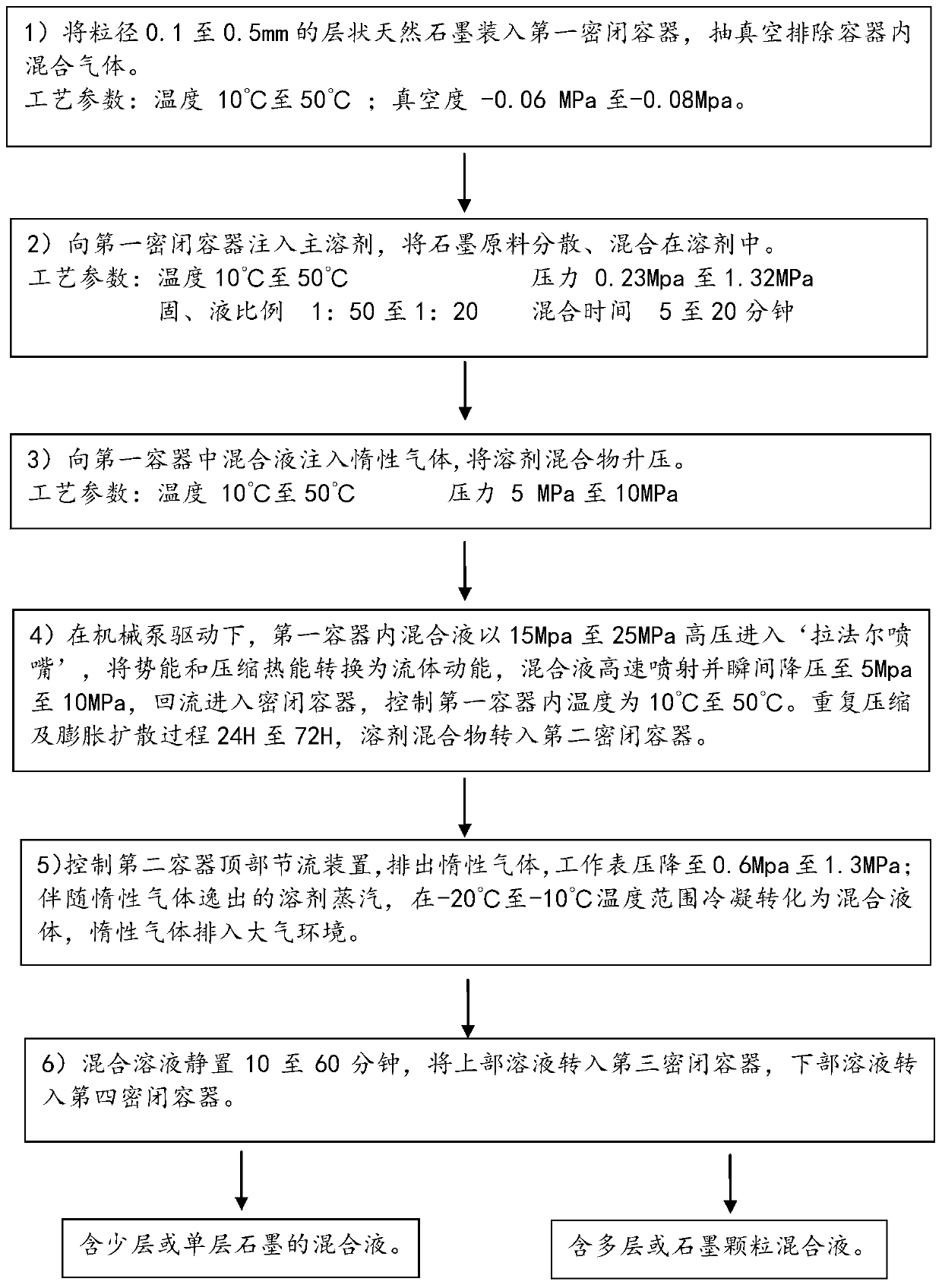
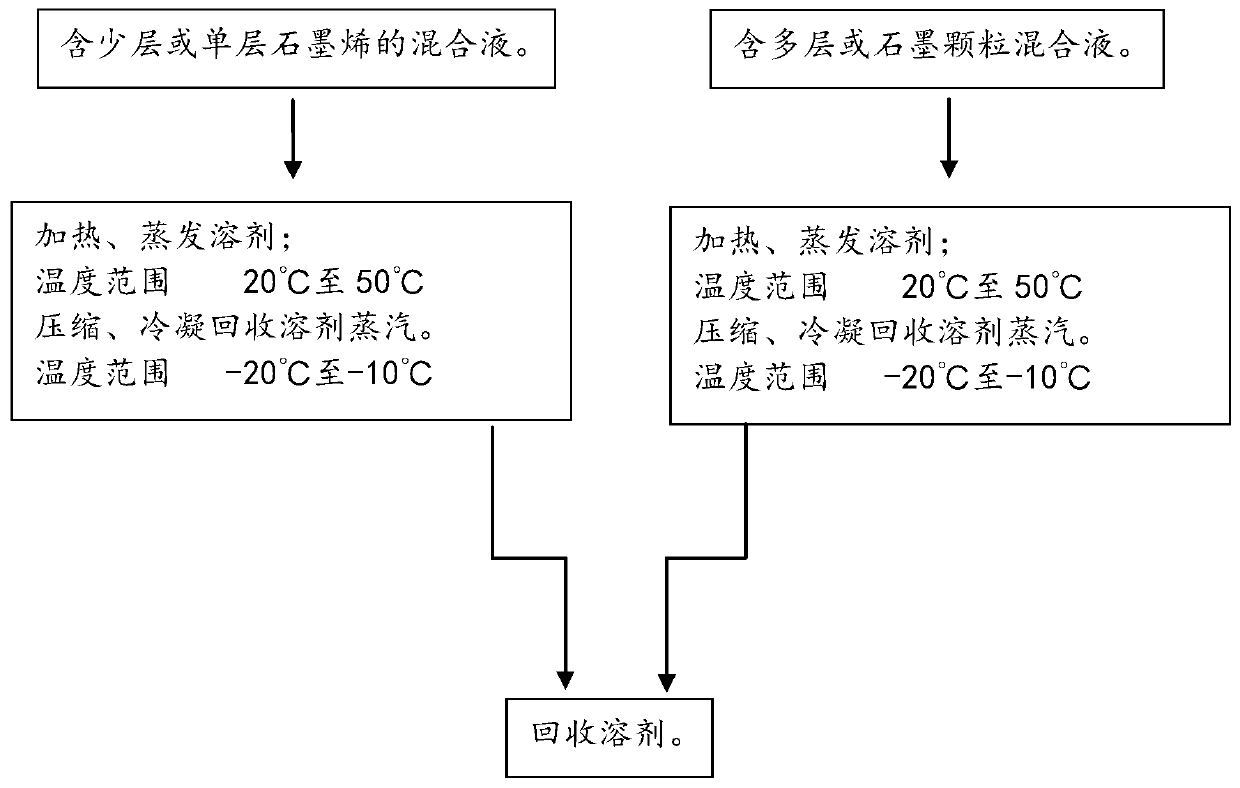
[0049] as attached figure 2 As shown, put the raw materials into a closed container, vacuumize, the working gauge pressure is -0.06MPa, and remove the non-condensable gas inside the container;
[0050] Add the intercalation solvent I to a closed container at a ratio of 20 times the graphite mass, and mix naturally for 5 minutes at a process temperature of 10°C and a working gauge pressure of 0.23MPa;
[0051] Inject N into the mixture 2 For gas, boost the pressure of the solvent mixture to 5MPa working gauge pressure;
[0052] Driven by the high-pressure pump body, the mixed liquid enters at a high pressure of 12MPa (this pressure is the outlet pressure of the high-pressure pump.) Figure 4 In the four-stage "Rafal nozzle" connected in series...
Embodiment 2
[0059] Raw materials: natural flake graphite with a particle size of 0.1-0.5 mm
[0060] Intercalation solvent Ⅱ: tetrafluoroethane (R134a), solvent parameters:
[0061]
[0062] Auxiliary working fluid: CO 2
[0063] as attached figure 2 As shown, put the raw materials into a closed container, vacuumize, the working gauge pressure is -0.08MPa, and remove the gas inside the container;
[0064] Add the solvent R134a to the airtight container at a ratio of 50 times the mass of graphite, and mix naturally for 20 minutes at a process temperature of 50°C and a working gauge pressure of 1.32MPa (at 50°C, the absolute pressure of R134a gas is 1.32MPa);
[0065] Inject CO into the mixture 2 For gas, boost the pressure of the solvent mixture to the working gauge pressure of 10MPa;
[0066] Driven by the high-pressure pump body, the mixed liquid enters the Figure 4 In the series-connected five-stage "Rafal nozzle" as shown, after the process of "compression-diffusion and inst...
Embodiment 3
[0073] Raw materials: natural graphite with a particle size of 0.1 to 0.5 mm
[0074] Intercalation solvent: select the mixture of R124a and R134a, the volume ratio is about 1:1, and prepare it as a liquid phase intercalation solvent Ⅲ, the solvent parameter range:
[0075]
[0076] Auxiliary working fluid: CO 2 gas
[0077] as attached figure 2 As shown, put the raw materials into the airtight container, evacuate, the working gauge pressure is -0.08MPa, and remove the gas inside the container;
[0078]Add the liquid phase intercalation solvent III to the airtight container at a ratio of 40 times the mass of graphite, and mix naturally for 20 minutes under the conditions of process temperature 25°C and working gauge pressure 0.9MPa;
[0079] Inject CO into the mixture 2 For gas, pressurize the solvent mixture to a working gauge pressure of 8MPa;
[0080] Driven by the mechanical pump body, the mixed liquid enters such as Figure 4 In the multi-stage series "Rafal noz...
PUM
| Property | Measurement | Unit |
|---|---|---|
| boiling point | aaaaa | aaaaa |
| thickness | aaaaa | aaaaa |
| particle diameter | aaaaa | aaaaa |
Abstract
Description
Claims
Application Information
 Login to View More