Check patentability & draft patents in minutes with Patsnap Eureka AI!

Organic solar cell and environment-friendly solvent protection preparation method thereof

An organic solvent, solar cell technology, applied in the field of stacked structure organic solar cells, can solve the problem of inability to prepare organic thin films and the like

Pending Publication Date: 2021-03-09
UNIVERSITY OF CHINESE ACADEMY OF SCIENCES
View PDF13 Cites 1 Cited by
  • Summary
  • Abstract
  • Description
  • Claims
  • Application Information

AI Technical Summary

Problems solved by technology

Therefore, these solvents cannot be used as orthogonal solvents to prepare organic thin films

Method used

the structure of the environmentally friendly knitted fabric provided by the present invention; figure 2 Flow chart of the yarn wrapping machine for environmentally friendly knitted fabrics and storage devices; image 3 Is the parameter map of the yarn covering machine
View more

Image

Smart Image Click on the blue labels to locate them in the text.
Viewing Examples
Smart Image
  • Organic solar cell and environment-friendly solvent protection preparation method thereof
  • Organic solar cell and environment-friendly solvent protection preparation method thereof
  • Organic solar cell and environment-friendly solvent protection preparation method thereof

Examples

Experimental program
Comparison scheme
Effect test

example 1

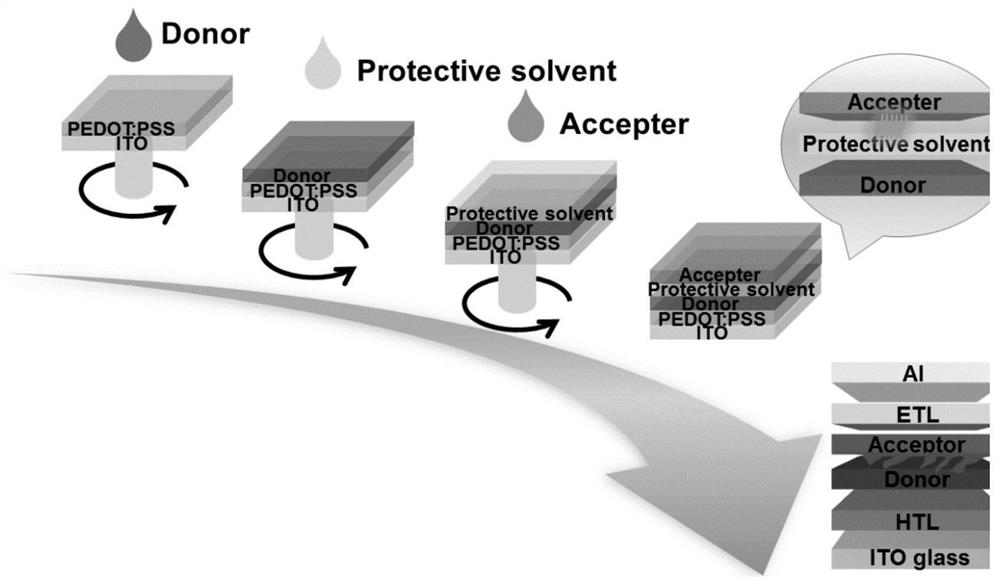
[0039] Preparation of double-layer structure organic solar cells (SD devices):

[0040] Several ITO glasses, the square resistance is about 20 ohms / square, and the size is 15 mm x 15 mm square. They were ultrasonically cleaned in detergent, deionized water, acetone, and absolute ethanol for 30 min, respectively. Before use, the ITO glass was blown dry under nitrogen, and placed under UVO ultraviolet lamp for 20 min. The hole transport layer PEDOT:PSS (Clevios P ​​VP Al 4083) was spin-coated at 3000rpm for 35s. After film formation, it was annealed at 150°C for 15 min on a heating platform, and then transferred to a glove box for later use. The donor material was dissolved in chlorobenzene solvent at a concentration of 8 mg / mL, and spin-coated on the hole transport layer at 1800 rpm. After that, set the working program of the glue homogenizer into two stages, the first stage is the spin coating of the protective solvent, and the second stage is the spin coating of the accept...

example 2

[0044] SD device performance and mechanism explanation

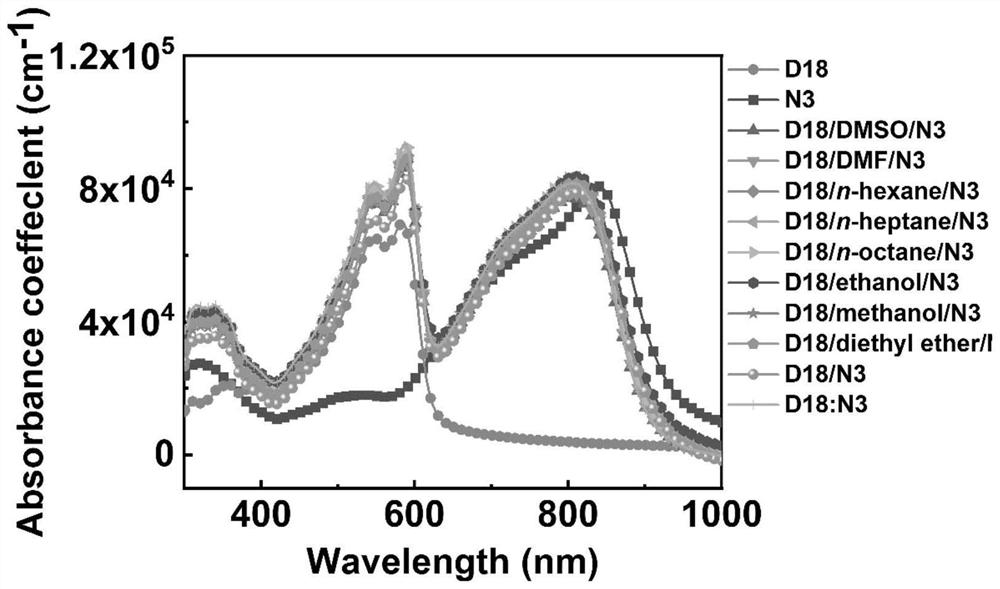
[0045] The performance parameters of SD devices based on D18 / protective solvent / N3 system are shown in Table 1. The performance of the device containing the protective solvent (D18 / protective solvent / N3) was significantly better than that of the device without the protective solvent (D18 / N3). Moreover, the performance parameters of different devices also vary due to the difference in the protective properties of the protective solvent. Among them, the device with n-octane as protective solvent has the highest energy conversion efficiency, which is 17.52%. Applying the environment-friendly solvent protection method to several other systems, the efficiency value of the system using n-octane as the protection solvent can reach more than 90% of the efficiency value of the bulk heterojunction structure (BHJ) organic solar cell, as shown in Table 2 Show.

[0046] Table 1 Device performance parameters of D8+protective solven...

the structure of the environmentally friendly knitted fabric provided by the present invention; figure 2 Flow chart of the yarn wrapping machine for environmentally friendly knitted fabrics and storage devices; image 3 Is the parameter map of the yarn covering machine
Login to View More

PUM

No PUM Login to View More

Abstract

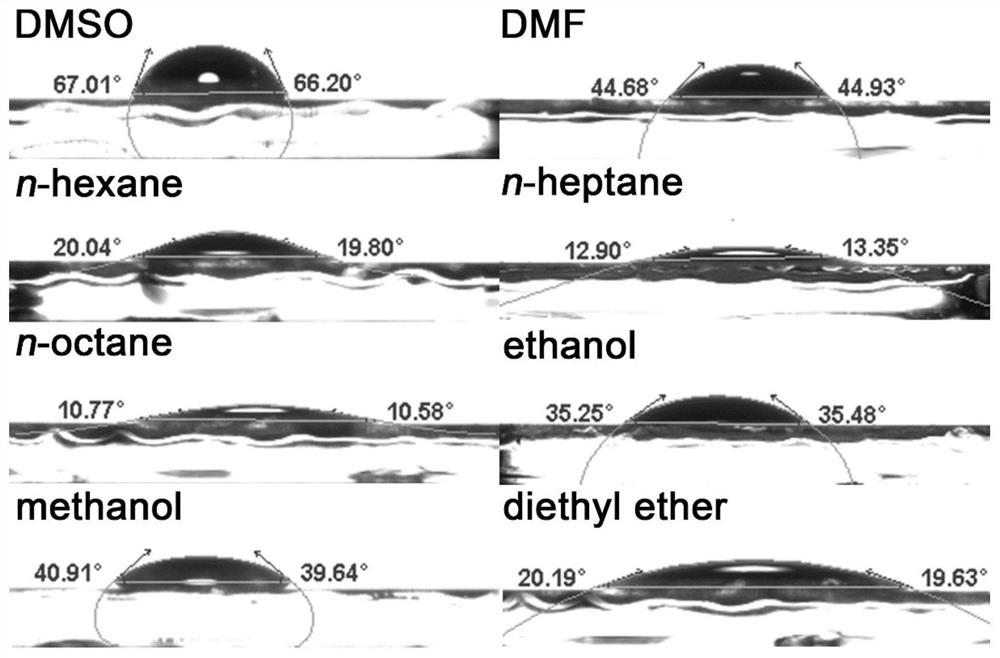
The invention relates to an environment-friendly solvent protection method, which is used for preparing an organic solar cell with a stacked structure, and breaks through the requirements on an orthogonal solvent in a sequential spin-coating process. By utilizing the characteristic that benzene-ring-free and halogen-free solvents (such as dimethyl sulfoxide (DMSO), N, N-dimethylformamide (DMF), normal hexane, normal heptane, normal octane, ethanol, methanol and diethyl ether solvents) do not have solubility or extremely weak solubility to donor and acceptor materials, the solvent is used as aprotective solvent to protect a thin film of the donor material from being damaged by subsequently spin-coated acceptor materials. The protection factor (delta) measures the protection characteristicsof different solvents on the thin film and establishes a quantitative relationship of delta-PCE, and the obtained empirical formula has prediction and guidance effects on other solvents as protectivesolvents.

Description

technical field [0001] The invention relates to the field of stacked structure (double-layer) organic solar cells, and specifically uses alcohols, alkanes, ethers and other poor solvents as protective agents. During the sequential spin-coating process, the solution spin-coated on the first layer is protected from being dissolved by the acceptor solution spin-coated later, so as to prepare an organic solar cell with a stacked structure. Background technique [0002] At present, the efficiency of single-junction organic solar cells based on bulk heterojunction (BHJ) can exceed 17%, and even reach 18%, and its efficiency has reached commercial feasibility. However, the random distribution of donors and acceptors increases the probability of carrier recombination, resulting in imbalanced charge transport, thus limiting the further improvement of efficiency. Also, during the spin-coating process, the components with lower surface energy in the mixed solution tend to gather towar...

Claims

the structure of the environmentally friendly knitted fabric provided by the present invention; figure 2 Flow chart of the yarn wrapping machine for environmentally friendly knitted fabrics and storage devices; image 3 Is the parameter map of the yarn covering machine
Login to View More

Application Information

Patent Timeline
no application Login to View More
Patent Type & Authority Applications(China)
IPC IPC(8): H01L51/42H01L51/48
CPCH10K71/12H10K71/40H10K30/00H10K30/20Y02E10/549
Inventor 黄辉魏亚男
Owner UNIVERSITY OF CHINESE ACADEMY OF SCIENCES
Features
  • R&D
  • Intellectual Property
  • Life Sciences
  • Materials
  • Tech Scout
Why Patsnap Eureka
  • Unparalleled Data Quality
  • Higher Quality Content
  • 60% Fewer Hallucinations
Social media
Patsnap Eureka Blog
Learn More