Method and kit for constructing next-generation sequencing library
A technology for a second-generation sequencing library and a construction method, which is applied in the field of second-generation sequencing library construction methods and kits, can solve the problems of unfavorable low-frequency gene mutation detection, difficulty in ensuring detection accuracy, and large loss of template DNA, and achieves a reduction in Cost of building a library, removing false positives, and improving sensitivity
- Summary
- Abstract
- Description
- Claims
- Application Information
AI Technical Summary
Problems solved by technology
Method used
Image

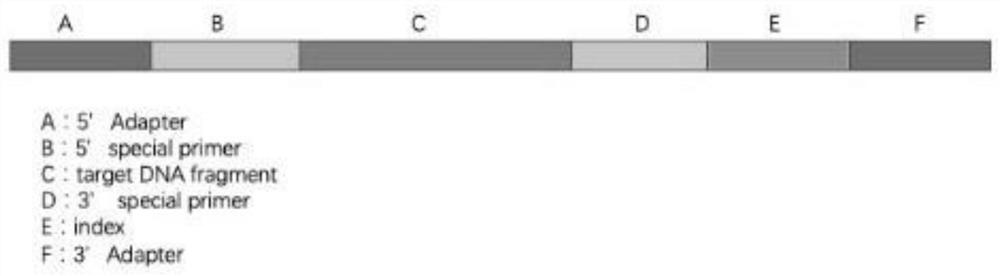


Examples
Embodiment 1
[0041] Using the library construction method of the present invention to construct a next-generation sequencing DNA library to detect AKT1, TP53 and PIK3CA gene mutations.
[0042] 1.1 Specific primer design
[0043]The following specific primers (equivalent to the single-stranded DNA shown in SEQ ID NO:3) were designed, wherein AKT1-T219P can be used to detect AKT1NM_001014431:c.A655C:p.T219P, and TP53-T245P can be used to detect TP53NM_001126115:c. A733C:p.T245P, PIK3CA-H047R can be used to detect PIK3CA NM_006218:c.A3140G:p.H1047R.
[0044] Specific primer sequences are shown in the table below
[0045]
[0046]
[0047] 1.2 DNA extraction
[0048] Select two plasma samples, use the magnetic bead method to extract free DNA samples 1 and 2 from 2mL plasma, and quantitatively take 10ng of free DNA to build a library, and use the above-mentioned specific primers to detect the target sequence. For the above two samples, use Except for different Index, other operations ...
PUM
 Login to View More
 Abstract
Description
Claims
Application Information
 Login to View More
PatSnap Eureka turns technology decisions into work you can execute. Powered by our Innovation Knowledge Graph, it runs expert workflows across engineering, life sciences, materials and intellectual property. Get your review-ready output in minutes.


