Cu-Co bimetal spinel type catalyst, preparation thereof and application of Cu-Co bimetal spinel type catalyst in methane production through dichloromethane reductive dechlorination
A spinel type, catalyst technology, used in catalyst activation/preparation, metal/metal oxide/metal hydroxide catalyst, physical/chemical process catalyst, etc., can solve the problem of reducing catalytic activity and stability, catalyst overheating, Catalyst sintering and other problems, to achieve the effect of accelerating electron transfer rate, excellent performance and mild conditions
- Summary
- Abstract
- Description
- Claims
- Application Information
AI Technical Summary
Problems solved by technology
Method used
Image

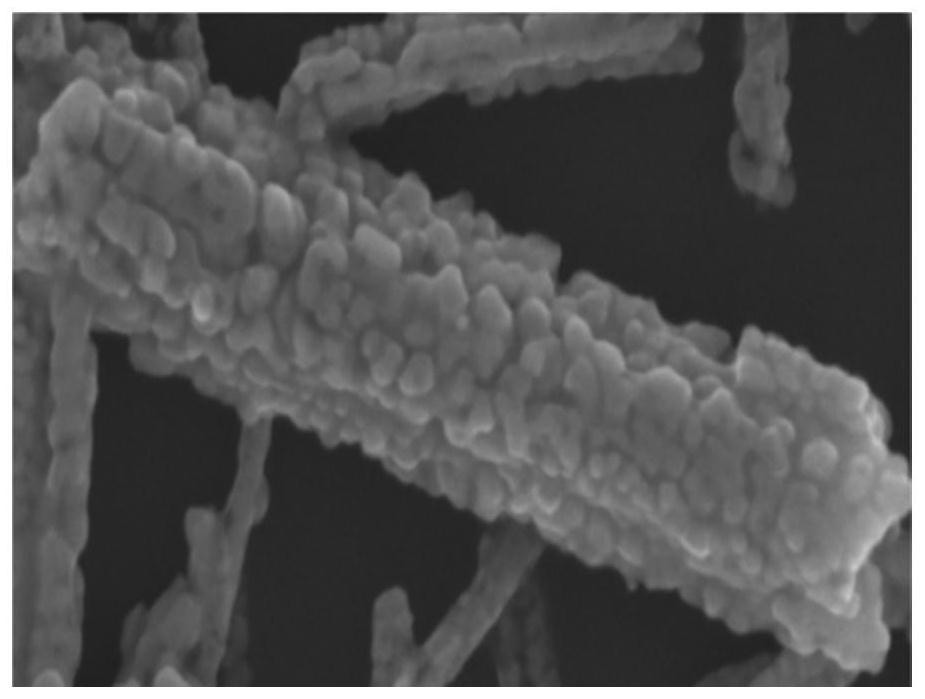


Examples
Embodiment 1
[0034] Preparation of bimetallic spinel catalysts:
[0035] (1) 0.145g Cu(NO 3 ) 2 ·3H 2 O, 0.349g Co(NO 3 ) 2 ·6H 2 O, 0.360g of urea and 0.1333g of NH 4 F was dissolved in 72 mL of deionized water, and solution A was obtained after complete dissolution.
[0036] (2) Place solution A on a magnetic stirrer and stir for 30 minutes, transfer it to a 100mL high-temperature reaction kettle, and tighten it;
[0037] (3) Place the tightened high-temperature reactor in an oven, and conduct a hydrothermal reaction at 150°C for 6 hours to obtain a solution B after the reaction;
[0038] (4) Solution B was washed 6 times alternately with deionized water and ethanol, and the centrifugation speed was 8000r / min, and the centrifugation time was 5min to obtain solid I;
[0039] (5) Dry the solid I in an oven at 70° C. for 24 h, and transfer the dried solid I to a crucible.
[0040] (6) Place the crucible in a muffle furnace and calcinate at 350°C for 3 hours, with a heating rate of ...
Embodiment 2
[0046] The difference from Example 1 is that the temperature of the hydrothermal reaction in step (3) is 140° C., and the obtained material is named catalyst 2, and the reaction results are listed in Table 1.
Embodiment 3
[0048] The difference from Example 1 is that the temperature of the hydrothermal reaction in step (3) is 170° C., and the obtained material is named catalyst 3, and the reaction results are listed in Table 1.
PUM
 Login to View More
 Abstract
Description
Claims
Application Information
 Login to View More