Antimicrobial and cytotoxic compounds and methods for treating cancer, a bacterial infection, and/or a fungal infection
a technology of cytotoxic compounds and compounds, applied in the field of antimicrobial and cytotoxic small molecules and methods, can solve the problems of limiting the application of chromones, reducing the activity of chromones, and exhibiting acute in vivo toxicity
- Summary
- Abstract
- Description
- Claims
- Application Information
AI Technical Summary
Benefits of technology
Problems solved by technology
Method used
Image

Examples
example 1
Materials and Methods
[0114]All melting points were measured on a Gallenkamp Electrothermal melting point apparatus and were uncorrected. The IR absorption spectra were measured on a Nicolet Magna 520 FT IR Spectrophotometer. 1H and 13C NMR spectra were recorded in deuterated dimethylsulfoxide (DMSO-d6) at 400 MHz on a Bruker DPX MHz spectrometer using tetramethylsilane (TMS) as an internal reference. Chemical shift was expressed as 6 values. Mass spectra were obtained from on a Shimadzu GCMS-QP 1000 Ex mass spectrometer at 70 eV. Elemental analyses were carried out at the Microanalytical Center at Cairo University.
example 2
Synthesis of Antimicrobial and Cytotoxic Small Molecules
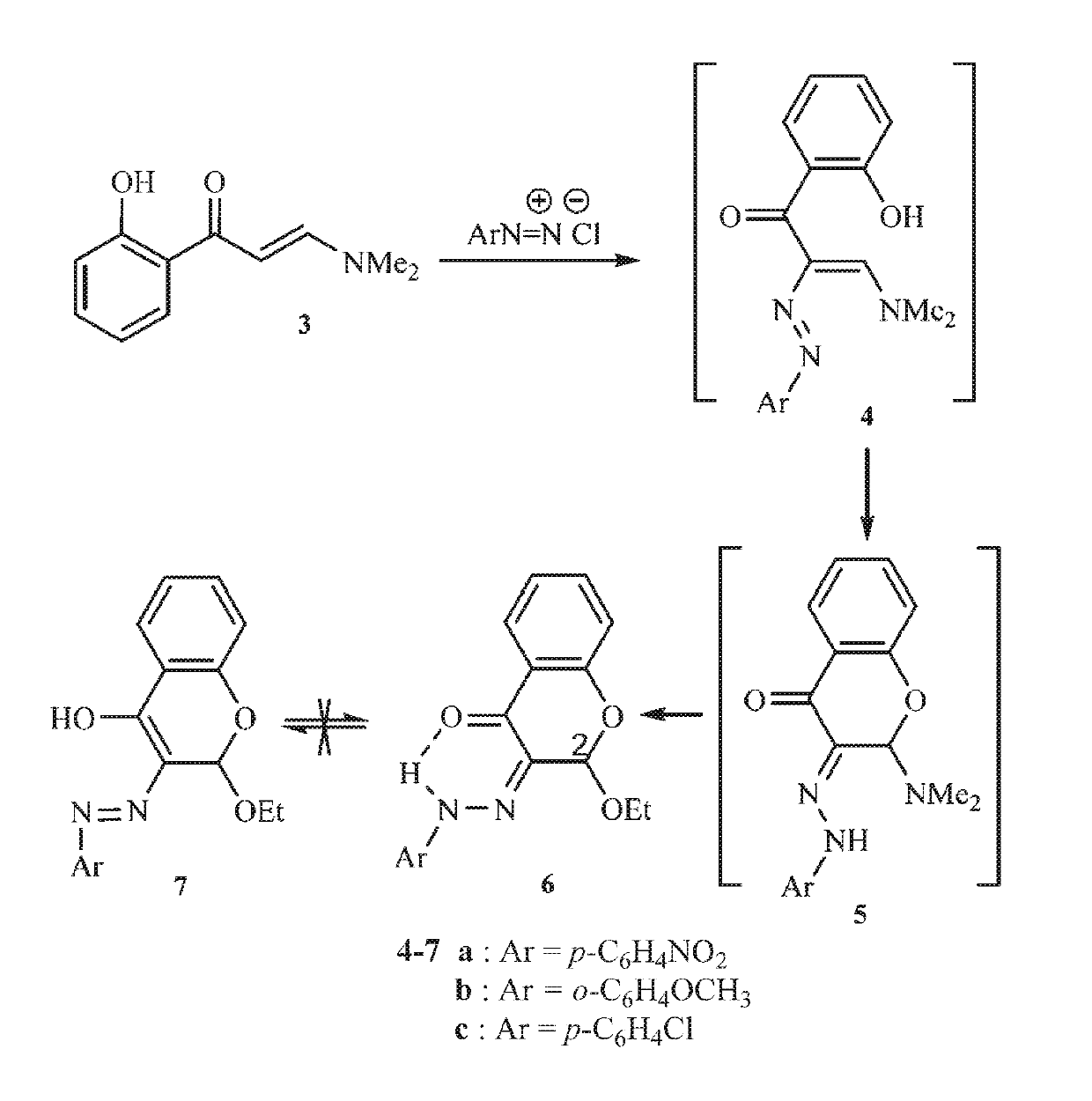
[0115]The synthesis of the chromenone derivatives was reported in Alzaydi et al. (K. M. Alzaydi, R. M. Borik, M. H. Elnagdi, J. Heterocyclic Chemistry, 44, 1187 (2007), incorporated herein by reference in its entirety). In the article, the coupling reaction of compound 3 with aromatic diazonium salts with the aim of obtaining compound 4 was studied (FIG. 1). Interestingly, the target molecule was not obtained, and cyclic N,O-acetal 6 was formed in good yields. The formed enazo compound 4 may have initially cyclized into compound 5 that reacted with ethanol to yield the final isolable compound 6.
[0116]13C and 1H NMR spectra of the products fitted the proposed structures completely. The 13C NMR spectrum revealed two carbon signals at δ=15.4 and 64.4 ppm for the ether moiety. The sp3 carbon-2 appeared at δ=98.2 ppm. The 1H NMR spectrum showed the ether triplet and quartet at δ=1.0 and 3.8 ppm and a singlet at δ=5.9 ppm for 2-H in ...
example 3
Experimental Procedure and Data for Cytotoxicity Studies in Human Cancer Cell Lines
[0122]Reagents: Fetal bovine serum (FBS) and L-glutamine were purchased from Gibco Invitrogen Co. (Scotland, UK). RPMI-1640 medium was from Cambrex (New Jersey, USA). Dimethyl sulfoxide (DMSO), doxorubicin, penicillin, streptomycin and sulforhodamine B (SRB) were from Sigma Chemical Co. (Saint Louis, USA).
[0123]Cell cultures: Three human tumor cell lines, HCT116 (colon cell line), HePG 2 (human hepatocellular carcinoma cell line), and MCF7 (human Caucasian breast adenocarcinoma) were used. In vitro bioassay on human tumor cell lines were conducted and determined by the Bioassay-Cell Culture Laboratory, National Research Centre, El-Tahrir St., Dokki, Cairo 12622, Egypt. They grew as a monolayer and are routinely maintained in RPMI-1640 medium supplemented with 5% heat-inactivated FBS, 2 mM glutamine and antibiotics (penicillin 100 U / mL, streptomycin 100 μg / mL), at 37° C. in a humidified atmosphere cont...
PUM
| Property | Measurement | Unit |
|---|---|---|
| concentration | aaaaa | aaaaa |
| concentration | aaaaa | aaaaa |
| concentration | aaaaa | aaaaa |
Abstract
Description
Claims
Application Information
 Login to View More
 - R&D
- Intellectual Property
- Life Sciences
- Materials
- Tech Scout
- Unparalleled Data Quality
- Higher Quality Content
- 60% Fewer Hallucinations
Browse by: Latest US Patents, China's latest patents, Technical Efficacy Thesaurus, Application Domain, Technology Topic, Popular Technical Reports.
© 2025 PatSnap. All rights reserved.Legal|Privacy policy|Modern Slavery Act Transparency Statement|Sitemap|About US| Contact US: help@patsnap.com