Unlock instant, AI-driven research and patent intelligence for your innovation.

One-time programmable bitcell with native anti-fuse

a bitcell and anti-fuse technology, applied in the field of one-time programmable bitcells, can solve the problems of increasing the cost of producing bitcells, changing the performance or characteristics of produced devices, and a significant portion of the total manufacturing cost of testing time, so as to achieve the effect of increasing the breakdown voltag

Active Publication Date: 2019-08-27
SYNOPSYS INC
View PDF27 Cites 1 Cited by
  • Summary
  • Abstract
  • Description
  • Claims
  • Application Information

AI Technical Summary

Benefits of technology

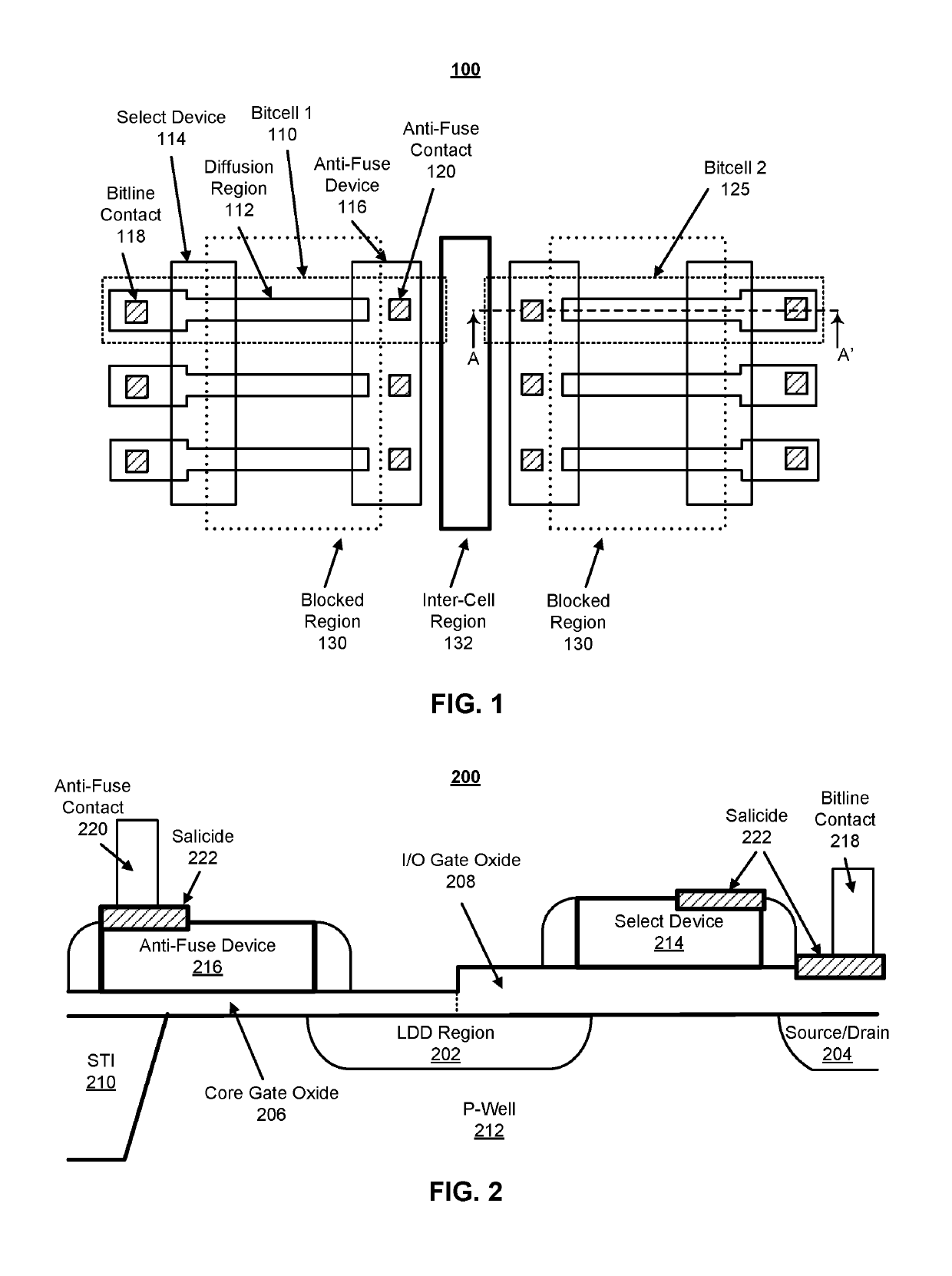
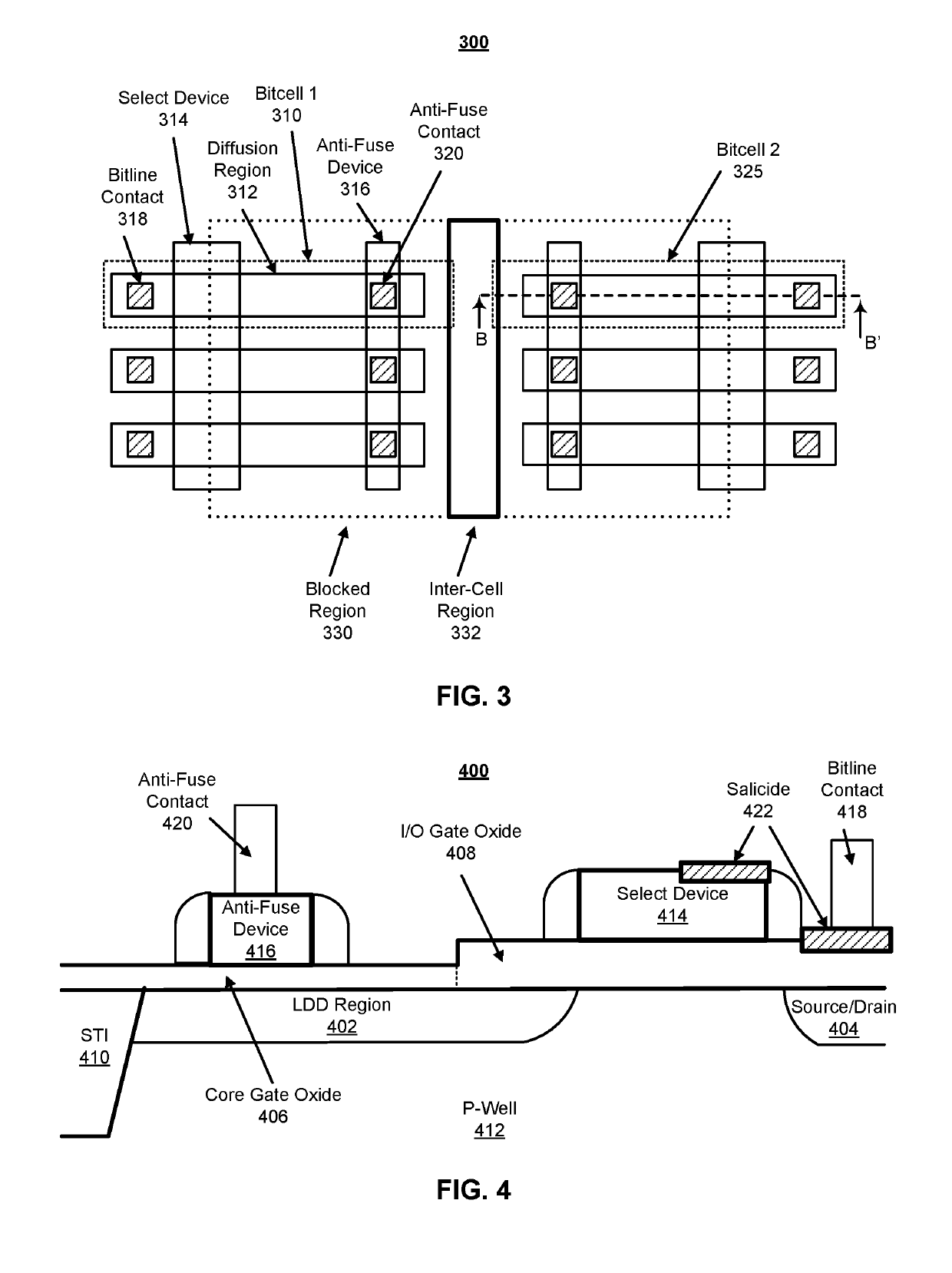
The patent describes a type of memory device that can be programmed to store information. The device has a structure called an anti-fuse, which is made up of a layer of material that is positioned over a specific region of the device. This structure helps to increase the breakdown voltage of the device, which improves its reliability. The device also includes a salicide layer that is formed over a portion of the device, but is blocked in the anti-fuse region. This helps to further improve the device's performance. Overall, the patent describes a technical solution for improving the programming and reliability of a one-time programmable memory device.

Problems solved by technology

Currently available memory devices include EEPROM and eFLASH, both of which have disadvantages. eFLASH has a very small bitcell, but it requires steps in addition to the standard CMOS process, which increases the cost of producing the bitcell and may change the performance or characteristics of the produced devices.
EEPROM is compatible with standard CMOS processes, but has a relatively large bitcell size, and thus is only suitable for low bit count memories.
Many applications program the OTP memory at test, and testing time is a significant portion of the total manufacturing cost of a chip.
However, higher voltages place higher stress on the other devices in the memory, including the select device in the bitcell.
As anti-fuses are blown during programming, a common leakage path between bitcells is created.
The combined leakage of many previously-programmed bitcells makes it difficult to blow the anti-fuses in later-programmed bitcells.

Method used

the structure of the environmentally friendly knitted fabric provided by the present invention; figure 2 Flow chart of the yarn wrapping machine for environmentally friendly knitted fabrics and storage devices; image 3 Is the parameter map of the yarn covering machine
View more

Image

Smart Image Click on the blue labels to locate them in the text.
Viewing Examples
Smart Image
  • One-time programmable bitcell with native anti-fuse
  • One-time programmable bitcell with native anti-fuse
  • One-time programmable bitcell with native anti-fuse

Examples

Experimental program
Comparison scheme
Effect test

example table

of Operations

[0052]FIG. 8 is a table of operation voltages of an OTP memory device according to one embodiment. The table of operation provides the voltage levels at different points in a memory device (given along the top of the table) and for different operations (given along the left side of the table). Vrupt is the high voltage used to rupture the gate oxide when a bitcell is being programmed. VDD refers to the power supply voltage for the core logic device, such as 1.8V in a 1.8V / 5V process. VDD_IO refers to the power supply voltage for the 10 logic device, such as 5V in a 1.8V / 5V process.

Overview of Electronic Design Automation Design Flow

[0053]FIG. 9 is a flowchart 900 illustrating the various operations in the design and fabrication of an integrated circuit. This process starts with the generation of a product idea 910, which is realized during a design process that uses electronic design automation (EDA) software 912. When the design is finalized, it can be taped-out 934. A...

the structure of the environmentally friendly knitted fabric provided by the present invention; figure 2 Flow chart of the yarn wrapping machine for environmentally friendly knitted fabrics and storage devices; image 3 Is the parameter map of the yarn covering machine
Login to View More

PUM

No PUM Login to View More

Abstract

A one-time programmable memory device includes a well of a first polarity in a semiconductor substrate. A lightly-doped drain (LDD) region is above one portion of the well. The LDD region has a first doping concentration and a second polarity that is opposite the first polarity. A source region or a drain region of the second polarity is above another portion of the well. The source region or the drain region has a second doping concentration that is higher than the first doping concentration. A first breakdown voltage between the LDD region and the well region is higher than a second breakdown voltage between the source region or the drain region and the well region. A select device is positioned at least partially above a portion of the source region or the drain region. The select device is configured to form a channel between the source region or the drain region and the LDD region. An anti-fuse device is positioned at least partially above a portion of the LDD region.

Description

CROSS REFERENCE TO RELATED APPLICATION[0001]This application claims the benefit of U.S. Provisional Application No. 62 / 411,450, entitled “ONE TIME PROGRAMMABLE (OTP) BITCELL WITH SOURCE / DRAIN IMPLANT BLOCKED OVER FUSE,” filed Oct. 21, 2016, which is incorporated by reference herein in its entirety.BACKGROUND[0002]This disclosure relates to one-time programmable bitcell, and more specifically to a one-time programmable bitcell with reduced leakage at its anti-fuse device.[0003]As the semiconductor industry continues to integrate more and more devices onto a single chip, the need for OTP memory on BCD (Bipolar CMOS DMOS) processes is increasing. High voltage devices (DMOS) are being added to standard logic (CMOS) processes. For example, LCD screens used on many smart phones and other screens use thin film transistors that operate at 32V. Accelerometers used to sense orientation in smart phones, acceleration in anti-lock brakes, and other MEMS devices usually operate between 40V and 60...

Claims

the structure of the environmentally friendly knitted fabric provided by the present invention; figure 2 Flow chart of the yarn wrapping machine for environmentally friendly knitted fabrics and storage devices; image 3 Is the parameter map of the yarn covering machine
Login to View More

Application Information

Patent Timeline
no application Login to View More
Patent Type & Authority Patents(United States)
IPC IPC(8): G11C17/16G11C17/18H01L23/525H01L27/112H01L29/78
CPCG11C17/16G11C17/18H01L29/665H01L29/78H01L23/5252H10B20/25G11C17/165H01L29/7833
Inventor HORCH, ANDREW E.NISET, MARTIN LUC CECIL ARTHURHU, TING-JIA
Owner SYNOPSYS INC
Features
  • R&D
  • Intellectual Property
  • Life Sciences
  • Materials
  • Tech Scout
Why Patsnap Eureka
  • Unparalleled Data Quality
  • Higher Quality Content
  • 60% Fewer Hallucinations
Social media
Patsnap Eureka Blog
Learn More