However, the use of commercially available components places certain constraints on the physical arrangement of the servers and server cluster.
There are significant facility costs associated with maintaining large server clusters.
Large server clusters according to the prior art typically require a relatively large amount of space in dedicated server farms, which in turn can lead to substantial costs.
Furthermore, as a server cluster grows by the addition of new servers, it can become too large for its original facility, necessitating further costs of facility expansion,
relocation, or cluster densification.
In addition, facility expansion is often not feasible and can be very expensive, and
relocation efforts can create a serious risk of prolonged server failure or
downtime.
At the same time, a server cluster failure can be very expensive in terms of lost network traffic, inconvenience, and lost opportunity, especially when the traffic from millions of individual users is passing through the cluster.
Cluster densification would avoid these facility costs and risk of
downtime, but densification is limited by technological factors, and in particular, by the need to prevent overheating of server components.
However, the
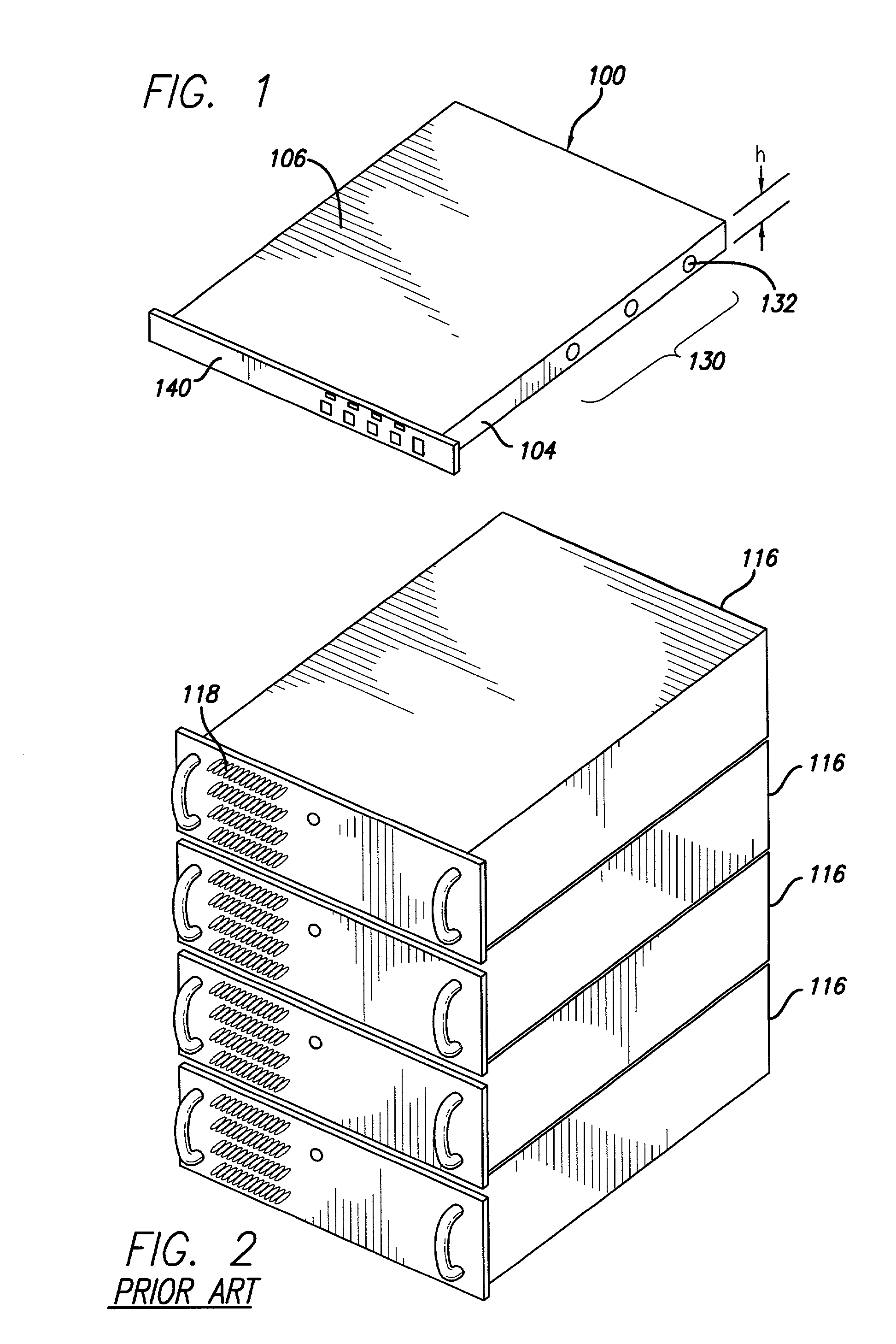
cooling capacity of electronic enclosures in prior art rack systems has limited the density of commercially available network server clusters to 41 servers per
industry standard 19"41U rack, which is much less than the theoretical density achievable using commercially available, compact computer components.
At substantially higher cluster densities, the limitations of prior art cooling systems and methods lead to increased operating temperatures, which can in turn severely impair the reliability and service life of the cluster.
Other trends, including trends towards increasing CPU frequency, installed RAM memory capacity, and hard drive capacity or
spinning speed, also create additional
heat load and place increasing demands on
computer cooling systems.
At the same time, as the density of the cluster increases, the space available for cooling systems decreases, thereby increasing the difficulty of providing adequate cooling without resorting to more expensive and relatively complex systems, such as liquid
refrigeration systems.
Prior art cooling systems and methods for rack-mounted electronic enclosures that rely on
air exchange with the ambient, "room-temperature" environment have failed to satisfactorily address this conundrum.
However, steel is a relatively poor heat conductor, and is relatively heavy.
Furthermore, rapid movement of air inside the enclosure tends to prevent particulate matter from
settling out, so that any particles that pass through the intake filters are exhausted instead of attaching to interior components.


 Login to View More
  Login to View More